
Five Bear Druid Gear Crafts, Preserved for PoE 2 Version 0.4
This is a historical guide to crafting a Talisman, body armour, helmet, boots and gloves under Path of Exile 2's 0.4 rules. The original five-slot demonstration is ronarray's video published December 20, 2025. The cover is that creator's bear-and-equipment collage, not a screenshot of an in-game crafting bench.
Do not follow the old multi-Essence sequences as a current recipe. The official 0.5 changes limit an item to one crafted modifier, with a separate limit of one Desecrated modifier. Lolcohol's separate written Talisman guide explicitly warns that its older multi-Essence method no longer functions after 0.5.
The useful lesson is how each craft manages rarity, prefix and suffix space, replacement risk and the point at which further spending stops being worthwhile. The workflows below retain those decisions and identify their historical conditions. They are not a promise of current results, current prices or profitable resale.
Read the Item Before Choosing the Currency
A normal item, a Magic item and a Rare item do not accept the same actions. Magic equipment normally has room for one prefix and one suffix; Rare equipment can have three of each. Removing a modifier from a Rare item does not turn it back into Magic equipment.
Use advanced item descriptions to identify the actual affixes and their tiers. Life, local armour and boot movement speed compete for prefix space in these examples. Elemental resistances and the desired glove attack-speed modifier occupy suffix space. “Good defensive stat” does not mean “prefix.”
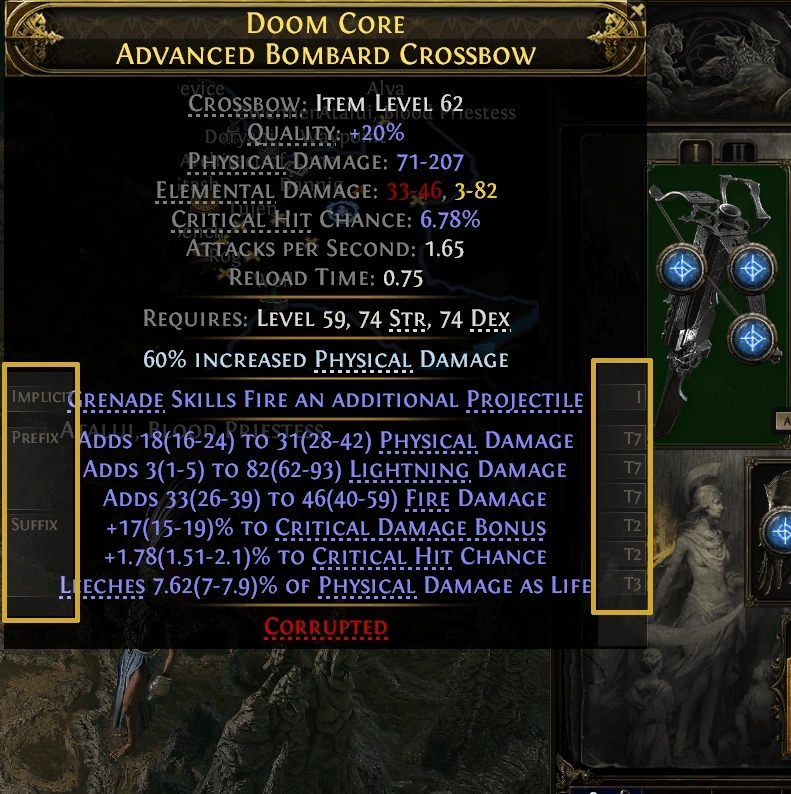
View the full-size annotated tooltip to inspect the prefix, suffix and tier labels.
An item's level enables particular modifier tiers; it does not guarantee the best roll. The original video's item-level 80 weapon and item-level 81–82 armour filters were targets for those crafts, not universal minimums for every Druid item. Similarly, the displayed armour on one pair of boots is not a guarantee of the character's eventual armour total.
Before committing valuable currency, identify the modifier you want to keep, which affix side can still accept another modifier, and which existing modifiers the next action can remove. Re-read that state after every promotion, fracture, Essence replacement or reveal. A fixed sequence is only valid while its assumed item state remains true.
Currency and Omens: What the Historical Steps Actually Do
The official 0.3 Essence rework established the distinction between promoting a Magic item and replacing a modifier on a Rare item. Those rules explain the 0.4 recipes; the later 0.5 restrictions still need to be applied when evaluating another version.
| Action | Item state and effect | Mistake to avoid |
|---|---|---|
| Transmutation, then Augmentation | Transmutation makes a normal item Magic. Augmentation adds a modifier to eligible Magic equipment. | Once the item is Rare, Augmentation is not a finishing tool. Repeated Transmutations do not reroll an already-Magic base. |
| Lesser, normal or Greater Essence | Promotes Magic equipment to Rare with the specified guaranteed modifier. | Read the Essence's item-type result. A guarantee of one modifier is not a guarantee of a finished six-mod item. |
| Perfect or Corrupted Essence | On a Rare item, removes a random eligible modifier and adds the specified guaranteed modifier. | It does not reroll the whole item. The removed modifier may be one you wanted. |
| Dextral or Sinistral Crystallisation | While active in inventory, modifies the next Perfect or Corrupted Essence: Dextral restricts removal to suffixes; Sinistral to prefixes. | The Omen does not copy a prefix into a suffix, add a stat by itself or permanently lock an affix group. |
| Exalted Orb with Greater Exaltation | An Exalted Orb adds a random modifier to Rare equipment. The active Omen of Greater Exaltation makes the next Exalted Orb add two random modifiers. | Confirm room for the intended additions. The Omen does not select resistances or guarantee their tiers. |
| Orb of Annulment | Removes a random eligible modifier. A directional Annulment Omen narrows the side, not the exact stat. | “Remove the bad roll” is not a deterministic instruction. Good life, damage or resistance can be lost. |
Omens must be present and activated in inventory; the associated currency performs the actual craft. Lolcohol's Omen reference separates these triggers. Greater Exaltation is also different from a Greater Exalted Orb: modifier-level floors belong to the currency, not the Omen, and those values changed between versions.
Desecration is another operation. The historical recipes use Preserved Jawbones for weapons and Preserved Ribs for armour, with directional Necromancy Omens where the intended affix side matters. Do not substitute a Crystallisation Omen for Necromancy simply because both names contain “Dextral.”
Talisman: Build Physical Prefixes Before Considering Utility Suffixes
The weapon chapter starts from a Magic Talisman with increased physical damage. Its example searches for roughly 155% or more at item level 80 and values a Maji Talisman's Rage implicit. Those are historical example filters; a different build or currency budget can justify another base.
Do not confuse the starting percentage-physical prefix with flat physical damage. The old process uses the two together, then adds another damage modifier before working on utility.
- Inspect the Magic base. The useful percentage-physical prefix must actually be present. Before the planned suffix-removal step, confirm there is an eligible suffix to remove; an implicit Rage value is not a suffix. Augmentation can add the second Magic modifier before promotion where needed.
- Promote with Greater Essence of Abrasion. In this historical route it supplies flat physical damage. Inspect the resulting Rare item before proceeding; Augmentation is no longer applicable.
- Use the intended replacement operation. Activate Dextral Crystallisation before the video's Perfect Essence of Abrasion step. Removing a suffix preserves the important physical prefixes while the historical Perfect Abrasion result adds damage as extra physical damage. This is controlled removal and addition, not prefix copying.
- Evaluate suffix space. The demonstration uses Greater Exaltation with a Greater Exalted Orb to fill two suffixes, and an optional Liege/Jawbone Desecration route for another modifier. Filling space does not make those random suffixes automatically valuable.
- Recognize the historical multi-Essence risk. Perfect Essence of Haste provides the relevant Onslaught-on-kill opportunity, while the old Perfect Essence of Battle supplied attack-skill levels. In the 0.4 demonstration, adding one can remove the other or remove the Desecrated modifier. Repeating the process spends more currency without guaranteeing the desired combination. If re-Desecrating an item whose affixes are full, the old suffix-preserving plan also needs the appropriate Dextral Necromancy control; blindly adding another Jawbone can endanger the physical prefixes.
Inspect the Exalted suffixes before the Battle step. An existing modifier granting levels to all Melee Skills can prevent using Perfect Essence of Battle. If that happens, reassess the item and the cost of another risky replacement instead of continuing as if the Essence were always applicable.
Onslaught tied to a killing hit is not guaranteed permanent uptime against an isolated boss. The old Battle result and Rage values also should not be copied into a current shopping filter: 0.5 changes the two-handed Battle result from +5 to +3 attack-skill levels and the Maji-family Rage implicit from 8–12 to 7–10.
Once a desirable weapon exists, judge it against the next upgrade instead of continually replacing good suffixes. The old multi-Essence loop is precisely the part invalidated by the later one-crafted-modifier limit. Lolcohol's written alternative is useful corroboration of the historical affix logic, not permission to bypass that limit.
Body Armour: Choose the Essence from the Mods Already Rolled
The body-armour chapter begins with normal armour bases and uses Perfect Transmutation and Augmentation to inspect initial Magic results. It demonstrates multiple bases, including failures; it does not repeatedly Transmute the same Magic item into a new result.
The priority is a useful combination of life, local armour and suffixes that help the character's resistances. A prefix already providing life changes what is sensible to add next.
- Start from a suitable normal armour base. Use its level and defence type as deliberate choices. The example's level 81–82 filter is not proof that every highest-tier modifier is unlocked on every item at that level.
- Inspect the Magic pair. Life with a useful suffix is a different starting point from armour with a useful suffix. A poor pair can be a reason to stop that base before expensive materials are committed.
- Add what is missing. The video uses Greater Essence of the Body for flat life on an armour/resistance start, or Greater Essence of Enhancement for defence when life is already present. A resistance Essence is another branch when the starting modifiers justify it.
- Choose a Desecration or Exalt finishing plan. The historical prefix-Desecration branch uses Sinistral Necromancy with a Preserved Rib. Other examples take random Greater Exalted additions before revealing. The result depends on open slots and which affix side is being targeted.
- Inspect the finished item as a whole. Keep a result that solves the character's needs; a random poor suffix is not automatically worth risking every good modifier to remove.
Perfect Essence of the Body is not a guarantee of the highest-tier flat-life roll. Its percentage-life result must not be confused with the flat-life modifier used in this example. Nor are completed prefixes permanently “locked” simply because the next planned additions are suffixes.
The creator shows both useful and failed outcomes. No fixed life, armour or resistance package is promised by this sequence, and a high local armour value does not establish a universal 21,000 character-armour target.
Helmet: Keep Affix Space for the Defence You Actually Need
The helmet example applies the same rarity discipline to a different base. It compares socketed starting options, then changes Essence and Desecration choices according to the initial life, armour and resistance rolls. The historical prices and socket comparison are not a current universal best-buy rule or maximum-socket claim.
- Inspect the starting base and first Magic modifiers. Keep useful life, local armour or needed resistances in context. An attribute roll is not universally worthless if the character actually needs that attribute.
- Promote with the missing stat in mind. Greater Body is a flat-life route; Enhancement is a defence route. Do not add a duplicate role mechanically when the item needs a different requirement.
- Target the appropriate Desecration side. Use a Preserved Rib with the relevant Necromancy plan if that risk is justified. Directional control affects the side; the revealed modifier and its roll still determine whether the item is useful.
- Assess additions and reveal before investing further. Greater Exalted Orbs add random modifiers. A useful reveal can be worth keeping even when a more ambitious reroll might be possible.
The modifier allowing a percentage of armour to apply to elemental damage is a suffix, as specified in the official 0.3 notes. It competes with other suffix choices; it is not an automatic extra life-and-armour prefix. The demonstration itself includes a reveal gamble that turns out worse.
Choose sockets and socketed bonuses around the result worth using. Do not treat “life, armour and one resistance” as a universal instruction to spend more on every helmet regardless of the character's other equipment.
Boots: The Fracture Result Changes the Movement-Speed Step
The boots chapter is not a generic “add movement speed, then fill resistances” recipe. Its historical method tries to protect life before using an Essence that removes a modifier.
The starting point is Magic boots with a life prefix and an elemental-resistance suffix. The video's 256/270 armour filters are examples for choosing bases; higher local armour does not itself cap the character's resistances.
In the 0.4 sequence, a suitable Essence adds another desired resistance or an Opulence modifier while promoting the boots to Rare. Dextral Necromancy with a Preserved Rib then creates the planned suffix-side Desecration. The item is inspected before a Fracturing Orb is used in an attempt to fracture life.
- If life is the fractured modifier
-
Life is protected by the actual fracture. With the example's suffixes filled, an Exalted Orb adds an expendable prefix. Sinistral Crystallisation with Essence of Hysteria then removes an eligible prefix while adding movement speed. The reason this branch works is the combination of a protected life prefix and another removable prefix—not a permanent lock created by an earlier Essence.
The remaining prefix can be filled and the Desecrated suffix revealed if continuing is worthwhile. Movement-speed tier, the final armour roll and the reveal still need inspection. These are historical item-state conditions, not a current permission to stack crafted modifiers.
- If the fracture hits another modifier
-
Life is not protected in the same way, so repeating the successful branch could remove it. The video's alternative uses Dextral Crystallisation with Hysteria, moving the removal risk to eligible suffixes instead.
That can cost a useful resistance or a removable Desecrated modifier. If Desecration is removed, the old example can attempt to add it again with the appropriate Rib/Necromancy setup; losing a resistance requires a different evaluation. The available candidates depend on which modifier was fractured. There is no universal success percentage for every failed-fracture layout.
Stop and re-read the item after the fracture. Do not spend another expensive material just because the previous step appears in the video. Buying movement-speed boots or keeping a usable result can be preferable to risking a good item for triple resistances.
Gloves: Reveal the Important Suffix Before Chasing Extra Prefixes
The gloves example starts with a Magic pair carrying +2 to all melee skills and one useful modifier such as life or flat attack damage. The creator uses item-level 75-plus searches, but the exact base should fit the build's requirements rather than a universal filter.
- Preserve the useful starting pair. Know which modifier is a prefix and which is a suffix before promotion.
- Use the appropriate Greater Essence. A needed resistance or an Opulence modifier is the historical choice. Rarity is optional; it is not an automatic replacement for a missing resistance or essential defence.
- Apply the armour Desecration route and inspect the reveal early. The video uses a Preserved Rib and considers Omen of Abyssal Echoes for the reveal. A desired resistance or attack-speed suffix changes whether the item is worth finishing.
- Decide whether to continue. Additional Exalted modifiers may complete useful prefixes, but they do not guarantee life and multiple strong damage rolls. Augmentation cannot finish the now-Rare gloves.
If the goal is the remaining suffix, activate Omen of Dextral Necromancy before using the Preserved Rib. Without that directional control, an item with both affix sides open can receive a Desecrated prefix instead; inspect its side before deciding how to finish.
Attack speed is a suffix here, not a prefix. It competes with other suffix goals. A poor reveal is a legitimate stopping point; an Orb of Annulment aimed at fixing it can remove one of the starting modifiers instead. Repeating attempts until a perfect result appears is not a spending plan.
Decide When the Item Is Finished
Evaluate a craft against the character's requirements before trying to make every line ideal. Life, attributes, movement speed, resistances and damage must work together across the equipment set. Three resistances on one slot are not mandatory if the other items already cover them, and losing a necessary attribute can disable an otherwise attractive replacement.
Compare a usable craft, the cost of the next risky attempt and the price of a suitable finished item. Those comparisons must use the market and rules actually available to you. Historical spoken sale values do not demonstrate today's profit, and earlier currency spent does not improve the next random roll.
The most transferable method is to record the item state before each action: rarity, valuable modifiers, available prefix/suffix space, protected modifiers, and every modifier eligible for removal. If the next step no longer matches its assumptions, choose another branch or stop. For modern crafting, revalidate the entire recipe under the relevant patch rather than adding one current currency to a 0.4 sequence.