Diablo 4 Patch 1.4 Skill Tags: PTR Archive
A verified archive of Diablo 4 Patch 1.4 PTR skill tags, with all 25 class mappings and a clear explanation of how tags affected item interactions.
By:
John Langan
The Diablo IV Patch 1.4.0 Loot Reborn update launched on May 14, 2024. Its item overhaul drew most of the attention, but the official notes also changed the labels used to classify class skills. The stated goal was to let more Aspects and other effects recognize more skills. An April PTR ledger recorded 25 additions across the five classes under Core, Chain, Mobility, Shout, and Summoning. A tag is a compatibility label. It tells the game that a skill belongs to a group named by an item, passive, or other effect. It does not quietly rewrite the skill's damage, range, target count, movement distance, or crowd control. Those behaviors still need their own tooltip or patch-note line. That distinction turns a loose list of labels into a useful historical record.
💡 Reading rule: When a patch adds a skill tag, check the trigger text on the interacting effect. The new label can make an interaction eligible, but the effect's own rules still decide what happens.
The useful question is therefore not “did this tag make the skill stronger?” It is “which effects could now see the skill, and what did those effects say they would do?”
Diablo IV effects often refer to a family rather than naming every eligible skill. If an Aspect checks for a Core Skill, a skill without the Core label does not satisfy that condition even when its resource behavior looks similar. Adding the label can place the skill inside that family. The power still comes from the Aspect or effect, and any cooldown, cost, or targeting requirement written there still applies.
This makes tags important without turning them into balance values. A Mobility label can make a movement-related effect recognize a skill that already moves the character. It does not supply another movement use. A Chain label can expose a skill to chain-specific interactions, but it does not add jumps on its own. The same logic applies to the other three groups.
| PTR tag | Classification signal | What the label did not grant by itself |
|---|---|---|
| Core | The skill could satisfy effects that explicitly ask for a Core Skill. | Extra damage, a new resource cost, or a new cast pattern. |
| Chain | The skill could satisfy effects written for the Chain family. | Another bounce, extra targets, or an automatic proc. |
| Mobility | The skill could satisfy effects that check for a Mobility Skill. | More range, faster travel, or another movement use. |
| Shout | The skill could satisfy effects that refer to Shout Skills. | A stun, an enrage, or a longer buff. |
| Summoning | The skill could satisfy effects that refer to Summoning Skills. | A new minion, extra ranks, or longer summon duration. |
The PTR data tells us which doors were opened. It does not prove that every possible item interaction was useful, intended for a particular build, or preserved in later seasons.
📌 Common mistake: Do not turn a classification change into a second, invented patch note. If no source states a damage, range, or crowd-control change, the tag alone is the complete change.
The archived ledger distributes the changes unevenly. Druid and Rogue each received six additions, Sorcerer received seven, Barbarian received four, and Necromancer received two. Counting by label gives nine Mobility entries, seven Chain entries, six Core entries, two Shout entries, and one Summoning entry. Both views total 25, which provides a simple check against a missing or duplicated row.
| Class | Added tags in the PTR ledger | Share of the 25 entries |
|---|---|---|
| Barbarian | 4 | 16% |
| Druid | 6 | 24% |
| Necromancer | 2 | 8% |
| Rogue | 6 | 24% |
| Sorcerer | 7 | 28% |
The class tables preserve that exact 2024 PTR ledger. Their direct skill pages are identity references and may display later live-game wording, so they should not be used to reconstruct the old tag column by themselves.
Barbarian, Druid, and Necromancer account for the first 12 entries. The notes beside each row describe the classification only; they do not claim an unstated mechanical bonus.
| Skill | PTR tag added | Safe historical reading |
|---|---|---|
| Charge | Mobility | Its existing movement could be recognized by Mobility checks. |
| Kick | Core | Effects asking for a Core Skill could include it when their other conditions were met. |
| Leap | Mobility | The movement skill entered the Mobility family for eligible effects. |
| Lunging Strike | Mobility | Its lunge could satisfy effects that checked the Mobility label. |
The unusual row is Kick. Core here is a classifier, not a promise that the skill inherited the tuning or cadence of every other Core option.
✏️ Archive check: If a 2024 planner claims Kick gained damage because it became Core, look for a separate numeric patch line. The tag entry alone supports eligibility, not a damage increase.
| Skill | PTR tag added | Safe historical reading |
|---|---|---|
| Blood Howl | Shout | Shout-specific checks could recognize this defensive utility skill. |
| Debilitating Roar | Shout | The roar entered the Shout family; the tag did not add a new control effect. |
| Rabies | Chain | Its spreading behavior could be classified for Chain interactions. |
| Shred | Mobility | The skill's movement component could satisfy Mobility checks. |
| Storm Strike | Chain | The skill entered the Chain family without receiving an unstated extra jump. |
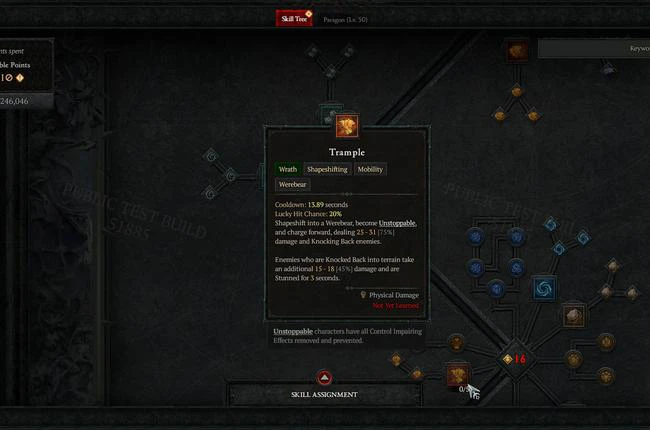
| Trample | Mobility | Its movement could be recognized by effects written for Mobility Skills. |
The two Shout rows were specifically consistent with the official high-level note that applicable Druid skills would receive that classification. The other four rows show why the full PTR ledger is needed for exact mapping work.
| Skill | PTR tag added | Safe historical reading |
|---|---|---|
| Army of the Dead | Summoning | Summoning checks could recognize the ultimate; the label did not create another summon. |
| Bone Spirit | Core | Core-specific effects could include the resource-consuming skill when their full text allowed it. |
Necromancer had the smallest class count, but its two additions reached separate effect families. That matters more for historical compatibility research than treating the number of rows as a class-power ranking.
Rogue split evenly between Chain and Mobility, with three additions in each group.
| Skill | PTR tag added | Safe historical reading |
|---|---|---|
| Barrage | Chain | Chain checks could recognize the skill; the tag did not add projectiles. |
| Caltrops | Mobility | Its displacement could satisfy Mobility checks without changing distance. |
| Dash | Mobility | The existing movement skill entered the Mobility family. |
| Heartseeker | Chain | Chain-specific effects could include it if their remaining conditions matched. |
| Puncture | Chain | The label opened Chain eligibility; it did not change target count by itself. |
| Shadow Step | Mobility | Mobility checks could recognize its repositioning behavior. |
This three-and-three split is a good reminder that tags describe different behaviors within one class. They do not form a tier list and should not be counted as direct buffs.
Sorcerer received the largest class set: four Core additions, two Chain additions, and one Mobility addition.
| Skill | PTR tag added | Safe historical reading |
|---|---|---|
| Ball Lightning | Core | Core-specific effects could recognize the skill under their written conditions. |
| Blizzard | Core | The skill entered the Core family; the label did not alter its area or duration. |
| Chain Lightning | Chain | The existing chaining skill could satisfy Chain-specific checks. |
| Firewall | Core | Core effects could include it without changing the wall's behavior by default. |
| Meteor | Core | The skill could be recognized as Core when an effect used that label. |
| Spark | Chain | The Chain label did not independently add bounces or targets. |
| Teleport | Mobility | Mobility checks could recognize the repositioning skill without extending its range. |
The four Core rows also match the publisher's broad explanation that more Core skills would include Mastery options and skills that consume resources. The archived ledger supplies the exact names.
The weakest reading of the PTR list turned each label into a new effect. That produces claims the source never made: wider spread from a Chain tag, extra movement from Mobility, a stun from Shout, or new damage from Core. None follows from classification alone.
| Unsupported shortcut | Source-safe correction |
|---|---|
| “Chain makes a skill hit more enemies.” | Chain makes the skill eligible for effects that ask for that label. Extra targets need separate effect text. |
| “Mobility adds movement or range.” | Mobility classifies a skill whose existing behavior fits the family. Range changes need their own number or tooltip line. |
| “Core is an automatic damage buff.” | Core opens eligibility for Core-specific interactions. Damage still comes from the skill or interacting effect. |
| “Shout adds crowd control.” | Shout lets Shout-specific checks recognize the skill. A stun or debuff must be stated elsewhere. |
| “Summoning creates or upgrades minions.” | Summoning is a family label. Minion count, ranks, and duration require explicit rules. |
A build could still gain power when a useful Aspect began recognizing one of these skills. The supported causal chain is tag, then eligibility, then the named effect's rules. Skipping the middle step is how an accurate data change becomes an invented mechanic.
⚠️ Historical warning: A planner that depended on Ball Lightning counting as Core or Caltrops counting as Mobility must still be checked against the exact 2024 item text. The tag confirms membership, not the rest of the interaction.
The official live record had reached Patch 3.1.3 on August 12, 2026. Multiple seasons, system revisions, item changes, and balance passes separate that build from the April 2024 PTR. Do not copy this ledger into a current build planner and assume every interaction is unchanged.
Use the list to answer historical questions: which labels were tested, how the 25 rows were distributed, and what the publisher meant by broadening effect eligibility. For a live setup, read the current skill and item text together, then Compare current Diablo 4 builds after confirming the patch shown on the build page.
Last reviewed 2026-08-21 against Patch 1.4.0 Loot Reborn — Maintained by WowCarry's Diablo 4 team.
No. The tag additions changed classification and effect eligibility. A skill could benefit if an Aspect or another rule asked for the new label and its remaining conditions were satisfied, but that benefit came from the interacting effect. A direct damage increase would need its own coefficient, percentage, or tooltip change in the patch record.
The April 2024 PTR ledger contains 25 additions. Barbarian received four, Druid six, Necromancer two, Rogue six, and Sorcerer seven. Counted by tag, the same list contains nine Mobility, seven Chain, six Core, two Shout, and one Summoning entry. Both totals reconcile to 25.
The PTR classification let effects written for Core Skills recognize those two abilities when the effects' other requirements were met. The broader official note also described adding Core to more skills, including Mastery options and resource-consuming skills. The label did not make either ability copy the cast pattern, damage, or resource rules of another Core Skill.
It placed each skill inside the Chain family for effects that checked that label. Their baseline spreading or chaining behavior already came from the skill itself. The tag entry did not state a new jump count, wider spread, extra target, or damage proc, so none of those should be inferred from the classification.
No travel-distance change is contained in the tag ledger. Mobility let compatible effects identify those skills as members of the movement family. Their displacement, range, cooldown, and charge behavior remained governed by their own tooltip and any separately documented patch changes. A current item may also define narrower conditions than the family name suggests.
This archive does not make that claim. It preserves the mappings documented during the 2024 PTR and explains their original purpose. The live game was on Patch 3.1.3 when this page was reviewed, after many balance and system updates. Check current in-game tooltips and current patch notes before relying on any tag interaction.
Start with the live skill tooltip and the complete text of the Aspect, Unique, passive, or system effect that refers to its tag. Confirm that both records match the patch your build uses. Current patch notes settle recent changes; this page is the historical source map for the Patch 1.4 PTR additions, not a substitute for live text.