Key Takeaways
- Confirm whether your static uses Toxic Friends or Kindred waymarks before the pull — the two sets differ in subtle ways that are fatal mid-fight.
- The boss's first weapon draw (axe or scythe) determines the entire Trophy Weapons sequence: the remaining two weapons follow clockwise from that starting point.
- Crown of Arcadia is a raid-wide opener — position for the weapon draw immediately after the damage resolves to avoid being caught out of position.
- Immortal Rain transforms the boss and introduces Great Wall of Fire (tank share or invuln) and Orbital Omen (sides safe while boss cleaves front and back).
- During the portal phase, the main tank takes the northern tether and the off-tank the southern — swapping roles leaves meteors untethered and wipes the raid.
- Heartbreaker at the end carries a tight DPS check with week-one gear: maximize uptime through the tower phase and use all offensive cooldowns during the final burst window.
Those six checkpoints cover the decisions that end most progression attempts. Each mechanic is detailed in the sections below.
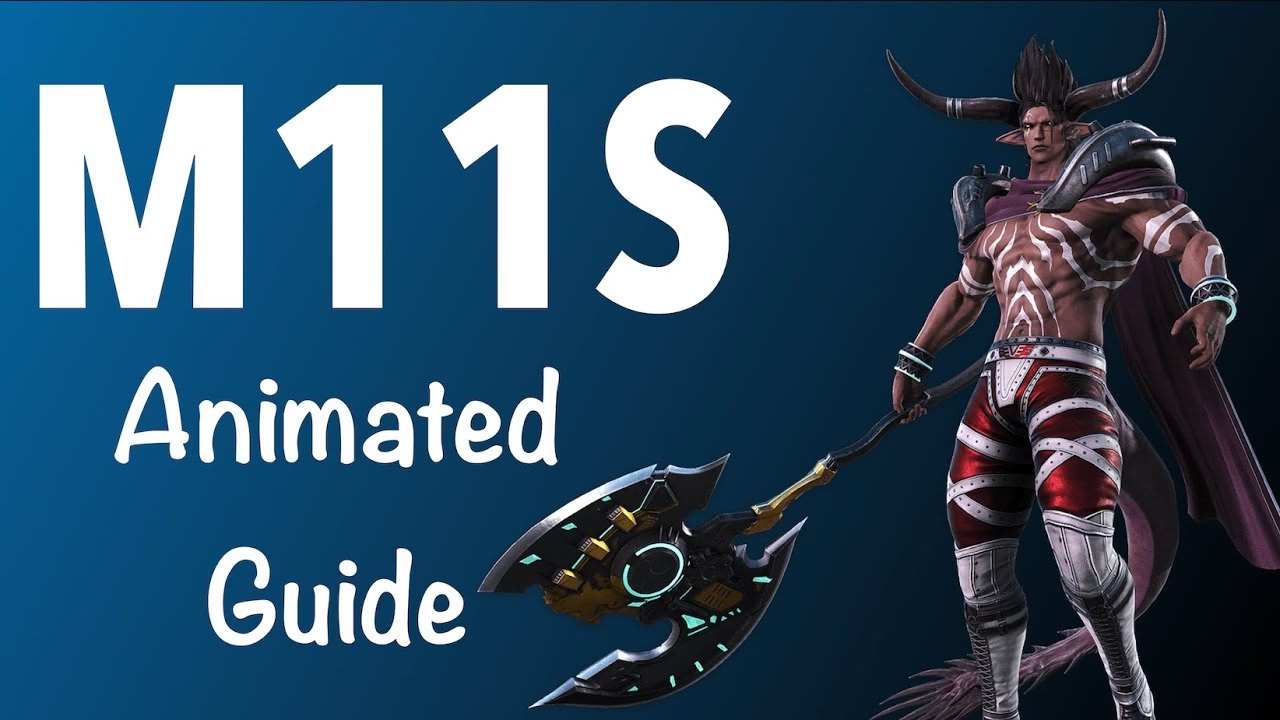
Understanding the Strategies for M11s - AAC Heavyweight M3 Savage
This guide is designed to help you navigate M11s — AAC Heavyweight M3 Savage, known as The Tyrant, from Final Fantasy XIV Dawntrail patch 7.1. While only week one strategies are featured here, improved strategies are likely to emerge, so adaptability is key to success in this challenging encounter.
Preparing for the Battle
In this fight, precision with way marks is crucial. Two sets of way marks, known as Toxic Friends and Kindred, are in use. Although they are similar, choosing the wrong one can be fatal due to minor differences. Confirm the correct way marks are assigned before the pull to avoid unnecessary risks.
To survive the encounter, you should prepare your party in the following ways:
- Light Parties: Organize into two smaller groups for certain mechanics.
- Clock Spots: These are vital for positioning, particularly using boss-relative positioning.
- Spread Positions: Required early on and helpful throughout the fight.
Those positioning tools establish the foundation for the fight's opening mechanics.
Initial Mechanics and Weapon Spawns
The battle begins with Crown of Arcadia, a raid-wide attack. Quickly afterward, the boss will draw an axe or a scythe, signaling different actions:
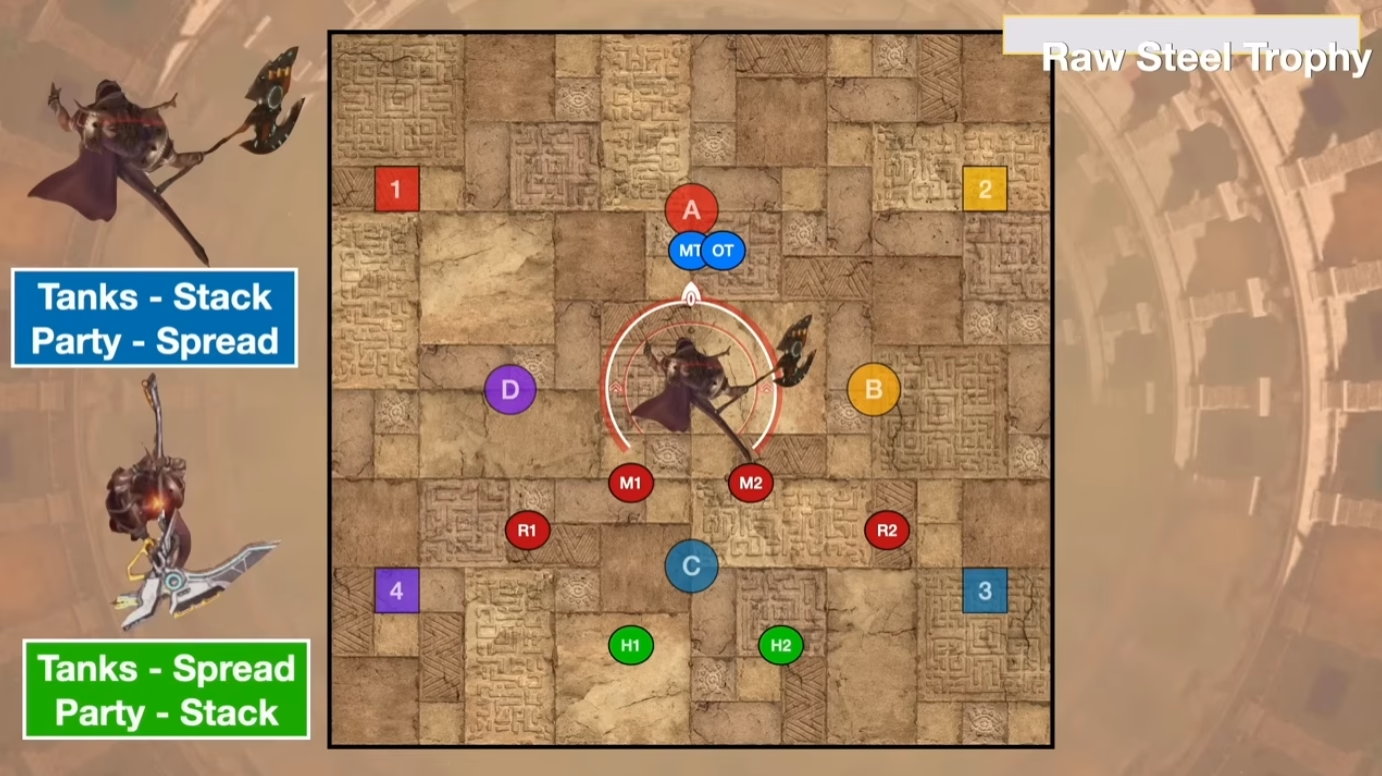
- Axe: Tanks need to stack for a shared tank buster, while the rest of the party spreads.
- Scythe: Tanks should separate, and the party groups together.
Following this, the boss will deploy Trophy Weapons, featuring three distinct weapons: scythe, axe, and sword. The sequence of activation is dictated by the initial weapon activation, proceeding in a clockwise manner thereafter.
The initial weapon draw sets up the detailed responses each weapon type requires.
Handling Each Weapon
- Sword: Dodge to the inner cardinals and split into light parties for line AoEs.
- Scythe: Arrange in clock spots while managing targeted cleaves.
- Axe: Move outward for a stack mechanic.
These mechanics mirror normal mode but with added complexity. For instance, Void Stardust involves puddles followed by stacks or spreads.
Advanced Mechanics
As the fight progresses, elements become more intricate:
- Dance of Domination Trophy: A pattern on the ground leaves four safe spots to align with.
- Ultimate Trophy Weapons: Six weapons are spawned in a random order and either rotate clockwise or counterclockwise.
The final encounter with Immortal Rain introduces four tornadoes, with teams positioned to bait cleaves effectively.
Tactical Table for Positioning
| Weapon | Light Party Action | Clock Spot Action |
|---|---|---|
| Sword | Split (Group 1 left, Group 2 right) | Not applicable |
| Scythe | Not applicable | Position for targeted cleaves |
| Axe | Stack | Move out |
✏️ Technique: Track the weapon rotation from the first two draws. If the initial draw is axe and the next clockwise weapon is scythe, the third will be sword. Pre-position before each activation rather than reading at spawn — earlier positioning reduces reaction time on the AoE.
With the weapon-sequence summary in mind, the fight shifts into a more dynamic second phase.
Transition to New Phase
Following Immortal Rain, the boss transforms. Key new mechanics include:
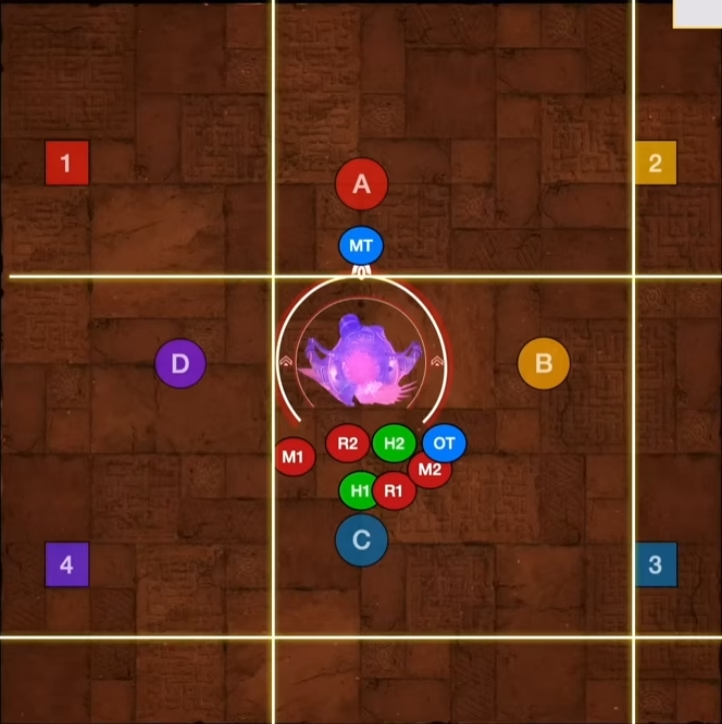
- Great Wall of Fire: A tank buster that can be shared or invulned.
- Orbital Omen: Portals appear, and the boss locks in place with cleaves front and back, leaving the sides safe.
Master these strategies to navigate this dynamic fight efficiently. Remember, as new tactics are discovered, continuous learning and adaptation will be essential to mastering M11s - AAC Heavyweight M3 Savage.
Navigating Safe Spots and Meteor Rain
Finding safety during the transition can be challenging, but with the right strategy, it becomes straightforward. As the boss positions itself north, players need to react to portal lines and the Fire and Fury effect. Here’s a simplified plan to follow:
- Start Point: Stand in the quadrant where the second portal's lines appear. This is in melee range.
- Dodge Sequence:
- Diagonally avoid the first Fire and Fury hit.
- Return to the original position for the second safe spot.
- Repeat the dodge for the third and subsequent hits.
Mastering this pattern keeps you safe during the initial phase. In preparation for Meteor Rain, the group splits responsibilities:
- Two players move under the boss to bait meteors.
- Remaining players position northwest for a line stack.
- The tanks are in front to handle the wild charge, as they can absorb the most damage.
When the meteor targets become incapacitated, quickly rotate in two more players to maintain the mechanics' continuity. Typically, healers take this role next.
With the meteor rotation handled, the portal phase introduces the next set of positional demands.
Dealing with Portals and Markers
As portals appear and tether to meteors, coordination is crucial:
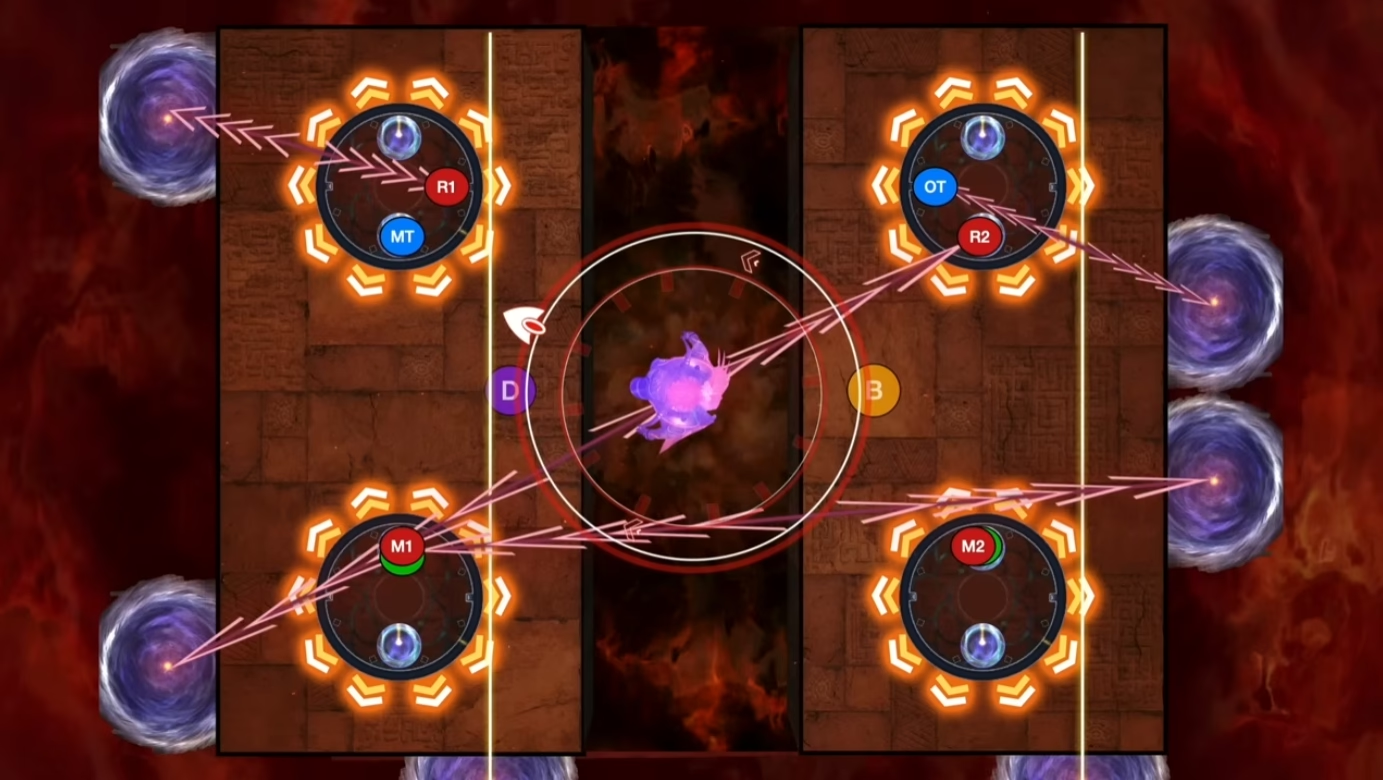
- Tanks should pick up the tethers: the main tank for the northern tether and the off-tank for the southern.
- Healers bait new meteor drops by positioning northwest and further southwest, ensuring they are not overlapping.
- The rest of the group manages a line stack behind the meteor, using it to absorb some of the incoming damage.
📌 Common mistake: The most common wipe in the portal phase is swapping tank tether assignments. Main tank takes north, off-tank takes south on every attempt. Swapping leaves one meteor moving toward the raid stack.
Positioning and Execution
A key aspect of success involves precise positioning throughout different complex mechanics. Upon completion of Fire and Fury and meteor baiting processes, players need to realign for Triple Tyrannilation:
- Stand behind three aligned meteors to survive the upcoming attacks.
- Melees stay engaged momentarily before retreating to safety.
Flatliner follows, dealing raid-wide damage and pushing players towards platforms. Prepare for Majestic Meteor, which introduces towers and additional portals:
- Tanks and ranged players handle northern towers, while melee and healers move to southern towers.
- Observe your tether status, which affects where you must position post-knockback.
- Manage tether stretching by moving to the opposite platform if needed, or remain on the same side if your tether is already sufficient.
Those tether assignments feed directly into the coordination required for the fight's final phase.
Coordination for Final Phases
The resolution of Majestic Meteor requires an organized approach:
- Post-knockback, form a 4-4 split, with tethered players managing their lines and untethered ones preparing for further AoEs.
- Tethered players should cross their tethers and remain out of the boss's hitbox, while untethered players aim to bait line AoEs without getting doubled up.
Successfully managing these phases relies on a combination of individual awareness and group coordination, ensuring that each role knows their part in these complex sequences.
Positioning and Mechanics Resolution
Achieving optimal positioning during this phase is crucial. If placed nearer to the north or south, maintain a position that allows the tethers to stretch efficiently. This precise alignment keeps the tether AoEs clear of players with markers. The space created in the outside corner is considered safe, and the line AoEs directed at the players with fire breath are similarly manageable. After executing these steps, the pattern repeats, but this time, parties are mixed up, and players must head to the tower corresponding to their resolved quadrants.
Alternate Strategy: Conga Line Method
Some groups use a method called the conga line. Here’s how it works:
- Line up in a conga line from north to south. At the appearance of tethers, distribute one tethered and one non-tethered player to each tower.
- This method simplifies determining the direction for non-tethered players post-knockback, facilitating a clearer division between north and south.
Many groups find rigid tower assignments more straightforward, but the choice depends on what your group finds effective.
With the portal phase resolved, the encounter shifts into its most demanding platform sequence.
Transition to Massive Meteor and Platform Management
As the Massive Meteor sequence begins:
- Stay close to the center due to potential healer placement on the same platform.
- Post-Meteor, move to the corresponding tower in your last quadrant.
When Arcadian Avalanche occurs, observe the boss's orientation. The platform the boss is facing will be destroyed, requiring a quick repositioning to avoid the falling platform. As soon as the platform dips, dodge toward safety. Awareness of these cues is pivotal.
Raidwide and Final Mechanics
After navigating the complex transitions, prepare for the Ecliptic Stampede:
- Tanks and melees should gather in the middle, while healers and range distribute to intercardinals.
- Upon completion of the cast, two opposite corners will experience proximity AoEs and markers will appear on the furthest players.
Position adjustments for the players in the middle and range players baiting puddles are as follows:
- Range players should keep corner placements clear so paths remain open for later mechanics.
- Sequence puddles starting in the middle and rotating clockwise.
- Pay attention to avoid overlapping fire puddles.
With the puddle cycle complete, the encounter moves into its tower and tether assignment sequence.
Tower Management and Tether Assignment
After the puddle cycle:
- Two tank buster towers and two two-person towers spawn.
- Assignments follow a priority order:
- Main tank locates their tower clockwise.
- Off tank goes counterclockwise.
- Melee pairs follow a similar path.
Four players will become tethered. These tethers should be stretched while untethered players remain central. Decide on a rotation direction in advance and position accordingly for efficient AoE resolution.
Those assignments set up the closing tower attacks that end the encounter's final phase.
Closing Steps: Handling Tower Attacks
The sequence culminates with towers requiring absorption of multiple hits over increasing durations:
- First tower absorbs five hits in 9 seconds.
- Second one takes six hits in 11 seconds.
- Third one endures seven hits across 13 seconds.
A recommended approach involves:
- Main tank utilizing invulnerability for the initial tower.
- Both tanks mitigating the second tower with abilities and the off tank's invulnerability handling the remainder.
- The final tower is managed by both tanks soaking hits with combined mitigation skills.
By following these strategies, your group should be equipped to handle the complex choreography of Majestic Meteor and its associated mechanics with precision and coordination.
Heartbreak Management and DPS Check
As you approach the final stages, mastering the heartbreak kicks becomes crucial. Once your group navigates through all three heartbreak kicks, prepare for the heartbreaker phase. This section underscores the importance of a robust DPS (Damage Per Second) strategy due to the tight check imposed by the encounter, especially with week one gear. Failing to meet the DPS requirement before the heartbreaker phase concludes can result in a quick end to your run.
⚠️ Warning: Heartbreaker carries a hard DPS check with week-one gear. If three or more party members die during the final tower phase, the remaining burst is insufficient to clear Heartbreaker before the encounter resets. Prioritize survival through the tower sequence over aggressive uptime.
Here are the key elements to keep in mind:
- Complete the three heartbreak kicks efficiently.
- Enter the heartbreaker phase with all members ready and aware.
- Prioritize maximizing your DPS output to meet the tough threshold.
- Exploit cooldowns wisely, ensuring they align with burst phases.
- Maintain focus to prevent any unnecessary errors that could delay progress.
By following these strategical steps and adjustments, your team should be positioned favorably to overcome the DPS challenges and achieve success in this section of the encounter.
The following questions cover the mechanics and decisions that come up most often in M11S progression.
FAQ
What is the difference between Toxic Friends and Kindred waymarks in M11S?
Both waymark sets cover the same cardinal and intercardinal positions but differ in small offsets that affect mechanic-specific positioning. Confirm the correct set with your static before the pull — toggling mid-fight is not possible and using the wrong one during a mechanic is instantly fatal.
How do I read the boss's weapon draw in M11S?
The initial weapon draw (axe or scythe) signals both the first mechanic and the Trophy Weapons rotation order. The remaining two weapons follow clockwise from the first. If the initial draw is axe, the sequence is axe → scythe → sword. Track this from the opening draw to pre-position rather than reading each weapon at activation time.
What does Crown of Arcadia do in M11S?
Crown of Arcadia is a raid-wide AoE that opens the fight, dealing significant damage to the entire party. Stack party mitigation on the cast to smooth healer load, then position immediately for the axe or scythe follow-up. The weapon draw begins as soon as the raidwide resolves.
How do portals and tethers work in the M11S meteor phase?
Portals appear and tether to meteors. The main tank picks up the northern tether and the off-tank the southern. Healers position northwest and southwest to bait subsequent meteor drops without overlapping. The rest of the group forms a line stack behind one meteor to absorb the incoming hit.
What is the Conga Line strategy for M11S towers?
The Conga Line is an alternate resolution for the Majestic Meteor tower phase. Players line up north-to-south; when tethers appear, one tethered and one untethered player distribute to each tower. Many groups prefer pre-assigned towers, but the Conga Line simplifies decisions for players unsure of their post-knockback direction.
What is the Heartbreaker DPS check?
Heartbreaker triggers after three heartbreak kicks at the end of the fight. With week-one ilevel gear the DPS margin is tight. Any party deaths during the tower and tether phases reduce the effective damage available for the check. Use all offensive cooldowns during the final burst window and treat each death in the final phase as a contributing factor to a wipe.
Is M11S accessible for casual groups?
M11S is a Savage-tier fight requiring precise mechanic execution and party coordination. Casual groups typically need several weeks of gear from normal-mode Arcadion and The Hunt before the DPS check is clearable with early-prog deaths. The waymark and weapon-draw mechanics are learnable quickly; the tower assignments and portal phase are the main execution walls for fresh groups.