Key Takeaways
- M12S Phase 2 pits eight players against Lindwurm through a replication-heavy gauntlet of clone baiting, tether management, and precise positional execution.
- Arcadia Aflame opens the phase with a heavy raid-wide — front-load mitigation before it resolves to survive the opening burst.
- Dark debuffs split the party: dark debuff holders bait fire clones to cardinal points while the rest manage dark clones without overlapping AoEs.
- Netherworld Near resolves by stacking at the boss hitbox perimeter; Netherworld Far sends players to preset far positions — assignment is determined by light party.
- Alpha debuffs block incoming damage until expiration; Beta debuffs require absorption before expiration, coordinated through candy interceptions in the mutating cells phase.
- Twisted Vision locks tethers and opens a cross-dimension tower sequence — pre-mark clone positions and meteor targets before the cast.
- Arcadian Hell is the enrage: four clones each fire a simultaneous raid-wide, then duplicate and repeat. Kill Lindwurm before overlapping damage exceeds available mitigation.
This guide covers every major mechanic in M12S Phase 2, from the opening Replication setup through the Arcadian Hell enrage sequence.
M12S Lindwurm Strategies and Positioning
In the M12S Phase 2 fight against Lindwurm, players need to adapt to different strategies depending on their region and playstyle. North American and European Party Finder groups use distinct adaptations for each mechanic, so awareness of both approaches helps when forming cross-region groups.
Key Mechanics and Initial Strategies
The fight opens with Arcadia Aflame, a powerful raid-wide attack that demands heavy mitigation from healers and supports before the cast resolves. Following this, Lindwurm casts Replication, spawning four clones at the cardinal points. These clones each execute one of three distinct attacks:
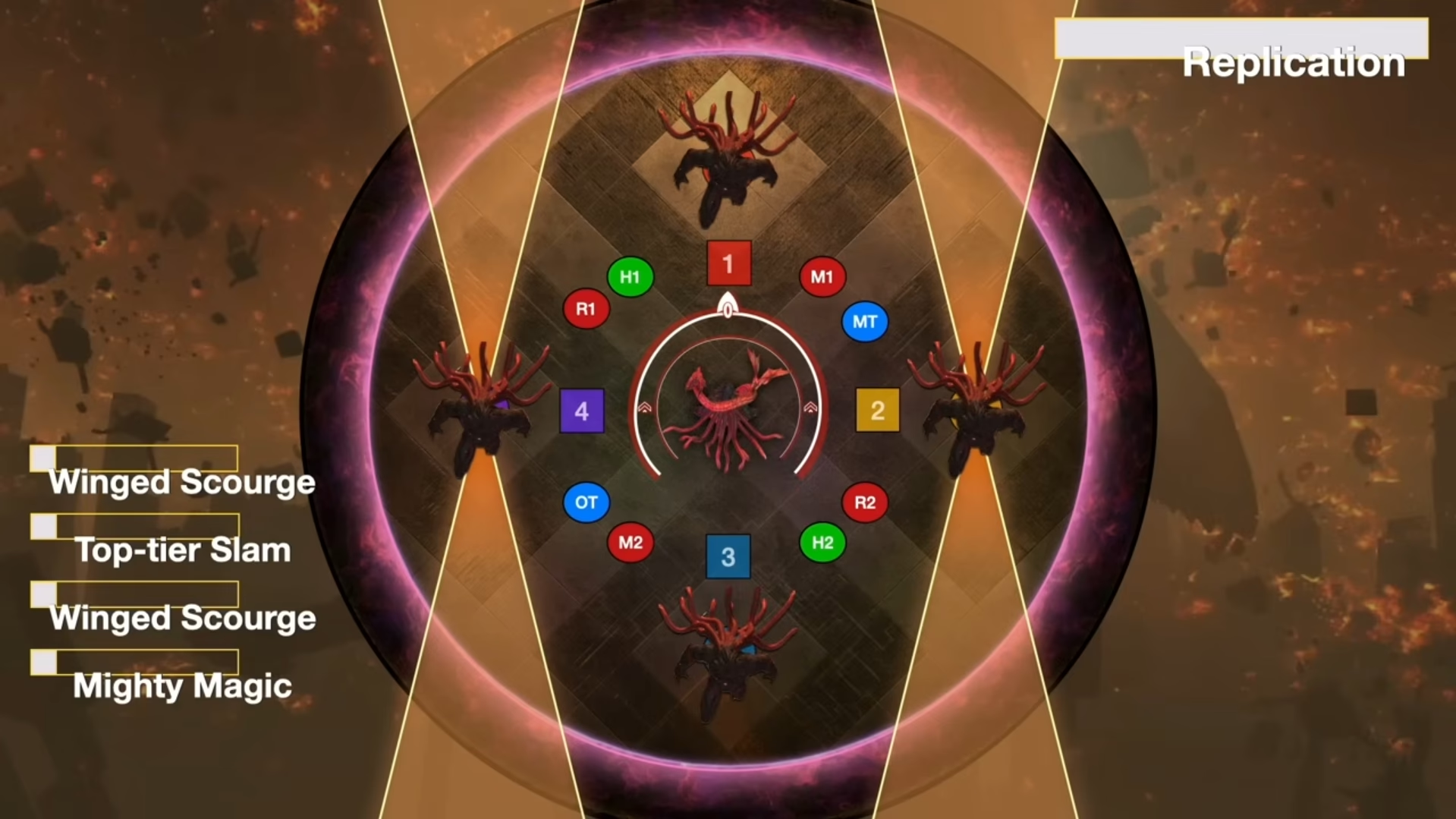
- Winged Scourge: Clones initiate cone-shaped AoEs aimed at their assigned positions.
- Mighty Magic: Targets the two nearest players with dark AoEs.
- Top Tier Slam: Requires a two-person stack on the nearest player. Players must be positioned properly before this resolves:
- All players partner up and stand at intercardinal points to naturally avoid cone-shaped cleaves.
- Players stay vigilant for slight movement cues if a cone attack approaches their position.
Committing to intercardinal positions early avoids unnecessary movement later when clone attacks begin firing.
Handling Clones and Baits
After the initial phase, the clones divide into eight and repeat their attacks. Players bait these attacks strategically to prevent lethal overlap:
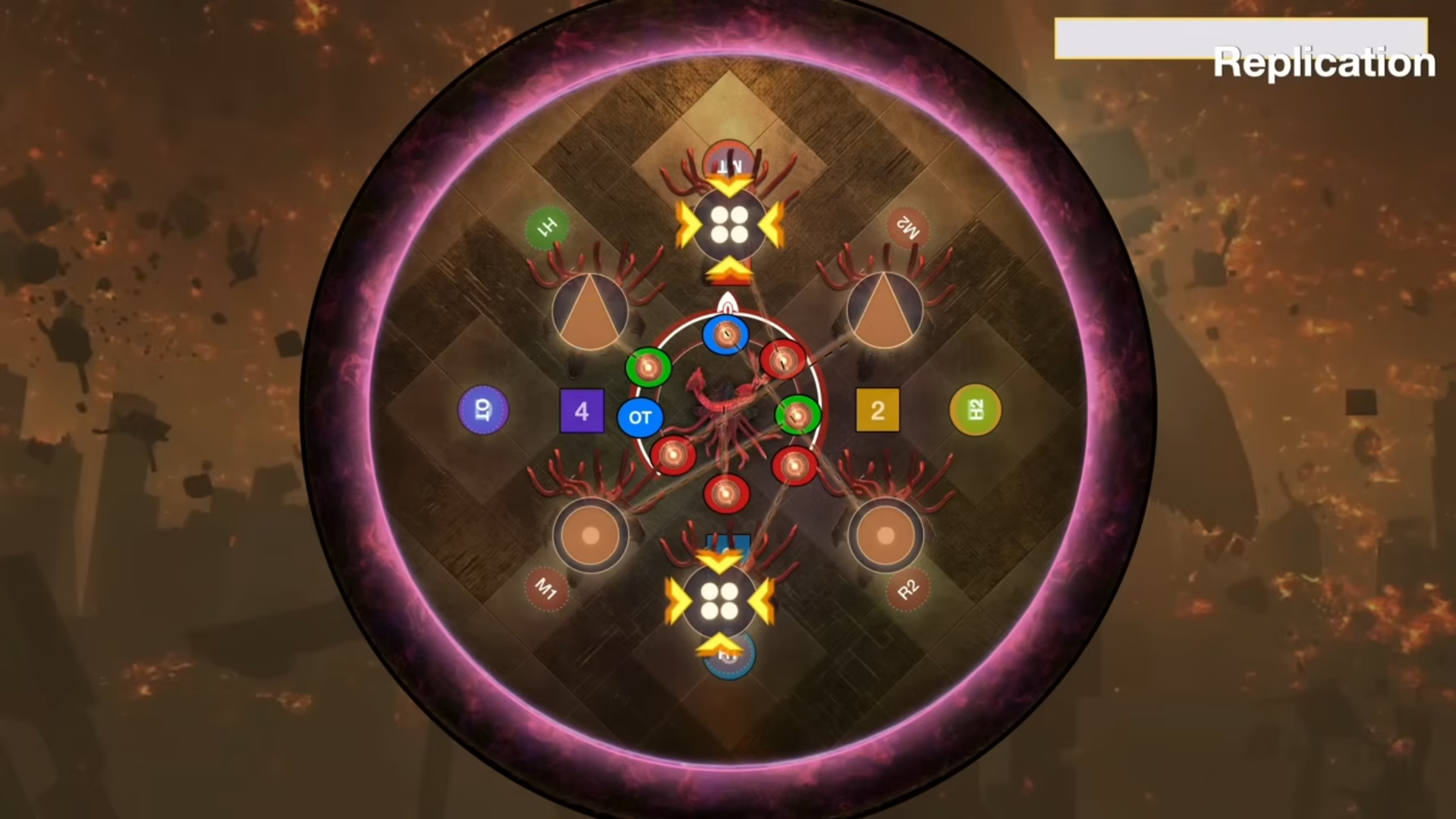
- Dark Fire Bait: Four players with dark debuffs bait fire clones — typically a healer paired with a ranged DPS and a tank paired with a melee DPS.
- Dark Clone Bait: The remaining four players manage dark clones, keeping two players nearest to each clone without overlapping AoEs.
- Fire Ad Positioning: Use way marks for consistent placement. Far fire ads head to cardinal points with dark debuff holders; the inner fire clone duo positions centrally.
- Dark Ad Positioning: Divide players without dark debuffs across cardinals to prevent AoE overlap. The inner dark clone duo stays near the boss but well clear of clone positions.
Coordinating bait groups cleanly sets up the Snake Pryo rotation and prevents cone AoEs from hitting unstacked players.
Snake Pryo Strategy
The standard Party Finder approach for this phase is "snake pryo":
- Support Players: Healers and ranged DPS baiting fire ads look north, then rotate clockwise to the nearest cardinal.
- DPS Players: Head northwest, then rotate counterclockwise.
An alternative is the "clone relative" method, which uses simpler left-right split positioning. This requires group agreement beforehand as it diverges from standard Party Finder conventions.
Sequence of Attacks and Tank Busters
Once positioning is confirmed, players minimize movement to hold bait positions accurately throughout the mechanic:
- Conclave Attacks: Minor adjustments may be needed to dodge cone AoEs from newly spawned clones.
- Tank Buster Mechanics: Tanks alternate on a three-part buster sequence. A well-timed invulnerability covers one cycle cleanly. The group prepares for the next replication set immediately after the busters resolve.
Consistent positioning through this sequence handles both the deterministic and random elements of the replication phase, bringing the group into the clone management section in good health.
Managing Clone and Boss Mechanics
The clone management phase presents two types of clones that each require different handling. Players hold stationary at predefined spots, facing the center, while tracking tether interactions:
- Player Clones: Tethers are fixed to specific players and cannot be exchanged. Each player must work around their assigned tether position for the full duration of the mechanic.
- Boss Clones: Tethers can be swapped by moving to a different boss clone. While briefly holding two tethers is possible, each player should hold exactly one before resolution begins.
Once tether assignments are secured, players move to optimal positions and orientations for the reenactment phase that follows.
Execution of Clone Mechanics
The reenactment phase involves coordinated dodges and stacks determined by the clone order established during tether collection:
- Cone Cleave: Determined by the direction the player or their clone is facing. Facing awareness is critical throughout.
- Defamation AoE: A large-radius attack that demands spatial separation from other players.
- Firefall Splash: Targets the tethered player, followed by a conal strike. Players split to contain both hits without crossfire.
Proper tether management makes these mechanics play out predictably, converting them into routine dodge-and-stack sequences.
Acting Light Parties and Mechanics
To handle tether and mechanic acquisition without overlap, the party splits into two acting light parties based on arena position:
- Acting Light Party 1: Players on the west side use a northwest-and-counterclockwise approach to assess mechanic priority.
- Acting Light Party 2: Players on the east use a north-and-clockwise methodology.
Each group avoids overlap in mechanic acquisition, moving to correct positions in response to the boss jump and the cleaves and defamations that follow.
Handling Netherworld Near and Far
During Netherworld Near and Far mechanics, stacks resolve based on proximity to the boss:
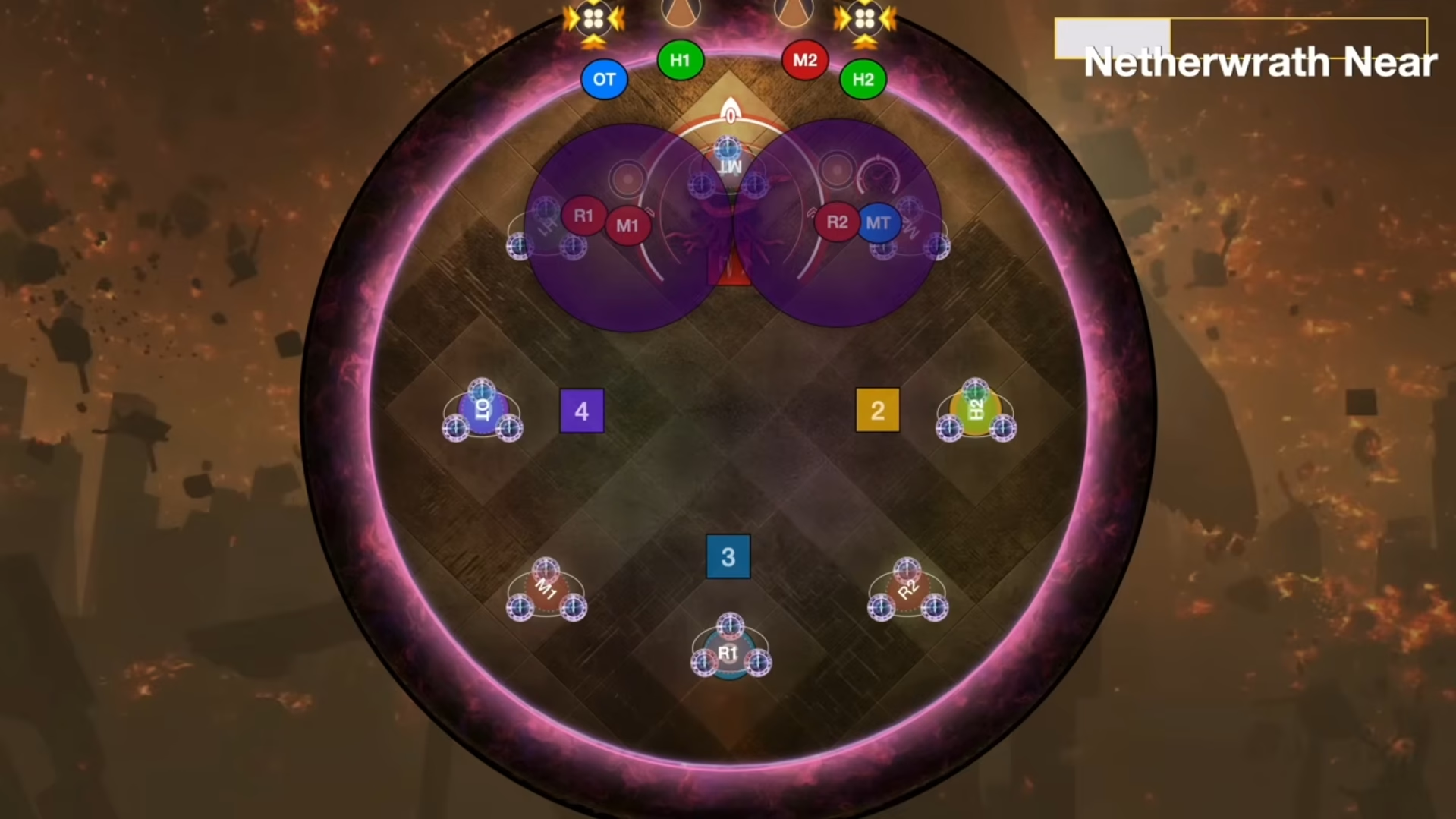
- Netherworld Near: The two nearest players combine stacks at the boss hitbox perimeter. Staying in tight means both players share the hit cleanly.
- Netherworld Far: Both players extend to predetermined far positions and share stacks with their light party partner at the designated spot.
Correctly identifying Near vs. Far on each cast is critical — the stack positions are mutually exclusive and a mix-up results in an uncleansable debuff or death.
Mechanic Resolution
After stacks resolve, the group transitions to choreographed movements that set up the next phase:
- Melees Proceed Northeast: Maintaining uptime as the boss tracks the main tank.
- Range Head Northwest: Dodging AoEs while preparing positions for subsequent light party stacks.
Tight execution here keeps the group alive and correctly positioned heading into the mutating cells sequence.
Transition to Mutating Cells
The fight escalates with the mutating cells sequence, which introduces Alpha and Beta debuffs operating simultaneously:
- Alpha Debuff: Blocks incoming damage until the debuff expires — any hit before then kills the player.
- Beta Debuff: Requires the player to absorb a hit before the debuff expires — missing the window causes a lethal self-destruct.
These debuffs interact with candy-like projectiles that execute distinct area effects as they return to their origin points, compounding the positional demands on every player.
Candy and Black Hole Strategy
The complex mechanics of the Abbey Phase require precise maneuvering to achieve successful resolution. A key aspect revolves around the interaction between candies and black holes. When all candies converge into a black hole simultaneously, the result is catastrophic. To mitigate this, beta players must stand in the path of the candies. This strategy staggers their arrival, allowing only two candies at a time to reach the black hole, making the mechanics manageable.
- Assign Beta Roles: Beta tank heads north with light mitigation while other three beta players stack south.
- Positioning: Beta players stand in front of the candies, then quickly dodge to create the delay.
- Strategize Black Hole Priority: Check the positioning of the candies relative to fixed sides, specifically focusing on green and orange candies for optimal staggering.
- Timing and Provocation: Beta tanks provoke accordingly as debuffs switch and position for dodging black hole attacks.
These role assignments carry into the replication and clone management phase.
Replication and Clone Mechanics
In the ensuing phases, replication and clone management are vital. Here, players must track multiple boss clones and maintain correct tether assignments.
- Clone Identification: Groups of four figures spawn cardinally or intercardinally. Mark these for later stages.
- Replication Order: Boss clones emerge pairs-wise starting north-south and rotating clockwise, impacting defamation and stack resolutions.
- Positioning and Tethering: Assign each player a quadrant based on their position relative to the clone, determining who picks which tether.
Table: Player and Tether Assignment
| Position | Quadrant | Task |
|---|---|---|
| 1 | North | Main Tank looks for stack |
| 2 | East | Checks for defamation |
| 3 | South | Assesses stack assignment |
| 4 | West | Confirms defamation choice |
These quadrant assignments carry into the Idyllic Dream positioning phase.
Idyllic Dream and Strategy Adjustment
As Idyllic Dream begins, players face one of the toughest challenges. The mechanic combines stacking, defamations, AoEs, and tower management.
- Mechanic Recognition: Initiate by identifying whether cardinals or intercardinals will determine the sequence of stacks and defamations.
- Resolving Stacks and Defamations: Conventionally, defamations deploy to east and west while parties stack north and south. However, the uptime idyllic strategy offers enhancements by concentrating defamations at north corners, allowing parties to hide south. This improves healing proximity and overall efficiency.
Combining these uptime and positioning refinements is how parties push through this phase consistently.
Conclusion
Effectively managing these sequences necessitates precise positioning and coordination among party members. By assessing the advantages of alternate strategies like upland idyllic positioning, parties can enhance both uptime and healing capabilities, thus paving the way for a more streamlined resolution of this intricate phase.
Clones and Telegraphed Attacks
In the intense dance of clone management, awareness of the sequence in which clones execute mechanics is critical. Players need to remember whether the cardinal points are addressed first to maintain proper positioning for avoiding attacks. Traditionally, clones will initiate from cardinal points; thus, teams are advised to organize with tanks heading east and the rest of the party north for optimal heal and mitigation efficiency. As these mechanics unfold, the intercardinal points follow the cardinals, requiring the group to reposition accordingly.
Managing Telegraphed AoE's
Telegraphed Area-of-Effect (AoE) patterns from boss clones add another layer of complexity to this phase. Consistently, three boss clones appear in the arena, each executing a distinct AoE attack. The middle clone always performs a point-blank AoE, while the two others execute either a front-to-back or side-to-side cleave. Here’s a quick rundown to help remember these events:
- Memorize which clone performs which attack.
- Observe the safe zones they create.
- Anticipate where to move for subsequent attacks.
It's essential to track the northern and southern ads as one will provide a safe zone by being sucked into a portal. The safety of a platform can often depend on recalling the ad’s teleportation pattern.
Tracking telegraphed AoE patterns correctly sets up the subsequent tower assignments.
Navigating the Tower Dynamics
Tower mechanics are another daunting aspect that requires strict positional awareness and role coordination. Here’s a breakdown of tower assignments and outcomes:
- Fire Meteor: Compels players to remain stationary post-impact, with any movement resulting in immediate penalty.
- Earth Meteor: Necessitates movement to avoid an emerging twister at the meteor’s location.
- Dark Meteor: Requires aiming away, as it projects a debuff-inducing laser.
- Arrow Meteor: Propels players to the opposing platform, needing awareness of landing zones to avoid additional risks.
Player roles and positions must be carefully arranged, with supports to the left and DPS to the right. Key precautions include:
- Coordinating swaps to handle light-affected towers.
- Healers must address players with Doom immediately after the meteor debuff.
- Positioning efficiently for twisters and managing lightning debuffs by standing strategically on platforms.
With meteors and tower debuffs resolved, the group tracks the dimension-transition timeline.
Order and Transition Management
Understanding the chronological unfolding of these mechanics across dimensions is crucial for mastering this phase. The primary mechanics initiate in one dimension before transitioning to another with the "Twisted Vision" cast. Here, strategic preparation can be invaluable by marking clone positions and meteor targets beforehand.
Monitoring this running order and anticipating each shift is key. Recognizing the sequence in which clones will act, where telegraphed AoE’s will be safe, and organizing tower responsibilities efficiently can make all the difference in overcoming this challenge seamlessly.
Execution of Twisted Vision Mechanics
As we re-enter the original dimension, players need to swiftly organize themselves to handle tether swaps. This involves recognizing quadrant assignments and collecting tethers from the boss clones. Each player should know precisely where to run, as the mechanics will sequence through stacks and defamations in a repeated pattern: stacks, defamation, stacks, defamation.
Once "Twisted Vision" is cast, the tethers are locked, requiring players to quickly dodge the already telegraphed AoEs. During this crucial time, Lindworm's meteor targets the platforms, splitting them into smaller sections. Here’s the positioning strategy:
- Light Party 1: West Platform
- Light Party 2: East Platform
Manage the heavy raidwide damage by positioning in the center for healing before moving into tower spots. Upon the "Downfall" phase, towers and meteors demand attention as Arcadian Arcanum targets support or DPS roles with AoEs. A proper vertical swap aids damage mitigation.
- Handle First Stack Positions
- Send Out First Defamations
- Address Second Stack Positions
- Execute Second Defamations
Returning to the dimension with towers, remember your previous swaps. Quickly adjust tower positions and prepare for any subsequent mechanics.
With tower responsibilities fulfilled, clone and portal tracking takes over.
Clone and Dimension Management
During the temporal curtain, understanding the clone behavior is paramount. The north clone being absorbed into the portal indicates that front and back positions are safe, with the side marked unsafe. Following this, track the south clone movement to determine the next safe area. If it jumps east, sidestep to positions on the boss or eastern platforms.
Twisted Vision prompts a move to intercardinal areas first, followed by a reenactment phase requiring cardinal positioning. Successfully resolving these sections leads to the ultimate maneuver:
Avoid the final clone, heal, and mitigate the idyllic dream raidwide. Conclude with managing a double sobat tank buster, leaving the main tank ready for replication and further damage.
Final Climax: Arcadian Hell
Replication spawns four clones, each casting Arcadian Hell—a formidable raidwide attack. Immediate damage mitigation is crucial as clones duplicate, amplifying the attack's force:
- Mitigate the first Arcadian Hell
- Prepare for clone duplications
- Mitigate heavily against subsequent Arcadian Hells
In this critical phase, collapsing under the continuous raidwide damage signals defeat. Swiftly eliminate the boss before the onslaught of Arcadian Hell forces a game over.
Frequently Asked Questions
What is M12S Phase 2 in Final Fantasy XIV?
M12S Phase 2 is the second phase of the AAC Heavyweight M4 Savage encounter against Lindwurm, accessed in the Arcadion Savage raid tier. It begins immediately after Phase 1 with the Arcadia Aflame raid-wide.
What do dark debuffs do in M12S?
Dark debuffs split the party into fire-clone baiters and dark-clone managers during Replication. Dark debuff holders head to cardinal points to draw fire clones; the remaining players spread to handle dark clones without overlapping AoEs.
What is the difference between Netherworld Near and Netherworld Far?
Netherworld Near requires the two nearest players to stack at the boss hitbox perimeter. Netherworld Far sends both players to predetermined distant positions to share the stack with their light party partner.
How do Alpha and Beta debuffs work in the mutating cells phase?
Alpha debuffs prevent incoming damage until they expire. Beta debuffs require absorbing a hit before expiration. Beta players intercept candy paths to stagger arrivals at the black hole, preventing a simultaneous-convergence wipe.
What is the Snake Pryo strategy in M12S?
Snake Pryo is a clone bait rotation where support players look north then rotate clockwise, and DPS players head northwest then rotate counterclockwise. It assigns each player a unique bait position deterministically without live callouts.
How does Twisted Vision work?
Twisted Vision locks all tethers to current boss clones and triggers a cross-dimension transition. Players dodge pre-telegraphed AoEs while Lindwurm meteors split the arena into platform sections — Light Party 1 takes west, Light Party 2 takes east.
What is Arcadian Hell?
Arcadian Hell is the fight enrage. Four clones each cast a simultaneous raid-wide, then duplicate and repeat. Without enough DPS to kill Lindwurm before the next cycle, the stacked damage causes a wipe.