Key Takeaways
- The European Parliament held its public hearing on the Stop Killing Games European Citizens' Initiative on April 16, 2026, jointly convened by the IMCO, JURI, and PETI committees.
- The ECI closed at 1,294,188 verified signatures (89% validity), with 24 of 27 EU Member States clearing the national-quorum threshold, against a requirement of 7.
- Ross Scott (founder), Moritz-Maximilian Katzner (General Director), and Daniel Ondruska led the campaign delegation; Professor Alberto Hidalgo Cerezo and attorney Marcin Barczyk presented the legal case.
- MEP Rene Repasi (JURI, S&D) proposed both the "right to resurrect" framing and a "Project Gutenberg for video games" public-library model — these were Parliament suggestions, not campaign proposals.
- MEP Axel Voss (EPP, JURI) was the only sceptical voice in the room, raising third-party licensing and copyright concerns rather than opposing preservation outright.
- The European Commission must publish its formal response by July 27, 2026; a parallel push aims to fold game preservation into the Digital Fairness Act expected in Q3 2026.
- The campaign's trigger event was Ubisoft's 2024 shutdown of The Crew, which remains an active national case (UFC-Que Choisir vs. Ubisoft) the Commission is monitoring.
The hearing was the first time these arguments were aired inside the European Parliament rather than in industry trade-press or YouTube commentary, and the post-hearing reading sets up the legislative track for the remainder of 2026.
What the April 16 Hearing Covered
The Stop Killing Games initiative reached its first formal European Parliament gate four weeks after its formal hearing in Brussels. The movement, which advocates for treating purchased video games as durable consumer goods rather than perpetual services, has now passed every procedural gate available to a European Citizens' Initiative: collection, verification, submission, and a public hearing in front of the relevant parliamentary committees.
The April 16, 2026 session at SPAAK 3C050 was not a press conference; it was an official public hearing jointly organised by the Committee on the Internal Market and Consumer Protection (IMCO), the Committee on Legal Affairs (JURI), and the Committee on Petitions (PETI). Anna Cavazzini, who chairs IMCO, opened the floor and signalled that support stretched across political groups rather than clustering on one side of the chamber.

The initiative is registered with the Commission under the name "Stop Destroying Videogames", which is the formal ECI title. The public-facing campaign brand, the website (stopkillinggames.com), and the social-media presence all use "Stop Killing Games." Both labels point at the same effort, but only the registry name carries legal weight.
Who Stood at the Microphone
Five people spoke for the campaign at the hearing. Ross Scott, the Accursed Farms creator who launched the petition after Ubisoft pulled the plug on The Crew in 2024, returned from a publicly-announced "standby break" specifically to testify. Moritz-Maximilian Katzner, General Director for the EU effort, walked the committees through the campaign's policy asks. Daniel Ondruska handled organisational detail. Professor Alberto Hidalgo Cerezo (Jean Monnet Professor of EU law) and Marcin Barczyk (President of the IP & New Technology section at the Krakow Bar Association) provided the legal scaffolding.
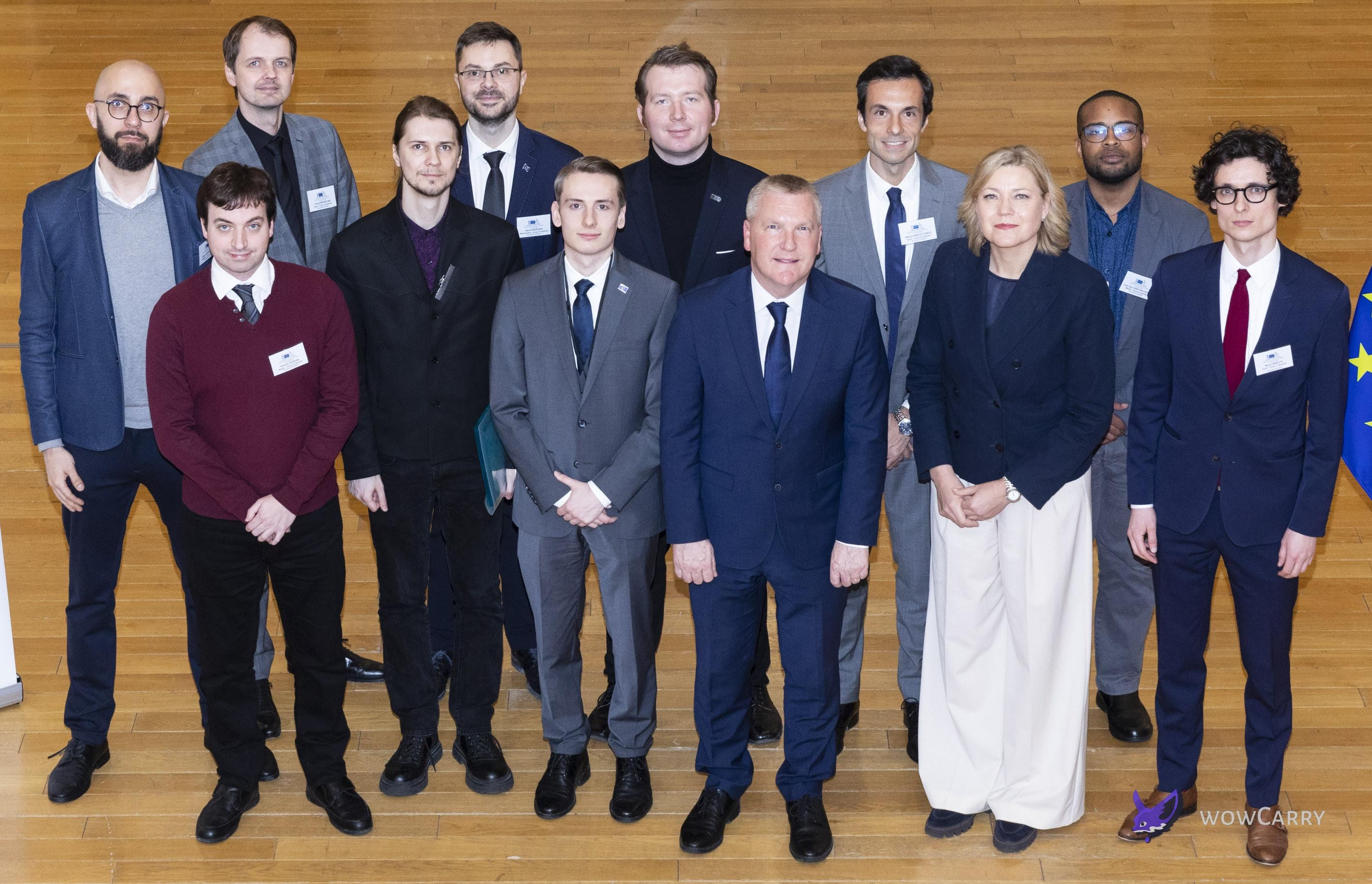
On the parliamentary side the speaker list ran well past the usual one or two committee chairs. Beyond Cavazzini, the room included P. Arias Echeverria (IMCO, EPP), Marion Walsmann (JURI Vice Chair, EPP), Piotr Müller (IMCO), Nikola Minchev (IMCO Vice Chair), Catarina Vieira (INTA), Leila Chaibi (IMCO, The Left), and Sandro Ruotolo, who anchored a child-safety angle. The hearing's earlier-named supporters Niklas Nienaß, Patrick Breyer, Markéta Gregorová, and Parliament Vice-President Nicolae Ștefănuță had spent the preceding months helping the petition collect signatures.
"Right to Resurrect" and Project Gutenberg for Games
Two framings dominated the discussion, and both came from MEP Rene Repasi (JURI, S&D), not from the campaign. The first was a shift from the existing "right to repair" template into a "right to resurrect" model — instead of asking publishers to keep servers online indefinitely, the legislation would require them to leave a game in a community-runnable state when commercial support ends. The second was a "Project Gutenberg for video games" public-archive concept, treating shipped titles as cultural artifacts that an EU institution could preserve once a publisher abandons them.
Neither framing was on the campaign's prepared list. Both have stuck in the post-hearing coverage because they answer the practical objection that game preservation requires forcing publishers to spend money — they don't, if the obligation is simply to leave the lights wired before walking away.
Axel Voss and the Copyright Question
Axel Voss (EPP, JURI) was the hearing's lone sceptical voice. His concerns were not procedural foot-dragging. The first was third-party content: many modern games embed licensed music, licensed engines, and licensed middleware whose contracts expire at different times than the game itself. The second was the basis question — would a preservation mandate live under consumer-protection law (DG JUST's territory) or copyright law (DSM Directive territory)? Different answers route the file through different legal frameworks and unlock different enforcement tools.
Katzner's response was that the campaign is not asking publishers to keep granting new licences; it is asking that the post-shutdown state of a purchased game leave the user with something playable, even if community-run. Industry counter-proposals — clearer end-of-life labelling, minimum support windows, advance notice, voluntary preservation plans — miss the substance because they all address the licensing layer rather than the game's terminal state.
Video Games Europe's Position
The industry trade body, Video Games Europe, filed a public position in July 2025 and reiterated it during the hearing window. Offline modes, the group argued, would be "too expensive" to retrofit onto live-service titles; fan-supported private servers "could present legal liabilities" around licensing and player safety; and preservation requirements "could prevent new games, features, and technology" by tying up publisher resources.
The hearing made one industry argument visible in a way it had not been before: that disabled games represent direct competition to new releases, and that letting old games stay playable would suppress sales of replacements. Katzner cited research suggesting voluntary end-of-life plans occur in only 4–6% of game shutdowns — a figure the committees took at face value during the session.
What Has to Happen Before July 27, 2026
The Commission's formal response is due July 27, 2026, a little over two months from now. Under the ECI procedure, the Commission must publish a "communication" setting out what action, if any, it intends to take. The communication has four legal options: propose new legislation, fold the request into an existing legislative track, decline to act with reasoning, or commit to non-legislative measures such as guidelines or recommendations.
The track most analysts are watching is the Digital Fairness Act, the Commission's proposal expected in Q3 2026. Game preservation is currently not in the DFA draft — the DFA targets dark patterns, addictive design, and gambling-like mechanics. But the campaign has opened a parallel push on the DFA public consultation, where roughly 3,000 responses arrived in the first two weeks of the consultation window, predominantly from gamers asking for preservation language to be included.
The Comparative Cases
The EU has a track record on consumer-rights wins in the technology sector. The Common Charger Directive (2022/2380) settled the USB-C question over industry objections from manufacturers using proprietary connectors. The Batteries Regulation (2023/1542) is forcing user-replaceable batteries back into phones and laptops on a multi-year timeline. The Right to Repair Directive (2024/1799) extends the same logic into household appliances and consumer electronics.
Game preservation would sit alongside those, not above them. The argument the campaign is making — that durable goods which a consumer paid full price for should not stop working at the seller's discretion — has already been settled in EU law for several adjacent categories. The Total War example the campaign uses (Medieval 2 from 2006 still actively played alongside Total War: Warhammer III) shows the market dynamic the publishers fear is overstated: older games coexist with new releases rather than cannibalising them.
For the United States the parallel is the Protect Our Games Act, introduced February 2026, which has not yet cleared committee but is being tracked by US industry lobbies and the same publishers. The American push echoes the EU campaign's framing on durable-goods consumer protection.
Frequently Asked Questions
Is Stop Killing Games passed in the EU yet?
No. The ECI has cleared the petition-and-hearing stage. The European Commission must publish its formal communication by July 27, 2026, setting out what action it will or will not take. Legislation, if any follows, would arrive on its own timeline through either a fresh proposal or the Digital Fairness Act track.
How many signatures did Stop Killing Games actually get?
The campaign collected approximately 1.45 million raw signatures by July 31, 2025. After national verification the final count was 1,294,188 — an 89% validity rate, above the 1 million required to trigger Commission consideration. The national-quorum threshold was cleared in 24 of 27 Member States, against a requirement of 7.
Who is Ross Scott?
Ross Scott is the founder of the Stop Killing Games campaign and the creator of the Accursed Farms YouTube channel. He launched the petition in 2024 after Ubisoft shut down servers for The Crew, rendering the purchased copies unplayable. He took a publicly-announced step back in August 2025 once the signature collection passed its milestone; he returned to testify at the April 16, 2026 Parliament hearing.
What is the "right to resurrect"?
The "right to resurrect" is a framing proposed by MEP Rene Repasi during the April hearing. It would require publishers to leave a shipped game in a state where the player or a community can run it after official servers go dark — no obligation to keep operating the game, just an obligation not to leave the product permanently bricked at end-of-life.
Will the Digital Fairness Act include video games?
Not yet. The DFA Commission proposal is expected in Q3 2026 and currently targets dark patterns, addictive design, and gambling-like features. Game preservation would need to be added during the public-consultation window or the legislative process. The campaign has organised a coordinated DFA consultation push specifically for this.
What did Video Games Europe argue against the initiative?
Video Games Europe argued that retrofitting offline modes onto live-service games would be prohibitively expensive, that fan-run private servers create legal liability around licensing and player safety, and that ongoing preservation duties would tie up resources that could otherwise fund new titles. The hearing also surfaced the argument that older games staying playable suppresses sales of new releases.
Which European Parliament committees handled the hearing?
Three committees jointly convened the April 16, 2026 hearing: the Committee on the Internal Market and Consumer Protection (IMCO, chaired by Anna Cavazzini), the Committee on Legal Affairs (JURI), and the Committee on Petitions (PETI). The joint format is unusual and reflects the cross-cutting nature of the initiative — part consumer protection, part copyright, part petition right.