What DLSS 5 is and why the announcement backfired
Nvidia announced DLSS 5 on the opening day of GTC 2026 on March 16. The feature is a real-time neural rendering model that goes beyond the upscaling and frame-generation that defined DLSS 1 through 4. Instead of cleaning up a lower-resolution frame, DLSS 5 re-renders pixels with photoreal lighting and materials inferred from a model trained on highly detailed assets. It launches in Fall 2026 and is exclusive to RTX 50-series Blackwell GPUs.
The community response was not the celebration Nvidia expected. The official YouTube reveal hit an 84% dislike ratio within 24 hours, with roughly 82,000 negative reactions against fewer than 16,000 positive ones. Several launch-partner developers told the press they were not consulted before their studios were named on Nvidia's slide deck, and Bethesda and Capcom both released softening statements within days.
Key takeaways
- DLSS 5 ships Fall 2026, RTX 50-series exclusive. Launch partners include Bethesda, Capcom, Hotta Studio, NetEase, NCSOFT, S-GAME, Tencent, Ubisoft, and Warner Bros. Games.
- The Zorah tech demo (500 million triangles, 30,000+ materials, 1,500 high-resolution textures) is Nvidia's flagship reveal vehicle, built in Unreal Engine 5 with the NvRTX branch.
- Demo titles shown: Starfield, Hogwarts Legacy, Assassin's Creed Shadows, and Resident Evil Requiem.
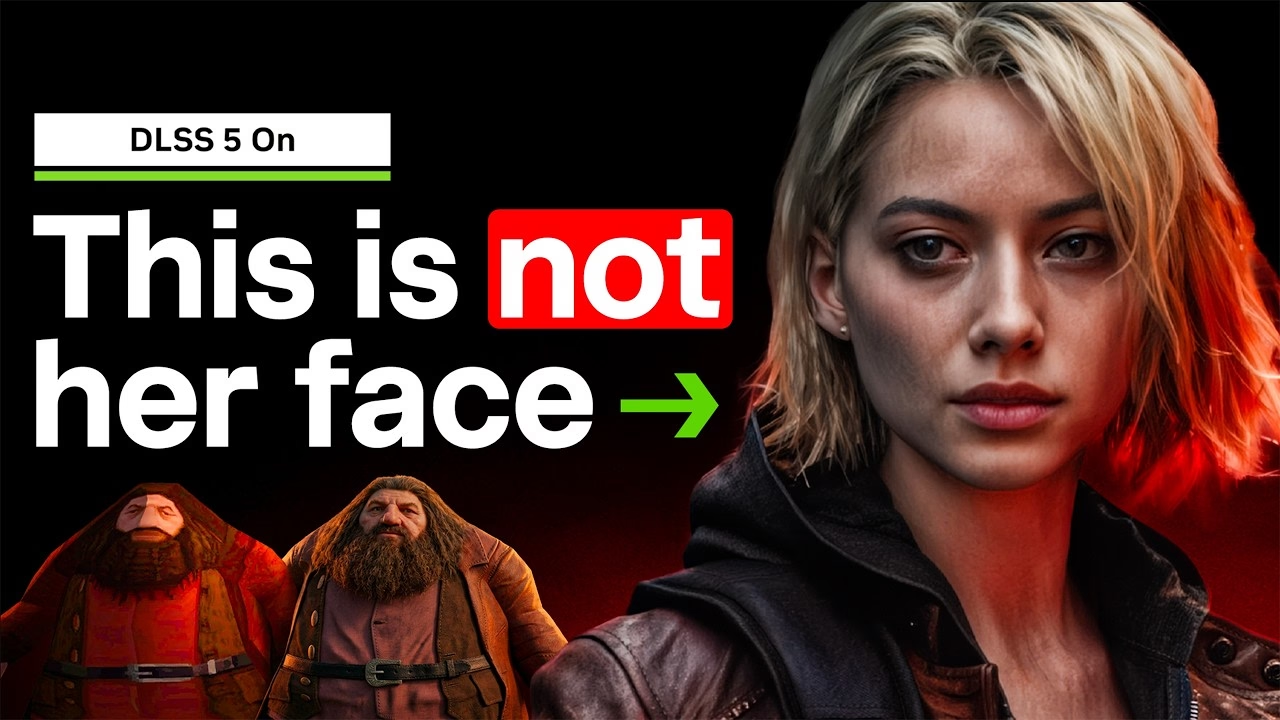
- Grace Ashcroft, the new Resident Evil Requiem protagonist, drew the loudest fan criticism after the DLSS 5 pass redesigned her face into a smoother, more conventionally polished look.
- Capcom and Ubisoft developers said they "found out at the same time as the public." The partnership was a leadership-level deal, not a studio-wide rollout.
- Jensen Huang called critics "completely wrong" and separately told PC Gamer that he is "empathetic" toward gamers but does not see DLSS 5 as AI slop.
- Nvidia's $1 trillion claim is cumulative Blackwell and Vera Rubin orders booked through 2027, not a single-year run rate.
The headline is real and the controversy is well-documented. What follows tracks what DLSS 5 actually does, how the partner studios reacted, and where the technology fits into a longer pattern of graphics-tech rollouts gone awry.
How DLSS 5 differs from DLSS 4
Previous DLSS generations were super-resolution and frame-generation systems. DLSS 1 and 2 reconstructed a high-resolution image from a lower one. DLSS 3 added frame generation, synthesising in-between frames for higher perceived frame rates. DLSS 4 sharpened both pipelines and expanded multi-frame generation.
DLSS 5 changes the model's role from upscaler to renderer. The neural model analyses the engine-produced frame, including color, motion vectors, materials, and lighting, then re-runs the lighting, reflection, and material passes through its trained network. The output is a frame that looks closer to a path-traced offline render than to the engine's native output. In practice, this means DLSS 5 can produce visuals the underlying game engine could not have produced on its own.
That capability is also the source of the backlash. Stylised art direction (Hogwarts Legacy's painterly characters, Resident Evil Requiem's deliberately stark survival-horror palette) competes with a neural network trained to push toward photoreal output. Where the engine and the model disagree, the model wins.
The Zorah tech demo and what it does
The flagship demo is Zorah, an Nvidia-built Unreal Engine 5 environment that is effectively a sandbox for DLSS 5. Zorah loads 500 million triangles, over 30,000 unique materials, more than 2,000 particle lights, and 1,500 high-resolution textures, with full path tracing and DLSS 5 driving the final output. Critics noted that Zorah avoids the artistic-integrity question because there is no licensed game IP and no original art direction to compete with the neural rendering.

Zorah was widely shared as a "look what's possible" reel. It was not, however, defensive cover for the rest of the demo reel. The complaints about Grace Ashcroft, Hogwarts Legacy's characters, and Oblivion Remastered's lighting all came from the live game footage, not from Zorah.
Why developers said they were blindsided
Within 48 hours of the announcement, Capcom and Ubisoft developers told PC Gamer they had not been briefed before Nvidia named their games as DLSS 5 launch titles. The line that travelled across coverage was direct: "we found out at the same time as the public."
Leadership at Bethesda (Todd Howard) and Capcom (Jun Takeuchi) signed the partnership deals. The artists, animators, and lighting engineers actually working on the named titles were not in those rooms. The DLSS 5 demo pass on each game ran on top of the in-development art assets, with no opportunity for the studio art teams to dial in (or veto) the result before it hit the keynote screen.
Two studios released softening statements within the week:
- Bethesda said the Oblivion Remastered footage was "a very early look" and that "this will all be under our artists' control, and totally optional for players." The optional-toggle framing is the company's preferred answer to the artistic-integrity concern.
- Capcom, through Resident Evil Requiem producer Masato Kumazawa, told VGC that the backlash over Grace Ashcroft's DLSS 5 look "shows we got Grace's original design right" — framing the controversy as validation of the studio's own work rather than the technology that overrode it.
That softening landed differently from studio to studio. Bethesda's statement was a procedural reassurance; Capcom's was a defiant flip of the criticism into a marketing win. Both responses point at the same underlying fact, which is that the demo pass shown at GTC was not approved by the studio art teams that own the characters.
The Grace Ashcroft controversy in context
Grace Ashcroft is the primary protagonist of Resident Evil Requiem, with Leon S. Kennedy returning as the secondary protagonist. Grace's section of the game is survival horror; Leon's is action, mirroring the dual-protagonist structure of Resident Evil 2. The DLSS 5 demo pass redesigned Grace's face in ways the community quickly described as a "Snapchat filter" or "AI beauty standard" effect, smoothing features and pushing the character toward a more conventionally polished look that fans felt overrode the deliberately grounded original design.
Kotaku's coverage framed the result as "AI slop faces", and the Grace-specific anger drove most of the meme cycle that followed. The Resident Evil Requiem producer's response, that the backlash proves the original design was correct, became the cleanest articulation of the broader industry concern: DLSS 5 does not just enhance art, it replaces choices the art team already made.
Hogwarts Legacy and the uncanny-valley problem
Hogwarts Legacy was the other launch demo that drew widespread criticism. Avalanche Software's character art deliberately avoids photoreal rendering in favour of a softly stylised, slightly painterly look. The DLSS 5 demo pass pushed those same character faces toward photoreal skin, eye, and hair shading. The result, in the words of multiple outlets, was an uncanny-valley mismatch where photoreal heads sit on stylised bodies, in stylised lighting, in a stylised world. It looked wrong precisely because it looked too real for the rest of the scene.
The pattern is familiar to anyone who has watched a stylised animated film run through a real-time photo upscaler. The technology is capable; the application is the problem. Stylised games are art-directed away from photorealism on purpose, and the DLSS 5 model has no notion of that intent.
Nvidia's GPU market position and the GTC pitch
The DLSS 5 announcement landed against a backdrop of unusual market dominance. Jon Peddie Research recorded Nvidia at 94% of discrete GPU shipments in Q4 2025, up from 84% a year earlier; AMD held 5% and Intel 1%. Jensen Huang opened the GTC keynote by projecting at least $1 trillion in cumulative Blackwell and Vera Rubin orders through 2027 — not a single-year revenue target, but a two-year order pipeline.

Notably absent from the keynote was a new gaming GPU. Instead, the gaming pitch was DLSS 5 as a "GPT moment for graphics", a phrase the keynote leaned on heavily. The framing positioned DLSS 5 less as a feature update and more as a paradigm change, which is the framing that drew the most pushback from artists and players who heard "your game will be re-rendered by an AI you do not control".
Huang's response and the RTX 50-series exclusivity issue
Jensen Huang's first public response, reported by Tom's Hardware, was that critics were "completely wrong" about the technology. A softer follow-up in a PC Gamer Q&A added that he is "empathetic" toward gamer concerns and that "I don't love AI slop myself — that's just not what DLSS 5 is trying to do."
Both quotes are revealing. The first read as dismissive and amplified the backlash. The second tacitly acknowledged the AI-slop framing the critics were using and tried to separate DLSS 5 from it. The space between those two responses is where Nvidia's PR will need to operate over the Summer.
The exclusivity layer makes the artistic-control debate sharper. DLSS 5 will run only on RTX 50-series GPUs at launch. Players without 50-series cards cannot enable it; players with 50-series cards may find DLSS 5 effects toggled on by default in games where Nvidia and the publisher have agreed on the integration. The "totally optional for players" line from Bethesda is meant to address exactly that worry, but Bethesda speaks for one studio and one game.
Why this rollout follows a familiar pattern
The DLSS 5 launch echoes earlier graphics-tech debuts that arrived with more fanfare than developer integration. Battlefield V's launch ray-tracing implementation, six years earlier, drew similar criticism: enabled it looked striking, but the performance cost and the visual changes prompted many players to disable it within hours. Ray tracing eventually found its footing, but only after developers learned to integrate it deliberately rather than as a flag flipped on top of an existing engine.
Path tracing followed the same arc. Initially showcased as a transformative leap, it became useful only once specific titles (Cyberpunk 2077, Alan Wake 2, the most recent Resident Evil engine refresh) built their lighting models around it instead of beside it. DLSS 5 sits at the start of that same curve. The technology may be defensible; the rollout was not.
Frequently asked questions
When does DLSS 5 actually ship?
Nvidia's announced release window is Fall 2026, RTX 50-series exclusive. The launch partner list (Bethesda, Capcom, Hotta Studio, NetEase, NCSOFT, S-GAME, Tencent, Ubisoft, Warner Bros. Games) confirms studio commitments but does not yet name specific patch dates for the demo titles. Individual game integrations are expected to ship alongside the games' own updates, not as a coordinated platform launch.
Can DLSS 5 be turned off?
Yes, on a per-game basis. Bethesda explicitly committed to making DLSS 5 "totally optional for players" in Oblivion Remastered. The other launch partners have not made identical statements, but the default expectation in the PC space is per-feature toggles. Nvidia has not publicly addressed whether DLSS 5 will be on or off by default in games that ship with the integration.
Does DLSS 5 replace DLSS 4?
No. DLSS 5 is positioned as a new tier of the technology, not a replacement. DLSS 4's super-resolution and frame-generation pipelines continue to work on RTX 40-series and newer cards. DLSS 5 layers on top, exclusively on RTX 50-series.
Why are developers' artists upset if leadership signed the deal?
Because the demo footage shown at GTC was generated by Nvidia's model running on top of in-development art assets, without studio art teams reviewing or approving the result first. The complaint is procedural as much as aesthetic: artists were excluded from a feature that overrides their work.
Will the 84% dislike ratio matter?
Probably less than the developer responses. Player dislike ratios on launch trailers have historically not stopped a feature shipping; they have, however, pressured publishers to add toggles or rework defaults. The Bethesda statement on Oblivion Remastered is the playbook other publishers are expected to follow.
Is the Resident Evil Requiem demo final art?
No. The game has not yet released. The Grace Ashcroft demo pass shown at GTC reflects an in-development build with DLSS 5 layered on. Whether the released game ships with DLSS 5 enabled by default on RTX 50-series cards is a Capcom decision Capcom has not yet publicly made.
What to watch next
Three things are worth tracking through the Summer. First, whether Nvidia revises its messaging from "GPT moment for graphics" toward something that emphasises developer control. Second, whether other launch partners follow Bethesda's "totally optional" promise on a game-by-game basis. Third, whether the Resident Evil Requiem release ships with a clean toggle and a default that respects the original art direction. The technology will probably find its place eventually, the way ray tracing and path tracing did. The question is how much trust Nvidia spends on the way there.