The Rise of Game Remakes and Remasters
Remakes and remasters are reshaping the gaming landscape in ways few predicted. A survey by MTM Consulting found that 90% of gamers have engaged with at least one remake or remaster in recent years — and the primary driver is not nostalgia. Data shows that 85% of players had never played the original version when buying a remake, meaning publishers are reaching a genuinely new audience rather than revisiting old fans.
Key Takeaways
- 90% of surveyed gamers have played a remake or remaster; 85% never played the original.
- The appeal is not nostalgia — most buyers are new to the IP.
- 74% of players expect remakes to cost less than new releases; the ideal gap between original and remake is 5–6 years.
- Elder Scrolls Oblivion Remastered outsold most new titles at launch, demonstrating remakes' commercial ceiling.
- Remakes carry lower development risk: known scope, defined creative template, predictable production cycles.
- The same logic sustaining classic film remasters drives game revivals — timeless IPs reach modern audiences on modern platforms.
These numbers frame the rest of the discussion: why remakes work commercially, how they are developed efficiently, and what the trend means long term.
Understanding Remakes and Remasters
The terms are often used interchangeably but represent distinct product types:
- Remakes: Complete rebuilds of the original game with updated graphics, reworked gameplay mechanics, and sometimes revised story elements.
- Remasters: Enhanced versions of the existing game with improved visuals, sound, and performance while preserving the original structure.
MTM Consulting's survey covered 1,500 gamers from the US and UK and forms the basis of the data referenced throughout this article.
Why Gamers Choose Remakes
Survey results reveal why remakes draw such a broad audience well beyond the original fan base:
- Comfort and Nostalgia: 80% of respondents view these games as comforting and nostalgic, even players who never touched the original.
- Bridging Generations: 71% see remakes as a way to share beloved classics with younger family members or friends who missed the originals.
- Graphical and Control Updates: Players consistently cite modern graphics and responsive controls as the baseline they expect from any revival. When remakes significantly change narrative or gameplay, 35% appreciate the changes while 30% prefer strict faithfulness — a meaningful split every developer must weigh.
That divide in player expectation shapes every creative decision made during a remake's development.
Pricing and Release Timing
Commercial viability depends heavily on how a remake is positioned at launch:
- 74% of gamers expect remakes to carry lower price tags than new releases.
- More than 30% consider a 5-to-6 year gap between original and remake to be the sweet spot — long enough to feel fresh, short enough to retain cultural memory.
Price and timing together set the conditions for whether a re-release converts a new audience or simply cannibalises the existing one.
The Business Perspective
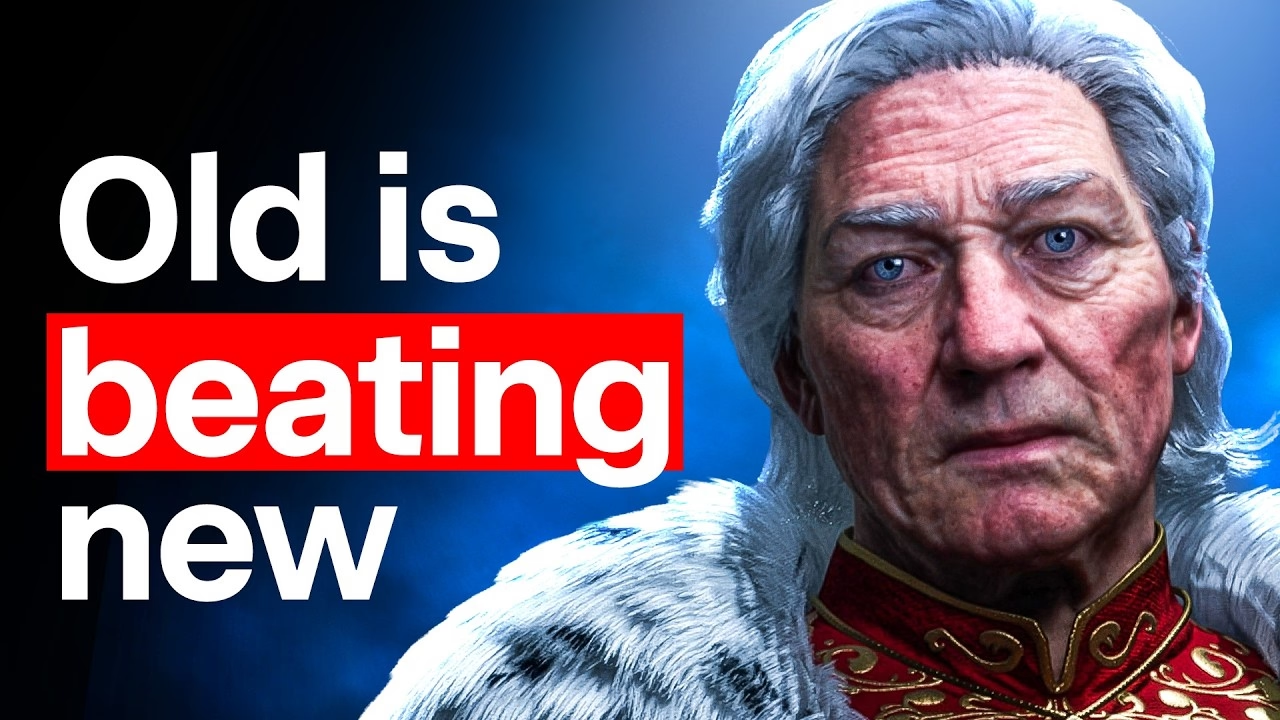
The commercial case is well established. Elder Scrolls Oblivion Remastered outperformed most new releases when it launched in 2025, capitalising on a gaming audience that has grown dramatically since the original shipped in 2006. For publishers, the appeal is straightforward: a proven IP carries built-in discovery, creator coverage, and brand recognition that a new IP spends years building from zero.

A game that sold 3 million copies in 2005 can realistically reach an addressable market ten times that size today. The audience has grown; the IP has not aged out.
Creative and Financial Balance
Where new IP development runs into unknown unknowns — scope creep, design pivots, unproven gameplay loops — remakes offer defined scope from day one. Teams allocate effort to polish and modernisation rather than first-principles design, resulting in more predictable production schedules and fewer costly late-stage pivots. Large studios can distribute remake work across specialised teams (environment art, audio re-recording, quality-of-life improvements) without the coordination overhead that routinely sinks new projects.
Expanding Market Opportunities
Any game in a publisher's IP library can be evaluated for remake potential — not just historic megahits. Companies like Embracer and Microids have been systematically acquiring legacy IPs specifically to exploit this logic. What was a niche title in 2002 can find a much wider audience in today's market. Recent examples bear this out: Oblivion Remastered and The Last of Us Part I both reached audiences who had no practical path to playing the originals.
- Lower development costs relative to new-IP projects
- Efficient resource allocation with a defined creative template
- Outsourcing-friendly structure for environment art and audio work
The comparison to classic film remasters holds: timeless stories gain new life on modern platforms, and audiences who discover an IP through a remake often seek out the rest of the franchise.
Challenges Ahead
Creating new games costs more than ever, and with talent pools shrinking due to burnout and studio closures, the pipeline of developers capable of launching a successful new franchise is narrowing. Sony's Shuhei Yoshida flagged this dependency directly — remakes and ports have become financial necessities at studios that once led on original content. If remakes crowd out new IP investment, the long-term supply of revivable titles begins to thin.
Remakes sustain the business today, but original titles build the catalogues that tomorrow's remakes will draw from. The industry's challenge is holding both in balance.
Frequently Asked Questions
Are game remakes more profitable than new games?
Often, yes. Remakes carry lower production risk because the core design is proven. Titles like Elder Scrolls Oblivion Remastered outperformed most new releases at launch, showing the commercial ceiling a well-executed revival can reach.
What is the difference between a remake and a remaster?
A remake is a full rebuild — new engine, reworked mechanics, sometimes revised story. A remaster is an upgrade of the existing build, improving resolution, frame rate, and audio while preserving the original structure.
Why do remakes attract players who never played the original?
Gaming audiences have grown dramatically since 2005. A game that launched to a small market now has access to hundreds of millions of additional players. Remakes with modern visuals and controls convert players who simply were not gaming when the original released.
How long should the gap be between a game and its remake?
The MTM Consulting survey found that over 30% of gamers see 5–6 years as the ideal window: long enough for the original to feel dated and the new version to feel meaningfully upgraded, short enough for cultural memory to still carry weight.
Why are remakes lower risk for developers than new IPs?
Known creative scope means teams face defined challenges rather than unpredictable design problems. Work can be parallelised across art, audio, and quality-of-life improvements without the coordination overhead that sinks new-IP projects mid-development.
Do younger gamers care about game remakes?
Survey data shows 85% of remake buyers had never played the original, suggesting the appeal is not nostalgia but quality. Younger players are not seeking a throwback — they are discovering a game for the first time, in a form that meets modern expectations.
Which publishers are most active in the remake market?
Publishers with large legacy IP libraries are best positioned. Embracer Group and Microids have made systematic IP acquisitions targeting remake potential. First-party studios at Sony and Bethesda have also made remakes a consistent part of their release calendar.