Key Takeaways
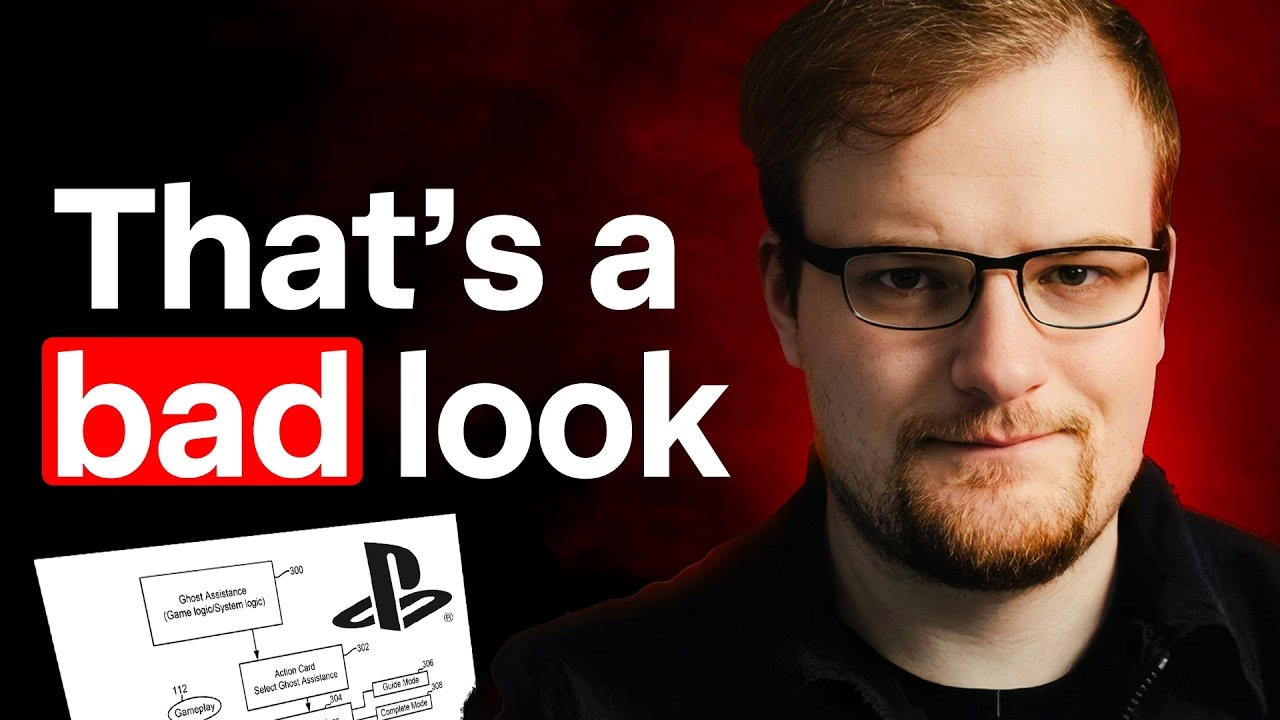
- Sony filed patent WO2025/080356 for an AI "ghost player" that can complete game sequences on behalf of players who get stuck.
- The system offers two modes: Guide Mode (AI shows the path via a ghost character) and Complete Mode (AI plays the sequence with no player input).
- Similar concepts already exist — Nintendo's Super Guide feature and racing games' ghost cars — but Sony's patent hinges on applying generative AI to complex, unscripted PlayStation environments.
- The AI trains on hours of developer-supplied gameplay footage before a title ships, requiring significant pre-release investment from studios.
- Sony's history of patent hoarding (the 2009 ad-skip-by-voice patent that expired in 2030 without ever shipping) suggests the ghost player may also function primarily as a competitive deterrent.
- Nintendo, Sega, Konami, and Capcom all treat patents as strategic assets; the pattern of filing before competing, not necessarily before shipping, is industry-standard.
Here is a closer look at the patent, Sony's history with speculative filings, and what this move actually means for PlayStation players.
AI in Gaming: Sony's Ambitious Vision
Sony has embarked on an unconventional and ambitious journey to integrate AI into gaming, offering solutions for gamers who struggle with certain aspects of gameplay. Traditionally, if a player was stuck, they might rely on friends or family to assist. However, with Sony's new approach, this external help could be replaced by AI. Imagine selecting a menu option and having an AI take over your game. This initiative is part of a broader trend where generative AI is becoming increasingly prevalent in gaming.
The AI Ghost Player Feature
The core of Sony's proposal lies in newly filed patent WO2025/080356, which aims to introduce an AI-backed ghost player into PlayStation systems. This patent describes an accessibility feature where players can opt for:
- Guide Mode: Provides a path through the game by displaying a ghost character completing the level, allowing players to watch and learn.
- Complete Mode: The AI completes the sequence without any player input, essentially playing the game on behalf of the player.
This concept is more than a mere difficulty adjustment; it is about making games more accessible by providing options for players who may be unable to tackle certain game mechanics.
Both modes draw on the same trained AI model, differing only in how much control the system hands back to the human player.
Potential Precedents and Challenges
While the idea of a ghost player might seem innovative, it is not entirely new. We've seen similar concepts in games like Mario, with its Super Guide feature. Moreover, racing games often use ghost cars to show players the perfect path. Notably, the PS5 generation has advanced accessibility features, including puzzle skips in some first-party titles.
However, there are considerable hurdles for this patent. The World Intellectual Property Organization (WIPO) evaluates prior art to verify the uniqueness of a patent. Since game mechanics and mathematical expressions can't usually be patented, Sony hinges this proposal on their innovative AI application. The AI aims to dynamically interact with complex game environments, like those in big-budget PlayStation titles, which don't rely on straightforward paths.
How the AI Learns
Sony's AI is designed to learn from gameplay footage, identifying scenarios and interactions necessary to navigate the game:
- AI models are trained using extensive gameplay footage.
- This training enables the AI to understand and perform necessary actions within the game environment.
For this system to function, developers must provide copious hours of gameplay footage before the game's release. This data is crucial to deliver high success rates for the AI, as players of Sony's first-party titles expect robust functionality.
Implications and Speculations
Sony's AI initiative, although promising as an accessibility feature, raises questions about practicality and viability. Competitors like Nvidia, with their extensive AI expertise, seem better equipped to bring such technology to fruition. Yet, Sony has pursued this patent, perhaps with hopes that their inclusion of AI might secure intellectual property rights.
Despite criticisms regarding vague language in the patent, especially concerning "ghost characters," Sony persists. This endeavor reflects a broader trend in the gaming industry where companies explore bold, R&D-heavy innovations. It's a glimpse into how AI might transform gaming experiences, even if, for now, it's more conceptual than reality.
The Role of Patents in Gaming Industry Strategies
The discussion on Sony's approach to patenting technology involves a crucial concept known as "patent hoarding". Essentially, this practice involves acquiring patents not necessarily for immediate implementation but to secure a competitive edge. The 2009 Sony TV patent, meant to allow skipping ads by vocalizing the brand name, remains a notable example. Despite never being executed, Sony's choice to secure this patent prevented any other entity from utilizing it without paying a licensing fee until it expired in 2030.
This strategy of stockpiling patents serves multiple purposes, primarily as a form of asset management within the gaming industry. Here's how it often plays out:
- Legal Advantage: By owning a patent, a company can prevent others from using the concept without a licensing agreement, potentially deterring competitors.
- Revenue Generation: Licensing patents can become an income stream, offsetting development costs.
- Strategic Security: Holding various patents means that if a new market trend aligns, the company is prepared to capitalize on it quickly.
This tactic isn't unique to Sony. Other gaming giants like Nintendo, Sega, Konami, and Capcom also treat patents as strategic assets. These companies patent almost every novelty in game mechanics and subsequently license these patents.
That competitive dynamic makes the ghost player patent as much a legal instrument as a product roadmap item.
The Implications of AI in Gaming Patents
Sony's recent patent endeavors related to AI exemplify this approach. The concept of integrating AI into gaming doesn't need to be fully realized; the mere potential can be enough to secure a patent. Once obtained, the patent becomes a tool for income generation through licensing and potentially limiting competitor innovations.
However, this leads to broader questions about the future of AI in gaming. Is the ultimate aim to create an autonomous gaming experience, or is this merely a strategy to broaden intellectual property holdings?
The implications of such patents are far-reaching. As AI continues to play a more significant role in game development, companies might increasingly leverage patents not just as a shield, but as a sword in the competitive landscape.
The Intersection of Patents and Game Development
The relationship between patents and game development can be summarised in a simple table to illustrate the dynamics at play:
| Aspect | Explanation |
|---|---|
| Ownership | Patents grant exclusive rights to use or license innovations. |
| Legal Leverage | Patents can lead to litigation or prevent competitive use. |
| Revenue Stream | Licensing fees can provide financial returns. |
| Competitive Edge | Securing patents may deter competitors from similar pursuits. |
As ongoing developments within the gaming industry continue, it remains to be seen how these legal maneuvers will influence the trajectory of game innovation and commercialization.
Frequently Asked Questions
What is Sony's AI ghost player patent?
Sony filed patent WO2025/080356 with WIPO describing an AI-backed "ghost player" for PlayStation systems. The system lets players hand off control to an AI trained on developer-supplied gameplay footage, either to watch the AI navigate a section (Guide Mode) or have it complete the sequence entirely (Complete Mode).
Does Sony's ghost player feature already exist in games?
Similar ideas exist in a limited form. Nintendo's Super Guide in New Super Mario Bros. Wii plays through levels for stuck players, and racing games use ghost cars as reference lines. Sony's patent differentiates itself by targeting complex, unscripted big-budget environments using generative AI rather than pre-recorded paths.
How does Sony's AI learn to play a game?
Developers supply hours of gameplay footage before a title ships. Sony's AI trains on this footage to recognize in-game scenarios and determine the actions required to progress. The training burden falls on studios, meaning the feature requires significant pre-release investment to achieve reliable results.
Is Sony's ghost player patent actually going to ship as a product?
Not necessarily. Sony's 2009 TV patent for ad-skipping via voice commands was filed but never shipped, expiring in 2030 without any product behind it. The ghost player patent could follow the same path — serving primarily as a competitive deterrent rather than a near-term feature release.
What is patent hoarding in the gaming industry?
Patent hoarding means acquiring patents for competitive advantage rather than immediate use. Nintendo, Sega, Konami, and Capcom all follow this practice, patenting novel game mechanics and licensing them. Owning the patent prevents rivals from building the same concept without a licensing agreement, regardless of whether the patent holder ever ships a product.
Could Nvidia build this AI ghost player better than Sony?
Nvidia's deeper AI infrastructure and GPU-level training pipelines give them a technical edge for building and deploying inference-heavy models like the ghost player at scale. Sony's patent may be more about blocking Nvidia or others from entering the accessibility AI space on PlayStation platforms than about Sony being the most capable builder.
Will the AI ghost player affect competitive gaming?
The patent describes an opt-in accessibility feature, not an automated competitive aid. Neither mode is designed to rank players or influence matchmaking; it targets single-player sequences players find too difficult. That said, the line between "accessibility tool" and "skill bypass" will be a point of debate once the feature moves beyond a patent filing.