Key Takeaways
- French consumer-rights group UFC-Que Choisir filed against Ubisoft on 31 March 2026 over the 2024 shutdown of The Crew, with Stop Killing Games backing the suit.
- The lawsuit's stated goal is legal precedent on game ownership, not restoration of the servers. Players who paid for The Crew will not get it back regardless of how this ends.
- The EU Citizens' Initiative "Stop Destroying Videogames" cleared 1,294,188 verified signatures and was formally submitted to the European Commission in February 2026.
- The European Parliament held its public hearing on 16 April 2026 in Brussels under the joint IMCO, JURI, and PETI committees; Ross Scott (Accursed Farms) spoke for the campaign.
- The European Commission must respond on the record by 27 July 2026; Commission director Giuseppe Abbamonte already pledged a copyright-regulation review by July.
- The French Cour de cassation already ruled against UFC-Que Choisir on digital game resale (UFC-Que Choisir v. Valve, 23 October 2024), so France's national courts have closed the easier path; Brussels is the next venue.
The story below walks through what The Crew shutdown actually triggered, who UFC-Que Choisir is, what the EU petition asks for, and what the live-service game you played yesterday has to do with any of it.
What Triggered the Lawsuit: The Crew Shutdown
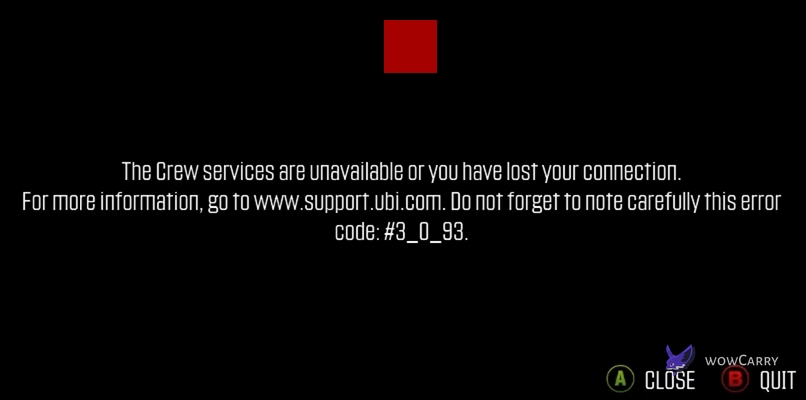
Ubisoft delisted The Crew in December 2023 and pulled the servers offline on 31 March 2024. Both digital and physical copies became unplayable on that day — even single-player content required the now-dead servers to authenticate. Players who had paid full price for the game lost access without compensation, and refund offers were limited to recent buyers only.
That shutdown is what UFC-Que Choisir is now putting on trial. Filed on 31 March 2026, exactly two years after the lights went out, the French complaint accuses Ubisoft of deceptive commercial practices and abusive contract clauses. The plaintiff has been clear about the ask: this case is about precedent, not bringing The Crew back. Even a sweeping win would not force Ubisoft to restore the servers.
With that scene set, the article continues.
Who UFC-Que Choisir Is, and Why That Matters
UFC-Que Choisir is France's largest consumer-rights association; the full name is Union fédérale des consommateurs (Que Choisir). They have a long track record of dragging publishers and platform holders into French courts over consumer-protection failures:
- Nintendo Joy-Con drift: after roughly three and a half years of legal pressure, Nintendo conceded unlimited free repair of affected Joy-Cons in France.
- Activision unjustified bans: filed complaint cited that "Activision is not able to justify its bans," targeting opaque enforcement in Call of Duty.
- Seven-publisher virtual-currency complaint: a 2024 European-level co-filing with CLCV against Activision Blizzard, EA, Epic Games, Mojang, Roblox Corp, Supercell, and Ubisoft over the way premium currencies obscure real prices.
So this is not a one-off. UFC-Que Choisir builds slow, methodical cases and wins them on patience. The Ubisoft suit is the same playbook applied to the biggest consumer-rights question in modern gaming: when you "buy" a game, what did you actually buy?
How Stop Killing Games Got the EU Petition Through
Stop Killing Games was launched in April 2024 by Ross Scott (Accursed Farms) in direct response to The Crew shutdown. The campaign's centrepiece has been a European Citizens' Initiative, "Stop Destroying Videogames," which needed one million verified signatures across at least seven EU member states to force the European Commission to respond on the record.
The campaign hit that threshold and then some. After a viral June 2025 video pushed signatures from roughly 500,000 to over one million in about ten days, the initiative finished verification at 1,294,188 confirmed signatures. It was formally submitted in February 2026, and the European Parliament's public hearing followed on 16 April 2026 in Brussels — a joint session of the IMCO (internal market), JURI (legal affairs), and PETI (petitions) committees.
Ross Scott himself stepped back from day-to-day leadership of the campaign on 4 August 2025, citing burnout; the watchdog NGOs launched in 2025 (one in the EU, one in the US) carry the operational load now. At the April hearing, committee Vice President Nils Ušakovs called the issue a concern for "probably hundreds of millions of European citizens," and Commission director Giuseppe Abbamonte pledged a copyright-regulation review by July.

With that scene set, the article continues.
Why the Legal Precedents Still Favour Publishers
The hard part of this fight is that the existing case law mostly sides with publishers. UFC-Que Choisir already lost the cleaner version of this argument once.
On 23 October 2024, the French Cour de cassation (the highest civil court) ruled against UFC-Que Choisir in UFC-Que Choisir v. Valve. The court held that copyright exhaustion — the doctrine that lets you resell a physical book or game — does not apply to dematerialised video games. Steam can therefore lawfully prohibit account or game resale. After that loss in February 2025, UFC-Que Choisir escalated the digital-resale question to the European Commission, which is part of why the broader EU pressure now exists.
In the US, the precedent for publisher account-revocation rights is older and even more settled. The Ninth Circuit Court of Appeals affirmed dismissal of Leong v. Square Enix on 20 December 2011, upholding Square Enix's click-through Final Fantasy XI EULA and confirming that Square Enix (not the player) owns the character data on the account. That case is still cited every time a publisher needs to defend an account closure.
Ubisoft's defence is expected to lean on exactly this body of law: physical and digital copies of a live-service game both depend on online servers, and the EULA always disclosed that those servers might shut down.
What Players Should Watch Next
The two dates that matter are already on the calendar:
- 27 July 2026 — European Commission response deadline. The Commission has to answer the Citizens' Initiative on the record by this date. The answer could range from "no action" to a new directive proposal protecting end-of-life game access.
- French civil court proceedings, ongoing. The UFC-Que Choisir v. Ubisoft case will move through the French system on its own clock; expect first procedural rulings before the end of 2026, with substantive judgment likely deep into 2027.
The other ecosystem players to track are DoesItPlay, which catalogues offline-playability of physical releases (around 3,000 titles tested so far), and Alderon Games, the Australian studio behind Path of Titans that publicly partnered with Stop Killing Games via an Eternal Skin Pack fundraiser. Both are evidence that the campaign now has institutional reach beyond a single YouTube channel.
Why This Matters for Live-Service Games You Play Now
Most of the games this audience plays are live-service: World of Warcraft, Final Fantasy XIV, Marvel Rivals, League of Legends, Path of Exile. All of them depend on publisher servers. The legal question UFC-Que Choisir is forcing — are you buying a product or licensing an experience? — applies directly to every one of those titles the day the publisher decides the lights are off.
If the Commission proposes an end-of-life-access directive in response to the petition, the practical effect would not be that publishers hand over server source code. The more likely outcome is a requirement that publishers either keep a minimum viable offline / private-server mode available, or disclose end-of-life policies up front at purchase. Either change would mark the first real European consumer-protection win for live-service buyers since digital storefronts existed.
Frequently Asked Questions
Will UFC-Que Choisir's lawsuit bring The Crew back?
No. UFC-Que Choisir has explicitly stated the goal is legal precedent on game ownership, not restoration of the servers. Even a full plaintiff win would not force Ubisoft to bring The Crew online. The damage to those specific players is treated as settled; the case is about preventing the next one.
What is Stop Killing Games actually asking for?
The Citizens' Initiative asks the European Commission to require publishers to leave games in a "reasonably functional state" when official support ends. The typical mechanisms named are an offline patch, a private-server release, or a documented end-of-life plan disclosed at the point of sale. It does not demand that publishers keep servers online forever or hand over proprietary source code.
How many signatures did the EU petition get?
The "Stop Destroying Videogames" initiative finished verification at 1,294,188 confirmed signatures across enough EU member states to qualify, comfortably above the one-million threshold. A viral June 2025 video by PirateSoftware pushed the campaign over the line in about ten days.
Did the French courts already settle this question?
Partly. On 23 October 2024, the Cour de cassation ruled in UFC-Que Choisir v. Valve that copyright exhaustion does not apply to dematerialised games, so Steam can legally prohibit resale. That ruling closed the resale-rights angle in France, which is why the new Ubisoft suit attacks from the deceptive-practices angle instead, and why the broader pressure has moved up to Brussels.
Is there a comparable US precedent?
Yes — Leong v. Square Enix, dismissed with prejudice by the Ninth Circuit on 20 December 2011. The court upheld Square Enix's click-through Final Fantasy XI EULA and confirmed publisher ownership of character data. US case law is consistently friendlier to publishers on account-access questions than EU directives have been.
When will the European Commission respond?
By 27 July 2026. The Commission is legally required to answer the Citizens' Initiative on the record by that date. Director Giuseppe Abbamonte has already publicly committed to a copyright-regulation review by July, so a substantive answer rather than a procedural deferral is the likely path.
Is Ross Scott still leading the campaign?
Not operationally. Scott announced a standby break from leading Stop Killing Games on 4 August 2025, citing burnout after roughly fifteen months of full-time campaign work. The watchdog NGOs launched in the EU and US in 2025 now run the day-to-day operations; Scott remains a public face and spoke at the EU Parliament hearing on 16 April 2026.
Should I keep buying live-service games?
The campaign's own framing is not "boycott live-service" — it's "demand disclosure at purchase." The practical reader takeaway is to check end-of-life policies before buying, prefer publishers with offline modes or private-server allowances on their other titles, and treat any always-online single-player purchase as time-limited unless the publisher commits otherwise in writing.