Ubisoft's Ongoing Turmoil
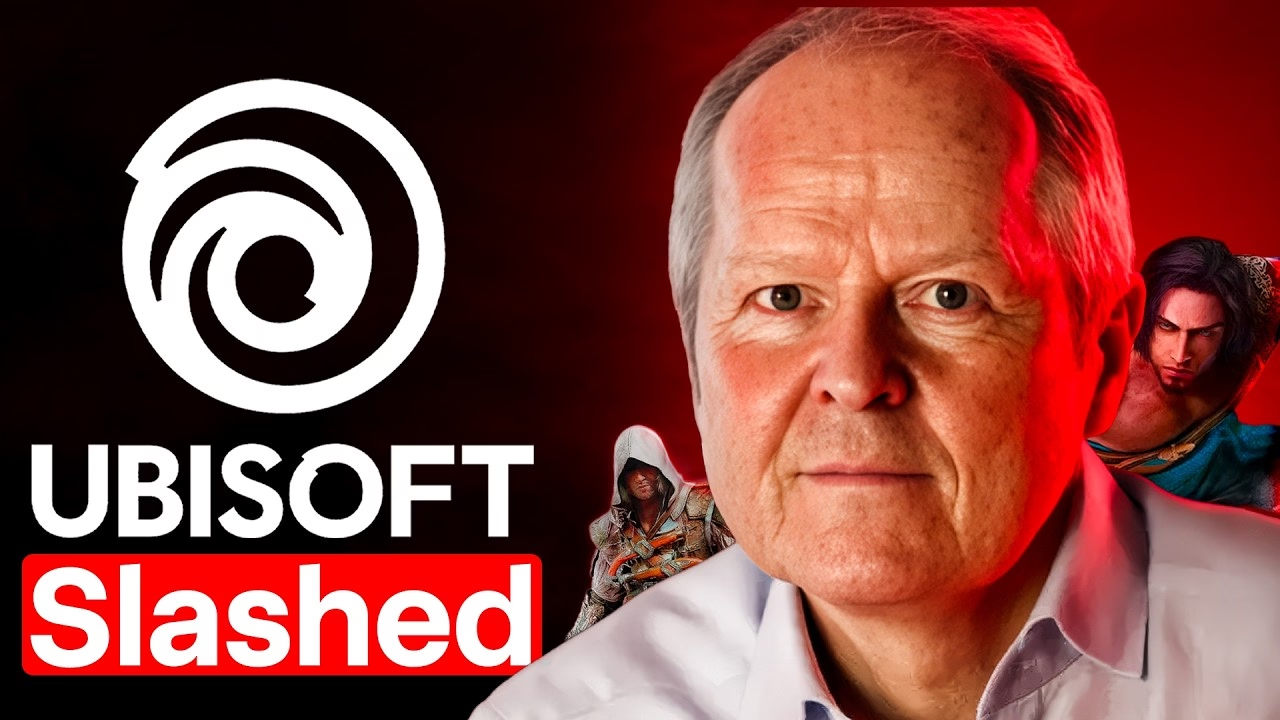
Ubisoft has recently undertaken significant restructuring, claiming it's moving towards a more "gamer-centric" organization. However, this claim seems dubious given the drastic changes underway. This year alone, Ubisoft confirmed an IFRS operating loss of €1.3 billion for FY2025-26—the worst annual result in the company’s history. Several key projects, like the much-anticipated Prince of Persia remake, have been scrapped, despite years of development that never reached the quality bar Ubisoft set for itself. That cancellation is one of six confirmed title cancellations (Prince of Persia: The Sands of Time remake, four unannounced games, and one mobile title), as multiple Ubisoft studios are shutting down and extensive layoffs are occurring at all levels.
Key Takeaways
- Ubisoft confirmed a €1.3 billion operating loss for FY2025-26, the company’s worst annual result, driven by six game cancellations and studio closures.
- Prince of Persia: The Sands of Time remake was among the six cancelled titles; Ubisoft Halifax and Ubisoft Stockholm were fully closed, with Abu Dhabi, RedLynx, and Massive Entertainment restructured.
- Five Creative Houses replace the old studio model; Vantage Studios (CH1) covers Assassin’s Creed, Far Cry, and Rainbow Six with €1.1 billion in Tencent co-investment.
- Assassin’s Creed Shadows was a commercial success (top-5 seller of 2025, 5M+ players) but could not offset the wider restructuring costs.
- Fixed costs must fall from €1.75 billion (FY2022-23 baseline) to €1.25 billion by March 2028; the FY26 run rate stands at €1.435 billion.
- Over 1,200 Ubisoft employees participated in an international strike after the January 21, 2026 announcement; leadership for several Creative Houses remains undefined.
Those pressures played out across multiple fronts simultaneously.
Financial Challenges and Strategic Shifts
Ubisoft's severe financial troubles stem from numerous project cancellations and delays. While Assassin's Creed Shadows performed well financially, the company has incurred substantial losses due to the high costs of cancellations and studio closures. To mitigate these losses, Ubisoft's restructuring efforts focus on developing "creative houses" aimed at fostering more dynamic game development. This new framework comes at a massive financial cost, pushing them towards a loss of over 1 billion euros this year alone.
A Legacy of Controversies
Several games and projects have been canceled alongside Prince of Persia, including four unannounced titles and one mobile title alongside Prince of Persia. The closures and layoffs not only affect studio employees—who learned of their job losses through abrupt announcements—but also contribute significantly to the company’s mounting fiscal woes. To save €100 million in fixed costs, Ubisoft is closing studios like Halifax and Stockholm, which experimented with cloud development, and imposing layoffs at Abu Dhabi, RedLynx, and Massive.
Shifting Towards a New Vision
Ubisoft’s restructuring organizes studios around five new Creative Houses, replacing the centralized model with a genre-focused approach:
- Creative House 1 — Vantage Studios: Assassin’s Creed, Far Cry, and Rainbow Six — Ubisoft’s flagship franchises; Tencent co-invested over €1.1 billion in this unit
- Creative House 2: Competitive and cooperative shooters — Ghost Recon, Splinter Cell, The Division
- Creative House 3: Live service titles — For Honor, Brawlhalla, Skull and Bones, Riders Republic
- Creative House 4: Immersive fantasy and narrative-driven titles — Anno, Might and Magic, Prince of Persia, Beyond Good and Evil
- Creative House 5: Casual and family games — Just Dance, Uno, Ketchapp titles, Hungry Shark
Each house operates with its own leadership and budget; who will lead units beyond Vantage Studios remains largely undefined.
Conclusion
Amid this substantial reorganization aimed at transforming Ubisoft into a “gamer-centric” entity, skepticism lingers. The organization’s focus on GaaS and open-world models raises questions about the extent to which their new trajectory caters to gamer interests. As the company prepares for its future, the real impact of these strategic decisions remains to be seen, particularly as they strive to reconcile this new structure with their financial realities.
As Ubisoft navigates its radical restructuring, a critical aspect surfaces: the struggle to maintain creativity amid financial constraints and an uncertain future for its employees. The company's plan pivots on prioritizing more "provable" intellectual properties (IPs) that promise a return on investment. This involves making tough decisions, like reallocating resources from a project plagued by delays to more promising ventures.
Financial Sacrifices and Structural Adjustments
- Immediate Financial Strain: The company has cut over 3,000 positions since its 2022 headcount peak through layoffs, attrition, and studio closures and plans to further reduce expenses by an additional €200 million by March 2028.
- Long-Term Financial Strategy: By decreasing operational costs from €1.75 billion in 2023 to €1.25 billion by 2028, Ubisoft aims to create a more sustainable financial structure.
- Rising Costs and Staff Concerns: This aggressive cost-cutting inevitably affects employees. Changes to employment terms, such as mandatory office attendance, are expected to prompt some to seek opportunities elsewhere, despite industry-wide hiring challenges.
Beyond the financial ledger, those cuts created serious internal turbulence.
Internal Challenges and Employee Dynamics
Ubisoft faces significant internal hurdles, particularly with its workforce. The restructuring process has left many staff members uncertain about their future roles within the company. This uncertainty is compounded by ongoing union-led protests and potential strikes, reflecting deep dissatisfaction with current leadership decisions. Moreover, low staff attrition could indicate industry-wide layoffs rather than improved job satisfaction at Ubisoft.
- Uncertain Future for Employees: Employees don't know which creative house they will belong to, resulting in low morale and engagement.
- Union Protest and Pushback: Unionized staff across Europe are quick to challenge decisions, potentially disrupting the restructuring process.
That internal instability extends to the people at the top of the organization.
Leadership and Talent Concerns
Leadership turnover poses a significant risk, with many long-standing and pivotal figures departing the company. This talent drain could undermine Ubisoft’s ability to deliver on its promised creative vision. The undefined leadership for new creative houses exacerbates this instability, casting doubt on who will take charge of future projects.
| Challenge | Description |
|---|---|
| Loss of Key Talent | Departure of influential leaders and developers |
| Undefined Leadership | Unclear direction for creative houses |
| Employee Uncertainty | Lack of clarity about individual project assignments |
Despite the prominent push for strategic overhaul, the results remain ambiguous. The central question is whether Ubisoft can weather this period of discomfort, retain its talent pool, and leverage its esteemed IPs to deliver games that fulfill player expectations. Only time will tell if the current trajectory will ultimately result in high-quality, compelling experiences for gamers worldwide.
Frequently Asked Questions
When did Ubisoft announce its 2026 restructuring?
Ubisoft announced the restructuring on January 21, 2026. The stock fell roughly 34% the following day, reflecting investor concern about the scale of cancellations, studio closures, and the projected billion-euro loss.
Which games did Ubisoft cancel in the restructuring?
Six titles were cancelled: Prince of Persia: The Sands of Time remake and five others including four unannounced games and one mobile title. Seven additional projects were delayed as part of the same portfolio reset.
Which Ubisoft studios closed in 2026?
Ubisoft Halifax (Nova Scotia, Canada) and Ubisoft Stockholm (Sweden) were fully closed. Ubisoft Abu Dhabi, RedLynx, and Massive Entertainment underwent restructurings but were not shuttered.
How much money did Ubisoft lose in FY2025-26?
Ubisoft posted a confirmed IFRS operating loss of €1.322 billion for FY2025-26. The non-IFRS operating loss was €1.045 billion. Both represent the largest annual losses in the company’s history.
Did Assassin’s Creed Shadows save Ubisoft financially?
Assassin’s Creed Shadows performed strongly on its own: it reached 5 million players, achieved above-80 Metacritic scores, and ranked in the top 5 selling games of 2025. But it could not offset the restructuring charges and game-cancellation costs that drove the full-year loss.
What is Ubisoft’s financial recovery plan?
Ubisoft targets cutting its fixed cost base from €1.75 billion (FY2022-23) to €1.25 billion by March 2028. The FY26 figure stands at €1.435 billion. Management projects a return to profitability in FY2027-28.
What is Creative House 1 (Vantage Studios)?
Vantage Studios is the newly formed unit covering Assassin’s Creed, Far Cry, and Rainbow Six — Ubisoft’s highest-revenue franchises. Tencent co-invested over €1.1 billion in Vantage Studios as part of the restructuring, valuing the unit at over €4 billion.