Tencent Under CFIUS Review: What's Actually Happening
The Trump administration is weighing whether to force Tencent to sell its stakes in major US gaming companies, with the Committee on Foreign Investment in the United States (CFIUS) revisiting a case that has been live since the first Trump term. Tom's Hardware reported in early March 2026 that the deliberations are timed to the Trump-Xi summit scheduled for March 31 through April 2, 2026. No decision has been announced. What is on the table is not an immediate ban but a divestiture review covering Riot Games, Epic Games, Supercell, and the broader Tencent portfolio of US gaming holdings.
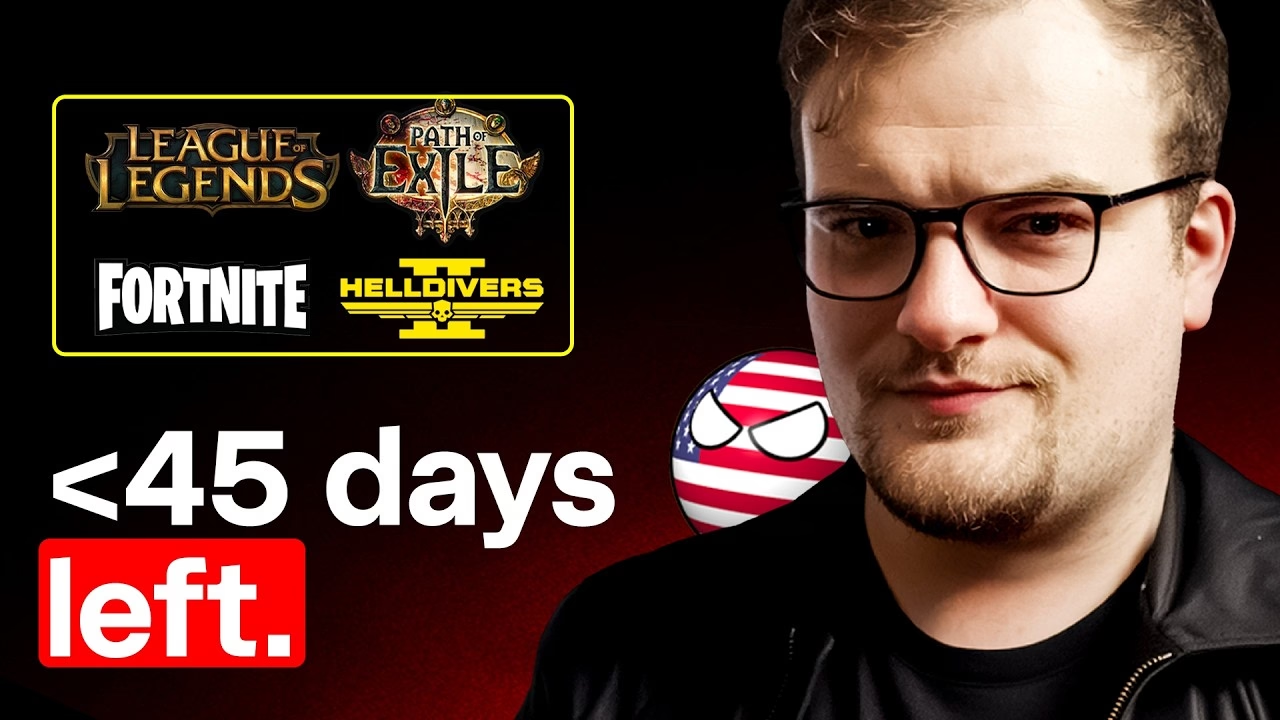
If you play League of Legends, Path of Exile 2, Fortnite, or Valorant, the headlines have probably already reached you. Most of the press coverage talks to investors. This post talks to you.
Key Takeaways
- This is a review, not a divestiture order. No US agency has compelled Tencent to sell anything as of mid-May 2026.
- Tencent's stakes vary widely. Riot Games is 100% owned; Epic Games is roughly 40% economic ownership with no board seats since December 2024; Supercell is controlled via a 51.2% stake in the Halti S.A. consortium; Grinding Gear Games (Path of Exile) is 100% owned.
- The Pentagon already moved. In January 2025 the Department of Defense added Tencent to its Section 1260H list of "Chinese military companies," triggering a share-price drop and a planned reconsideration challenge from Tencent.
- The trigger is the Trump-Xi summit window. CFIUS is reportedly preparing its options ahead of the March 31 – April 2, 2026 meeting.
- Game servers are unlikely to go dark. Riot, Epic, and GGG operate as independent US- or NZ-based subsidiaries; an ownership transfer would change the parent on the cap table, not the servers your client connects to.
- The actual concern is data, not gameplay. CFIUS reviews focus on US user data access and content-influence pathways, not on game balance or matchmaking.
With those headline calls in hand, here is the ownership picture the rest of the post unpacks.
What Tencent Owns in US Gaming, by the Numbers
Several of the percentages circulating in social posts and quick news rewrites are out of date. Here is the verified ownership picture as of May 2026.

Tencent's holdings break out across four ownership tiers: full subsidiaries, controlled consortia, minority equity, and recent strategic investments. Each company maps to a different state of the cap table.
| Company | Tencent stake | Status |
|---|---|---|
| Riot Games | 100% | Full ownership since December 2015. |
| Grinding Gear Games (Path of Exile) | 100% | Reached full ownership in March 2024, from an 80% stake in 2018. |
| Supercell (Clash of Clans, Brawl Stars) | Controlling, via 51.2% of Halti S.A. | Halti is the consortium that owns Supercell outright. Tencent is the majority owner of Halti. |
| Epic Games (Fortnite, Unreal) | ~40% economic, no board seats | Tencent paid $330M in 2012 for roughly 40% fully diluted. A December 2024 DOJ settlement required Tencent to remove two directors and surrender its unilateral director-appointment right while keeping the equity. |
| Vantage Studios (Ubisoft subsidiary) | 26.32% | €1.16B investment closed November 21, 2025. Vantage holds Assassin's Creed, Far Cry, and Rainbow Six. Ubisoft itself is roughly 5% Tencent. |
| Discord | Minority position, reportedly reduced | Tencent participated in Discord's 2018 Series D and later rounds; recent reporting suggests the position has been trimmed by 2025. |
The Ubisoft / Vantage deal is the part most worth flagging: it closed while the CFIUS scrutiny was already public, which is one of the reasons the White House review is now being framed as urgent.
Why CFIUS Is Looking Now
CFIUS started reviewing Tencent's gaming holdings during the first Trump term and continued the case through the Biden administration. Two events accelerated it in the last 18 months. The first was the Pentagon's January 2025 Section 1260H designation, which formally listed Tencent as a "Chinese military company" and pushed institutional investors to reconsider exposure. PC Gamer's coverage of the CFIUS debate notes that the deliberation now spans the Treasury Department and the Department of Justice, with the two agencies reportedly disagreeing on how aggressive any forced-divestiture remedy should be.
The second accelerant is the summit. Major foreign-investment decisions involving China are routinely staged around bilateral meetings, and the Trump-Xi window gives the administration a deadline for landing on a public position. As of mid-May 2026 no public decision has been reported.
The concern itself, when stripped of the headline language, is narrow. CFIUS focuses on two questions for any China-linked investment: can the foreign owner gain access to sensitive US user data, and can the foreign owner influence content delivered to US users. For a publisher like Riot or Epic, that means account data, payment information, voice and chat logs, and editorial control over what content reaches US players. It does not mean game balance or matchmaking.
Three Scenarios on the Table
Three rough outcomes are on the table. The first is a negotiated remedy: Tencent retains the equity, but agrees to firewalls on data access, additional US-domiciled board oversight, and stricter compliance reporting. This is the precedent set by the December 2024 Epic settlement and is the lowest-friction outcome.
The second is partial divestiture: Tencent is required to sell down to a non-controlling threshold in specific holdings while keeping a financial position. A natural cut line is the line between "minority investor" and "controlling owner," which would primarily affect Riot and the Supercell consortium.
The third is full divestiture, the TikTok-style remedy that requires Tencent to find a US-domiciled buyer for the affected stakes. This is the outcome that produces the dramatic press coverage, but it is also the slowest and most legally contested path. The 2024 PAFACA law that targeted TikTok took roughly nine months from enforcement deadline to legal stay; a similar timeline for Tencent's gaming holdings would put any forced sale well into 2027.
What This Means for Your Game Time
This is the part that gets buried under the policy narrative. For day-to-day players, the practical impact of any of the three outcomes above is small in the short term.
Riot operates Los Angeles studios and its own infrastructure stack. Grinding Gear Games runs from Auckland on AWS. Epic's Fortnite servers run on its own backend. A change in parent ownership does not change which data center your client connects to or how the game patches deploy. The companies whose carry and boosting services we run for League of Legends and Path of Exile 2 would continue to operate under any of the three scenarios above.
The thing worth paying attention to is account-data policy. If a Riot or Epic sale forces a renegotiation of US data-handling rules, the user-facing change you would actually feel is updated privacy terms, possibly a region-locked data export workflow, and clearer parental-control language for accounts owned by US minors. That is the change worth reading the email for.
Beyond that, the headlines are mostly investor-facing noise. League of Legends will hold its 2026 World Championship. Path of Exile 2's next league will ship on schedule. Fortnite's chapter cadence continues. The companies are independent operators, and the CFIUS review is about who sits on the cap table, not whether the lights stay on.
Frequently Asked Questions
Is the US government banning Tencent from owning US gaming companies?
No. The current CFIUS process is a review of Tencent's existing stakes. As of May 2026 there has been no public order requiring divestiture; the deliberation is reportedly timed to the Trump-Xi summit on March 31 – April 2, 2026.
Does Tencent own Riot Games?
Yes. Tencent acquired the majority stake in 2011 and reached full 100% ownership in December 2015. Riot continues to operate as an independent subsidiary headquartered in Los Angeles.
How much of Epic Games does Tencent own?
Roughly 40% economic ownership on a fully diluted basis, from the original $330M acquisition in 2012. Tencent removed its two directors from Epic's board and surrendered its unilateral director-appointment right under a December 2024 DOJ settlement, while keeping the equity.
Will League of Legends servers shut down if Tencent has to sell?
No. Riot runs its own server infrastructure and would continue operating under any new owner. A forced sale would change the cap-table parent, not the operational entity that runs the game.
What about Path of Exile 2 — does Tencent own that too?
Yes. Tencent reached 100% ownership of Grinding Gear Games in March 2024. GGG runs from Auckland and would not see operational disruption from a US-side ownership change, since the studio is New Zealand-domiciled.
What is the Section 1260H list?
It is the Department of Defense's annual list of "Chinese military companies" operating in the United States. Tencent was added in January 2025. The designation does not itself trigger divestiture, but it raised institutional concern and prompted Tencent to announce a reconsideration challenge using the same legal pathway Xiaomi successfully used in 2021.
How long would a forced divestiture take?
Based on the 2024 TikTok / PAFACA timeline, roughly nine months from signing to enforcement deadline, with legal challenges able to extend the effective timeline to two years or more. The reviews announced in early 2026 are unlikely to produce ownership changes before 2027 even in the most aggressive scenario.
Will my account data be affected?
Possibly, in the form of updated privacy terms and clearer data-handling disclosures. The CFIUS concern is specifically about US user data access pathways, so any negotiated remedy is likely to include tighter data-residency requirements and revised consent language.