What Highguard Was, and How Fast It Fell
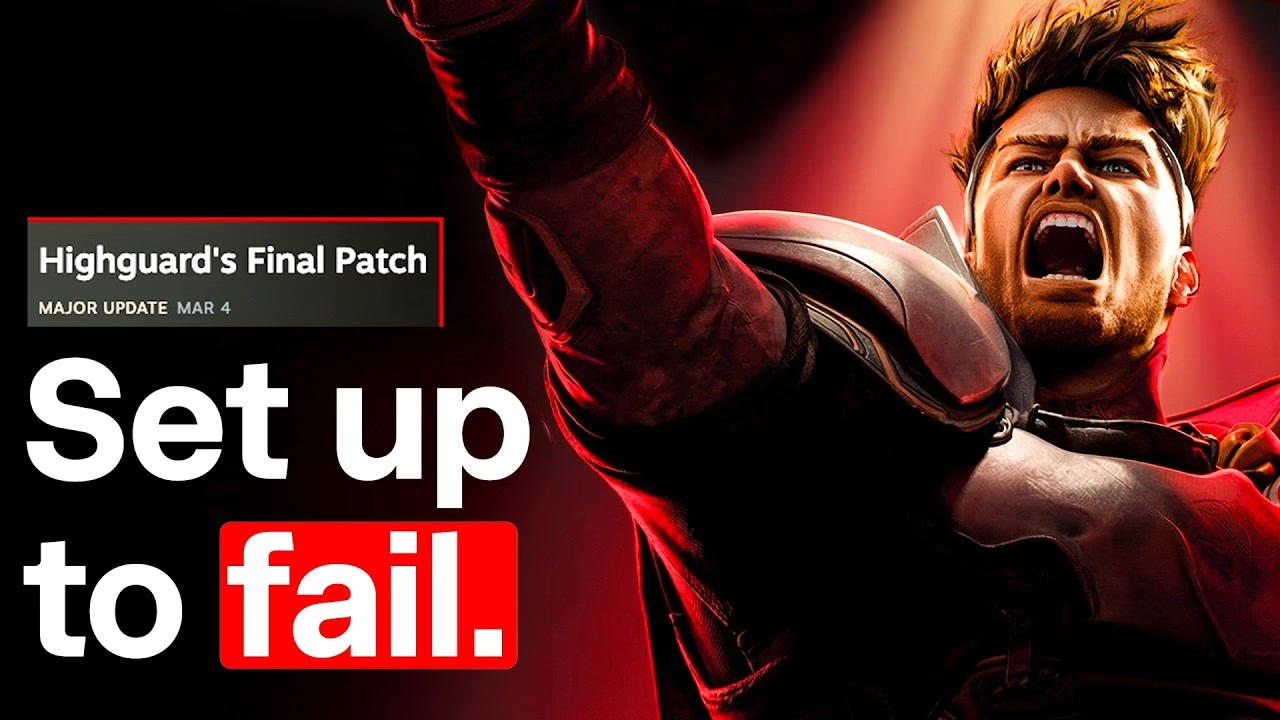
Highguard was a competitive hero shooter from Wildlight Entertainment, revealed at The Game Awards in December 2025 and launched on January 26, 2026 for PlayStation 5, Windows and Xbox Series X and S. Forty-five days later, on March 12, 2026, the servers went dark for good.
That timeline is the story. Highguard did not limp along for a year searching for an audience. It launched, collapsed, and was switched off inside seven weeks. The reasons are worth unpacking, because they say more about how live-service games are funded than about anything Wildlight got wrong in the game itself.

The key art promised a polished competitive shooter, and by most accounts the game underneath was competent. Competence was not the problem.
Key Takeaways
- Highguard launched on January 26, 2026 and shut down on March 12, 2026, a lifespan of 45 days.
- The game peaked near 97,000 concurrent players in its first hour and lost roughly 90 percent of that base within the first week.
- Wildlight Entertainment later said Highguard reached more than two million players, a cumulative-reach figure rather than a concurrent count.
- Reporting tied Highguard's funding to Tencent's TiMi Studio Group, though neither company has confirmed it; the funding reportedly ended shortly after launch.
- Highguard spent roughly four years in development, with the competitive-shooter version salvaged from an earlier survival project after a 2024 refocus.
- Developer-first publishers such as Outersloth, Pocketpair Publishing and Hooded Horse offer a counter-model to the launch-or-die economics that ended Highguard.
What follows traces the shutdown, the money behind it, and the alternative model some studios are now choosing.
A 45-Day Lifespan
Highguard's launch was not quiet. The game drew close to 97,000 concurrent players in its first hour, a peak that would be a respectable result for many shooters. The drop that followed is what defined it. By the next day the concurrent count had fallen below 20,000, and within the first week roughly 90 percent of the launch audience was gone.
The decline did not level off. Player numbers fell to around 1,600 by the middle of February and below 600 by the end of the month. Steam reviews turned sharply negative, with thousands of negative entries piling up as players reacted to the game's direction and, later, to the shutdown news itself.
Wildlight's own framing leaned on a larger figure: a March 2026 statement said Highguard had reached more than two million players. That number is cumulative reach, not concurrent population, and the gap between two million people trying a game and a few hundred still playing it a month later is the entire problem in a single sentence.
📌 Common mistake: Reading "two million players" as a sign of success. For a live-service game, total reach is almost meaningless. What pays the bills is the population that stays, spends and logs in next week, and on that measure Highguard had effectively no game left by mid-February.
A shooter can survive a rocky launch. It cannot survive losing nine in ten players before the first content update.
The Publishing Economics Behind the Shutdown
The detail that turns Highguard from a flop into a case study is the funding. Reporting linked the game's backing to TiMi Studio Group, a Tencent subsidiary, and described that funding ending in the weeks after launch, with staff reportedly informed in February 2026. Neither TiMi nor Wildlight has publicly confirmed the arrangement, so it should be read as reported rather than established fact.
Confirmed or not, the shape of the situation is familiar. A live-service shooter is expensive to keep running, and its costs are front-loaded: servers, live operations, content pipelines and user-acquisition spend all begin before the revenue does. Backers underwrite that gap on the expectation that the game reaches a stable, paying population within a defined window, often one to three years.
When the population collapses in week one, that window closes immediately. There is no path to the retention numbers the funding assumed, so the rational financial decision is to stop spending. That is how a game with a competent build and a two-million-player reach figure ends up switched off after 45 days. The decision is made on a spreadsheet, not in a design review.
⚠️ Watch out: The "live-service is broken" headline misses the mechanism. The model is not broken so much as it is unforgiving. It works when a game retains players and ends abruptly when it does not, because the funding was always conditional on retention the game never reached.
Highguard is not the first game to hit this wall. Concord, Sony's 2024 hero shooter, was pulled within two weeks of launch under the same logic. The pattern is consistent enough that it now shapes how some studios choose to be funded at all.
What Actually Went Wrong in Development
The development history adds nuance to the idea that Highguard was rushed. Wildlight announced an ambitious project in early 2023 and spent roughly two years building it as a survival shooter in the mould of Rust. After a refocus in January 2024, the team salvaged that work into the competitive hero shooter that became Highguard.
So the often-repeated "two-year development" line is misleading. Total development ran closer to four years. The two-year figure describes only the survival-game phase that preceded the pivot. A mid-project genre change is a real risk factor, because it means the final game inherits systems and assets designed for something else, but it is not the same as a studio cutting corners on a short timeline.
Players' criticisms after launch focused on game feel rather than polish: 3v3 maps that felt too large for the player count, and a hero roster that did not stand out in a crowded genre. Those are design problems a studio can usually fix with time and updates. Highguard never got the time, because the funding ended before the first major content drop could land.
A Different Model: Developer-First Publishers
The counter-trend to launch-or-die funding is a small group of publishers and funding labels built around giving developers room to recover. Three stand out.
- Outersloth: the indie funding label from Innersloth, the studio behind Among Us, announced in 2024. It funds smaller developers on a recoup-and-revenue-share basis without publishing the games or owning the intellectual property, leaving studios in control of their own work.
- Pocketpair Publishing: the publishing arm of Palworld developer Pocketpair, launched in January 2025. Its positioning is deliberately hands-off, aimed at long-term partnership rather than rapid recoupment.
- Hooded Horse: an established strategy-game publisher whose standard terms give developers a 65 percent revenue share, flat from the first dollar, with no recoup clause before the split begins.
None of these models would have guaranteed Highguard's survival. A live-service shooter has running costs that a recoup-friendly indie deal does not erase. But they show that the launch-or-die structure is a choice, not a law of the industry, and that studios building smaller games increasingly have somewhere else to go.
What Shutdowns Cost the People Who Played
One group is usually missing from the post-mortems: the players who bought in. When Highguard's servers closed, everyone who paid for the game or spent on it lost access entirely. A shooter with no offline mode is worth nothing the day the servers stop.
That cost compounds the trust problem. Every fast shutdown teaches players to wait before buying a live-service launch, which makes the next game's first week even harder, which makes funders even quicker to pull out. Highguard did not create that cycle, but its 45-day lifespan is a clean example of how it tightens.
✏️ Takeaway for players: For any always-online launch, the safe move is to wait out the first week or two. If a game cannot hold its players, that shows almost immediately, and waiting costs nothing but a little patience.
The healthiest outcome of a story like Highguard's is that it makes both players and funders a little more careful about what a "successful launch" actually means.
Frequently Asked Questions
When did Highguard launch and shut down?
Highguard launched on January 26, 2026 and shut down on March 12, 2026, a lifespan of 45 days. It was developed by Wildlight Entertainment for PlayStation 5, Windows and Xbox Series X and S.
How many players did Highguard have?
Highguard peaked near 97,000 concurrent players in its first hour and fell below 20,000 the next day. Wildlight later said the game reached more than two million players in total, which is cumulative reach rather than a concurrent figure.
Did Tencent fund Highguard?
Reporting linked Highguard's funding to TiMi Studio Group, a Tencent subsidiary, and described that funding ending shortly after launch. Neither TiMi nor Wildlight has publicly confirmed the arrangement, so it is reported rather than established fact.
Why was Highguard shut down so quickly?
Live-service games have front-loaded costs that backers underwrite on the expectation of stable retention within one to three years. Highguard lost roughly 90 percent of its players in week one, which closed that window and made continued funding financially untenable.
How long was Highguard in development?
Roughly four years. Wildlight spent about two years building a survival shooter before a January 2024 refocus, after which the work was salvaged into the competitive hero shooter that launched as Highguard.
What did players criticise about Highguard?
Common criticisms focused on game feel: 3v3 maps that felt too large for the player count and a hero roster that did not stand out in a crowded genre. The game was generally considered competent rather than broken.
Are there publishers that handle funding differently?
Yes. Outersloth, Innersloth's indie funding label, Pocketpair Publishing and Hooded Horse all use developer-first terms aimed at long-term partnership rather than rapid recoupment, offering an alternative to launch-or-die funding.
The Lesson Worth Keeping
Highguard's failure was not really a failure of craft. The game was competent, the studio spent four years on it, and two million people gave it a try. It failed because live-service funding is conditional on retention, and a game that loses 90 percent of its players in a week has no way to meet that condition. The developer-first publishers gaining ground show the model can be structured differently, and the players burned by every fast shutdown are slowly forcing the industry to take that seriously.
Maintained by WowCarry's gaming-news team. Last reviewed 2026-05-20. Reporting drawn from coverage at PC Gamer.