Key Takeaways
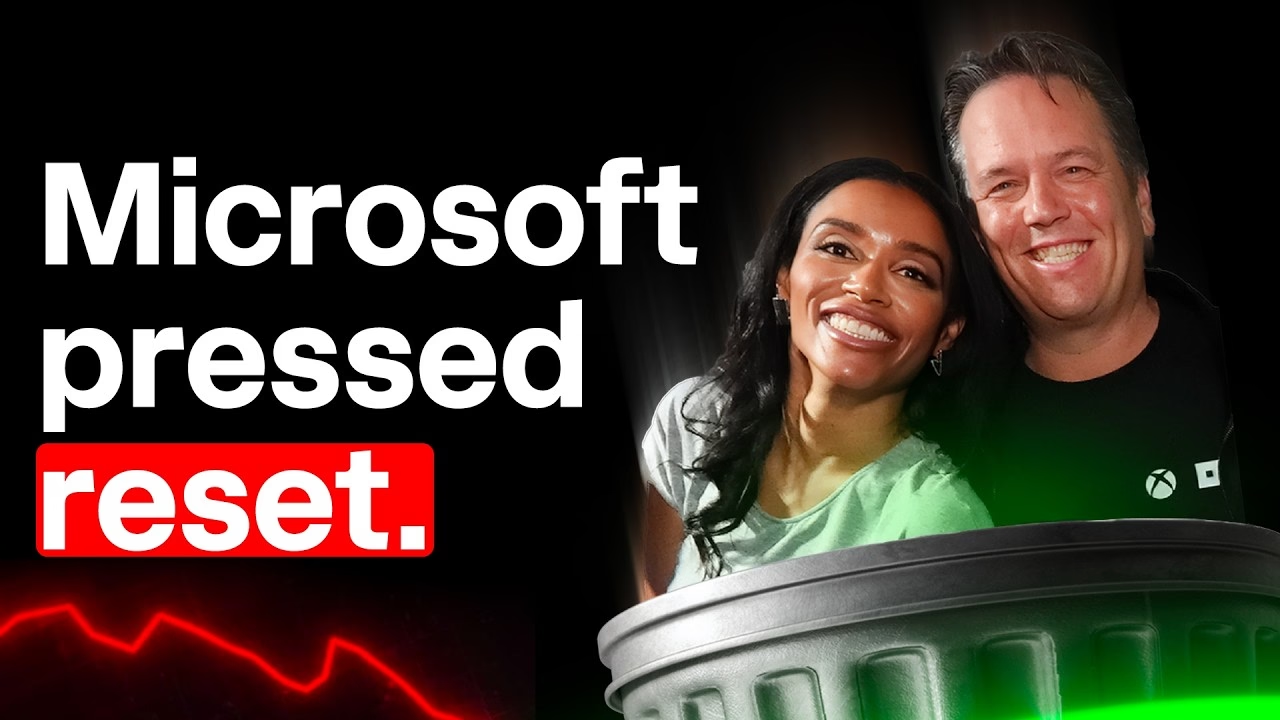
- Phil Spencer retired as CEO of Microsoft Gaming after 38 years at Microsoft, with the move announced quietly on Friday, February 20, 2026.
- Asha Sharma, previously President of Microsoft's CoreAI division, is the new Executive Vice President and CEO of Microsoft Gaming.
- Sarah Bond, long treated as Spencer's likely successor, is also leaving Microsoft.
- Matt Booty moved up to Executive Vice President and Chief Content Officer — he did not take the president-of-Xbox seat.
- Xbox console sales fell sharply in 2026, and Microsoft publicly denied a Bloomberg report that it had set Xbox a 30% profit-margin target.
- The new leadership has committed to no studio layoffs, with Forza Horizon 6, the Fable reboot, Halo: Campaign Evolved, and Gears of War: E-Day still on the slate.
- A second wave of leadership hires through May 2026 brought in a CoreAI-weighted roster, sharpening questions about Xbox's long-term direction.
With the headline facts established, here is how the shakeup actually unfolded and why the timing matters.
Phil Spencer's Retirement and the Friday Announcement
Phil Spencer's exit closes a 38-year run at Microsoft. The news landed on a Friday afternoon, February 20, 2026, with Spencer officially retiring the following Monday. Coming as Xbox approaches its 25th anniversary, it could read as a natural milestone exit. But a Friday-afternoon release is the slot companies reserve for news they would rather not see picked apart across a full weekday cycle, and the scale of the reshuffle that followed gave that read some weight. By most accounts it is the biggest leadership shift Xbox has seen in two decades.
Who Is Asha Sharma?
Asha Sharma stepped in as Executive Vice President and CEO of Microsoft Gaming, a transition Microsoft confirmed in its official announcement. Before the move she ran Microsoft's CoreAI division as its president. Her career is heavy on consumer product: marketing roles at Microsoft, Chief Operating Officer at the home-services platform Porch, a product-engineering vice president role at Meta covering Messenger and Instagram, and COO at Instacart through its preparation for a public listing.
That is a strong product-leadership track record. It is also almost entirely outside games, and that gap is the single biggest question hanging over the appointment. Running a storefront or a messaging app is not the same as steering a console platform, a first-party studio portfolio, and a live-service subscription at once.
The Departures and the Succession Question
Sarah Bond, who led Xbox as president, is leaving Microsoft as well. She was widely treated as Spencer's heir apparent, which makes her exit the more telling half of the story. Press reporting attributes the departure to disagreements over strategic direction rather than the anniversary timeline, though Microsoft has not stated a reason publicly. When the obvious continuity candidate leaves at the same moment as the outgoing leader, the handover stops looking routine.
Matt Booty's Elevated Role
Matt Booty, who previously headed Xbox Game Studios, moved up to Executive Vice President and Chief Content Officer. The detail that matters is what he did not get: the president-of-Xbox seat. That role went to an outside-of-gaming hire from one of Microsoft's fastest-growing divisions rather than to a studio veteran. Choosing a corporate-priorities candidate over an internal continuity pick is itself a signal about how Microsoft now wants the division run.
The Financial Pressure Behind the Shakeup
Xbox hardware had a rough 2026, with console sales dropping sharply year over year. Microsoft has leaned on Game Pass and a multiplatform strategy — releasing first-party titles on PlayStation and PC — to grow its audience beyond the box itself. Call of Duty also underperformed against expectations, a softness analysts have tied to legacy decisions made under Activision before the acquisition closed.
Bloomberg reported that Microsoft had handed Xbox a 30% profit-margin target; Microsoft told CNBC that figure is inaccurate. Whatever the exact number, the pressure for the division to carry its own weight financially is real, and by multiple reports it has already surfaced as cancelled projects and internal restructuring.
What the New Leadership Has Promised
Sharma's early messaging to staff leaned reassuring. The stated commitments: no short-term-only thinking, no flooding the platform with low-substance AI-generated content, and no studio layoffs. Microsoft has said there are no organizational changes underway for its studios. The marquee 2026 slate — Forza Horizon 6, the Fable reboot, Halo: Campaign Evolved, and Gears of War: E-Day — remains on track, and the company has tied that lineup to the 25th-anniversary calendar.
The May 2026 Second Wave
The reshuffle did not end in February. Through May 2026, reporting indicated Sharma continued reshaping the leadership bench, bringing in a roster weighted toward CoreAI alongside senior strategy and technology hires. An org chart stacked with AI and platform leadership, rather than console-and-studio veterans, points toward where the next Xbox generation may be heading: less a traditional console in isolation, more a gaming service designed to run anywhere. That is the part the official messaging has not spelled out, and it is the real story behind the headline.
What It Means for Xbox
This is, at its core, a leadership change driven by corporate strategy and financial pressure, not a tidy anniversary handover. A product executive with deep consumer and AI experience now runs a division that has historically been led by people who came up through games. The next console generation will be the real test. If Xbox returns to bold, platform-first decision-making, the outside perspective could pay off. If the AI-heavy org chart instead pulls the division further into Microsoft's broader corporate strategy, the friction that pushed out Spencer and Bond will not have gone anywhere.
Frequently Asked Questions
Who is the new head of Xbox?
Asha Sharma is the new Executive Vice President and CEO of Microsoft Gaming. She previously served as President of Microsoft's CoreAI division and has a background in consumer product leadership at Meta, Instacart, and Porch. She replaced Phil Spencer, who retired in February 2026.
When did Phil Spencer retire?
Phil Spencer's retirement was announced on Friday, February 20, 2026, and he officially stepped down the following Monday. It ended a 38-year career at Microsoft and arrived as Xbox approaches its 25th anniversary.
Did Sarah Bond leave Microsoft?
Yes. Sarah Bond, who served as president of Xbox and was widely seen as Phil Spencer's likely successor, is also departing Microsoft. Press reports attribute her exit to disagreements over strategic direction, though Microsoft has not confirmed a reason publicly.
Is Xbox shutting down its studios?
No. Microsoft has stated there are no organizational changes underway for its studios, and the new leadership has committed to avoiding studio layoffs. Major franchises including Forza, Fable, Halo, and Gears of War remain in active development.
Did Microsoft set a 30% profit-margin target for Xbox?
Bloomberg reported that Microsoft set Xbox a 30% profit-margin goal, but Microsoft told CNBC that the figure is inaccurate. The broader pressure for the gaming division to be financially self-sustaining is real and has contributed to project cancellations and restructuring.
Why did Xbox change its leadership?
The change followed Phil Spencer's retirement after 38 years, combined with weak console sales in 2026 and pressure from Microsoft for the gaming division to improve profitability. The appointment of a CoreAI executive points to a strategy increasingly shaped by corporate and AI priorities.
What Xbox games are still planned for 2026?
Xbox's confirmed 2026 slate includes Forza Horizon 6, the Fable reboot, Halo: Campaign Evolved, and Gears of War: E-Day. Microsoft has tied that lineup to Xbox's 25th-anniversary calendar, and the new leadership says the releases are on track.
Maintained by WowCarry's gaming-news desk. Last reviewed 2026-05-21 against reporting from Microsoft, CNBC, and Variety on the February–May 2026 Microsoft Gaming leadership changes.