Understanding Ranking Challenges in Marvel Rivals
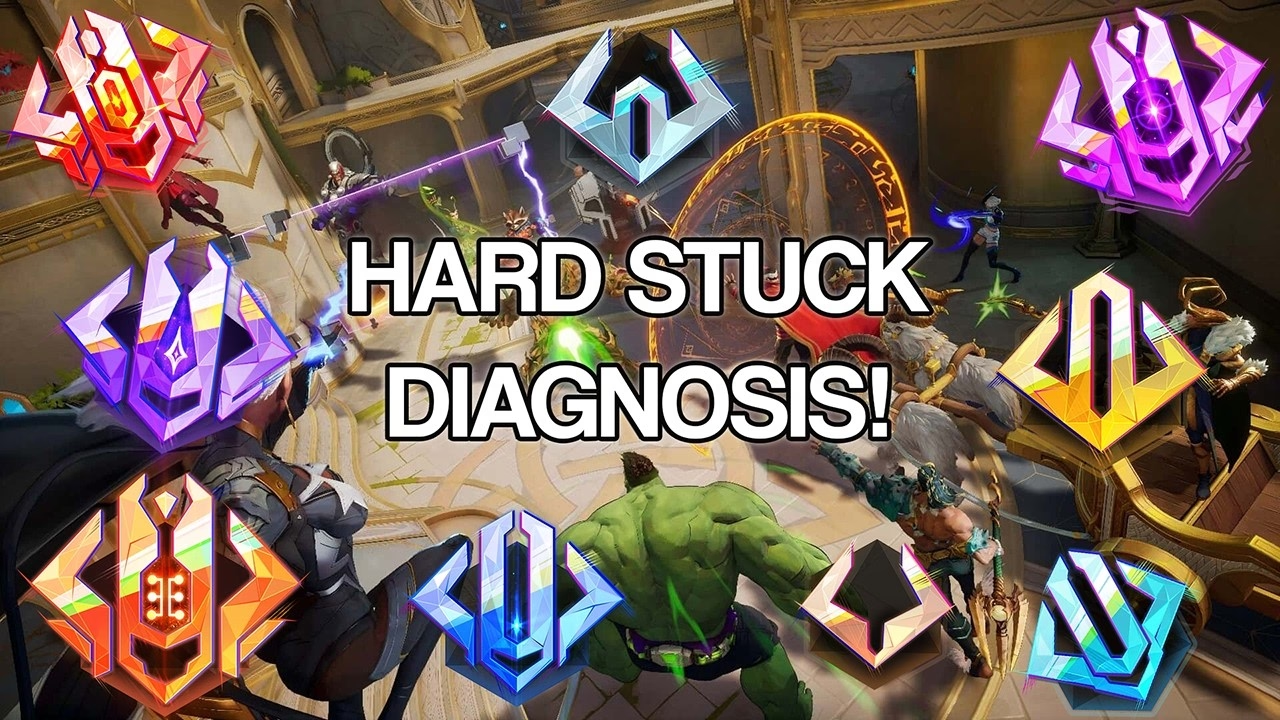
Marvel Rivals ranks are not just skill brackets — each tier comes with its own psychological fingerprint. Whether you're struggling to escape Gold or watching your Grandmaster MMR drift, the pattern that keeps you there is almost never purely mechanical.
Key Takeaways
- Psychological traps define each rank — Bronze lacks foundational mechanics, Silver overclaims skill, Gold resets its own mistakes, while Diamond and Grandmaster fall to ego and competitive stress.
- Top 500 is its own trap — the "esports delusion" confuses leaderboard position with professional readiness, causing behaviour that actively stalls further growth.
- Celestial combines raw skill with denial — players here have the mechanical ceiling to reach higher ranks, but fixation on external factors (luck, cheating, teammates) blocks honest self-review.
- Grandmaster ego is the defining barrier — blaming the matchmaker and gravitating toward low-rank stomp sessions are ceiling signals, not talent signals.
- Diamond peaks unpredictably — inconsistency and high-stakes match stress, not a lack of skill, are what keep Diamond players from reaching Grandmaster.
- Self-awareness breaks rank stagnation faster than grinding — identifying your tier's specific mental pattern is a more actionable fix than adding practice hours without changing approach.
Each rank's pattern is worth examining in detail to identify where your own progression is stalling.
Top 500 Players: The Esports Delusion
In the competitive world of Marvel Rivals, reaching the top 500 is both an achievement and a trap. Players in this bracket often fall prey to 'esports delusion syndrome', believing that they're merely an email away from being recruited by a professional team. Ironically, many major esports organizations have recently moved away from Marvel Rivals, highlighting the disconnect between reality and perception for many top 500 hopefuls. Such players combine stress and ego from lower ranks, resulting in a unique form of self-induced confinement — the "rank Stockholm syndrome". The persistent fear of losing leaderboard prominence drives this behavior, where some players spend more time gaming than addressing other important aspects of life.
Celestial Rank: Skills Meet Denial
Celestial players exhibit an intriguing combination of raw skill and denial, referred to as "skill issue denial hyper complex." These players are usually skilled enough to break into higher ranks, yet they fixate on the notion that their rank is a result of others cheating or getting lucky. This delusion masks their own shortcomings and hinders genuine progress. Their overemphasis on maximizing their strategies comes at the expense of recognizing occasional personal mistakes. In essence, while skill is present, the lack of humility and self-awareness traps them in this rank.
Grandmaster Rank: Ego and Blame
Climbing to the Grandmaster rank often results in ego inflation among players. The disorder labeled as "competitive induced ego expansion" manifests through unconstructive complaints about game balance and blaming teammates for losses. Their belief that the matchmaker consistently works against them makes introspection challenging, inhibiting further skill development. In addition, Grandmasters frequently exhibit "smurfing withdrawal syndrome", showing discomfort when not dominating lower-ranked games for easy wins.
Diamond Rank: Inconsistency and Stress
Diamond players are distinguished by their inconsistency and overstressed mindset. Often likened to experiencing game seven of the NBA finals with every match, these players can showcase high-level gameplay and then falter dramatically in the next game. Their inability to maintain consistent performance keeps them from advancing further. A common behavioral trait here is providing passive-aggressive feedback to teammates, which highlights their own internal frustrations.
Key traits among Diamond players include:
- Mechanical skill overshadowed by inconsistency.
- High stress during matches leading to frequent tilts.
- Passive-aggressive communication styles.
These traits reveal how competitive stress shapes Diamond-level decision-making far more than mechanical ability alone.
Platinum Rank: Paralysis by Overanalysis
Players in the Platinum rank often suffer from "strategic overthinking paralysis". They are capable of envisioning complex strategies but falter in execution, often due to overthinking and worrying about multiple variables simultaneously. This rank might possess the knowledge of higher plays, but their downfall lies in ineffective execution and self-doubt.
Gold, Silver, and Bronze: The Foundation Ranks
Gold players are marked by a condition known as "chronic almost good enough itis", where their potential doesn't consistently translate into performance. They're well-versed in strategy yet fail to deliver under pressure or when it counts most. Despite understanding the game's nuances and watching educational content, their peak performance is fleeting.
The struggles across these ranks reveal an interesting spectrum of challenges, from mental barriers to overconfidence, highlighting the complex landscape of competitive gaming.
In the chaotic world of competitive gaming, the struggle among different ranks is fueled by unique challenges. Gold players, for instance, are trapped in a repetitive cycle of mistake recognition, with little improvement in execution. Despite their promises to learn, they succumb to the infamous "gold brain reset," which erases past errors after each respawn. This results in a consistent pattern of repeating blunders with a somewhat optimistic outlook.
Silver players, on the other hand, exhibit traits of severe mechanical overconfidence. Despite often performing at a bronze level, they argue as if they are seasoned grandmasters. A silver player's downfall is often their tendency to engage recklessly in battles they cannot win. Their issues are amplified by a phenomenon known as "delayed accountability reaction," where they are practically immune to acknowledging their mistakes.
Bronze players suffer from "terminal tutorial skipping disorder." This affliction leads to a fundamental lack of understanding of their abilities and team dynamics. Their decision-making is impaired by extreme decision paralysis, forcing them constantly to choose non-strategic actions, such as chasing distant enemies rather than engaging in team objectives. They are notorious for their "chronic ability hoarding," holding onto ultimate abilities indefinitely, waiting for a perfect moment that never materializes.
Challenges Across Ranks
These insights shed light on different challenges faced by ranks in competitive gaming:
- Gold:
- Repeated mistakes due to memory resets
- Underperformance despite promising improvement
- Silver:
- Overconfidence leading to reckless plays
- Lack of acknowledgment of personal errors
- Bronze:
- Poor understanding of game mechanics
- Decision paralysis and ineffective ability use
This playful yet pointed critique of the various ranks reveals the often humorous but real struggles players face. Embracing these challenges can lead to personal growth and a deeper understanding of the game, though, as always, it's tempting to place the blame on teammates.
Players who want to bypass the stagnation cycle and reach their target bracket can browse Marvel Rivals ranked services to accelerate their climb while developing game sense on the side. The official Marvel Rivals site covers current patch changes that directly affect rank dynamics each season.
Frequently Asked Questions
Why do Marvel Rivals players get stuck at the same rank?
Rank stagnation in Marvel Rivals is almost always tied to a psychological pattern specific to that tier. Diamond players tilt under pressure, Platinum players overthink execution, Gold players reset their own mistakes after each death, and Silver players overestimate their mechanical level. Identifying which trap applies to you is the first step toward consistent improvement.
What separates Diamond from Grandmaster in Marvel Rivals?
The gap between Diamond and Grandmaster is primarily one of emotional consistency, not raw mechanical skill. Diamond players have the ability to play at a high level but flame out mid-session due to stress or one bad game. Grandmaster players maintain composure through variance and avoid the passive-aggressive teammate dynamic that burns Diamond players' mental energy.
What is rank Stockholm syndrome in Marvel Rivals?
Rank Stockholm syndrome refers to the pattern where Top 500 players become so attached to defending their leaderboard position that they play defensively, avoid risky improvements, and prioritize not losing rank over actually developing. The fear of falling prevents the experimentation needed to grow beyond the current ceiling.
How do Silver and Bronze players differ in their core mistakes?
Bronze players struggle with fundamental mechanics and objective awareness — they hoard ultimates, chase low-priority targets, and often don't understand what their own abilities do. Silver players have more mechanical exposure but overclaim their skill level, leading to reckless aggression and a near-total inability to accept personal accountability for losses.
Does one-tricking a single hero help escape rank stagnation in Marvel Rivals?
For ranks up to Platinum, one-tricking a mechanically forgiving hero dramatically reduces the cognitive load that fuels rank traps like overthinking or inconsistency. From Diamond upward, hero flexibility becomes more valuable as opponents start counter-picking more deliberately.
Is reaching Celestial or Top 500 realistic for an average competitive player?
Celestial is achievable for a dedicated player who consistently self-reviews and avoids the ego traps that define Grandmaster. Top 500 requires both elite mechanical skill and a competitive mindset free of the "esports delusion" — it is a realistic long-term goal only for players who treat ranked as a skill-development system, not a validation metric.
How can I identify my rank-specific bad habit in Marvel Rivals?
Review three recent losses and look for a pattern: were you tilting after the first teamfight loss? Did you over-prepare strats without adapting in-game? Did you hold your ultimate too long? The answer almost always maps directly to the psychological fingerprint described for your current rank tier.