What This PoE 3.29 Bow Craft Covers
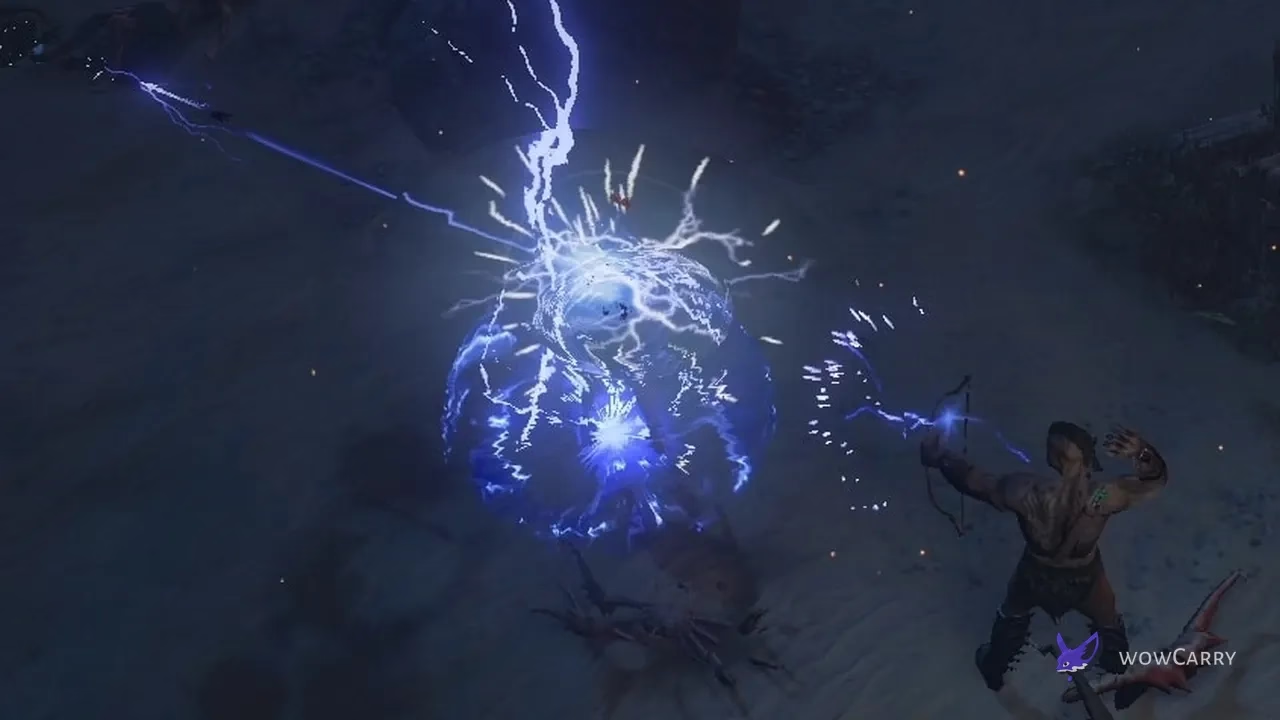
Lightning Arrow converts part of a bow hit to lightning damage and sends lightning bolts to nearby enemies. In Patch 3.29, a Deadeye can still scale the skill with a fast elemental Spine Bow, but the correct craft depends on item level, open affixes, and acceptable failure risk. This guide uses the live Curse of the Allflame boundary, separates a dependable Essence start from optional recombination, and explains why additional Arrows are suffixes while Trinity Support does not require three different elemental rolls merely because the gem is equipped.
Key Takeaways
- Spine Bow offers a balanced elemental base: its 1.4 attack rate and 6.5% base critical strike chance are useful, but the completed affixes decide whether it beats the current weapon.
- Item level controls different goals: level 82 enables the highest natural flat elemental prefix tiers, while the +1 and +2 additional-Arrow suffixes require levels 70 and 86.
- Essence of Wrath guarantees one lightning prefix on a weapon, but the remaining affixes are still random, so each use needs a clear keep-or-reroll rule.
- Trinity checks the highest element in each hit, so at least two elements must trade the highest-hit position often enough to build all three resonance types.
- The Recombinator is an optional advanced tool: predictable mode can fail without an output, unpredictable mode randomizes the transfer, and both modes consume the inputs.
- Prefixes Cannot Be Changed protects completed prefixes during compatible finishing steps, but it does not block a random modifier from filling an open prefix.
A good result starts with the right base constraint, then moves through prefixes, build validation, and suffixes in that order. Skipping that order is how an apparently promising bow becomes an expensive dead end.
Choose the Base and Item Level First
A clean item-level-82 Spine Bow is a sensible starting point when the goal is high natural flat fire, cold, and lightning prefixes. Item level does not raise the bow's 1.4 attack rate or 6.5% critical base; it changes which affix tiers can appear. Buying a higher-level base without a modifier plan only broadens the pool and can increase the cost of later recombination.
Additional Arrows need separate treatment. The modifier Bow Attacks fire an additional Arrow is an item-level-70 suffix. Its rarer two-Arrow version requires item level 86 and is also a suffix. A fracture can preserve one of those lines through later rolling, but the fracture occupies a suffix slot; it does not turn the modifier into a prefix or create extra affix capacity.
| Base goal | Relevant item level | What the level unlocks |
|---|---|---|
| Strong natural elemental prefixes | 82 | Highest natural flat fire, cold, and lightning prefix tiers used by the elemental craft |
| One additional Arrow | 70 | The of Splintering suffix for one additional Arrow |
| Two additional Arrows | 86 | The rare of Many suffix for two additional Arrows |
Before buying, decide whether the build needs a clean base, a fractured elemental prefix, or a fractured Arrow suffix. A player comparing those routes can browse current PoE item options before committing currency to a base that cannot roll the intended modifier.
✏️ Base check: hold Alt over the bow and verify item level, fracture position, influence, and open affix slots. A level-82 base cannot naturally roll the level-86 two-Arrow suffix.
Build Elemental Prefixes With Essences
The most readable starting route uses one guaranteed elemental prefix. A Shrieking Essence of Wrath or Deafening Essence of Wrath guarantees added lightning damage on a weapon. Essence of Anger guarantees added fire damage, while Essence of Hatred guarantees added cold damage. Choose the Essence whose guaranteed line complements the damage already available elsewhere in the setup.
Each Essence use creates a rare item around that one fixed prefix. The practical stopping point is not three elements or nothing. Keep a bow when the total local elemental damage and supporting affixes improve the build after comparison, or when it provides a clean input for an advanced craft. Attack speed and local critical strike chance are useful suffixes, but an open suffix can be more valuable than a weak natural roll because it leaves room for a bench craft.
- Confirm the base and item level before using any currency.
- Pick one elemental Essence and define the second prefix or useful suffix that would make the roll worth keeping.
- Stop on a usable mapping bow instead of rerolling past a clear upgrade.
- Compare the item in the build planner before paying for metamods or destructive crafting.
A fractured elemental prefix makes this route more controlled because the fracture survives the Essence use. A fractured Arrow suffix changes the suffix budget instead, so the player must leave enough room for attack speed, critical chance, or the final bench craft.
Verify Trinity Before Investing Further
Trinity tracks the highest elemental damage dealt by each supported hit. If lightning is highest, that hit grants fire and cold resonance. A later hit must have fire or cold as its highest element to grant lightning resonance. The support's more elemental damage scales from the lowest resonance, and its penetration requires at least 25 of each resonance.
This is why a two-element bow can work and a three-element bow can fail. Wide damage ranges, other gear, auras, conversion, and temporary buffs all change which element wins each hit. Three local elemental prefixes are often desirable for weapon damage, but their presence alone does not prove that Trinity cycles correctly.
📌 Trinity test: attack a durable target and watch all three resonance segments. If one segment remains empty, change the elemental balance before spending on the bow's finishing steps.
The test also prevents the opposite mistake: forcing a weaker third elemental roll onto a bow whose existing two elements already alternate correctly. The support's in-game resonance display is a better answer than counting elemental affix names.
Use Recombination as an Optional Advanced Route
The Kingsmarch device combines two magic or rare items of the same class. It charges Gold and Thaumaturgic Dust, with the cost influenced by item level and modifiers. Two useful bows can therefore be prepared as inputs, but the device is not a guaranteed shortcut to three perfect elemental prefixes.
Predictable Recombination lets the player select attempted affixes and displays the success chance. Asking it to carry more or higher-tier affixes reduces that chance; failure destroys both inputs and creates no output. Unpredictable Recombination always creates a new item, but it chooses transferred affixes through its own weighting rules. It still destroys both source bows.
Use recombination only when the displayed outcome justifies losing the inputs. A clean plan might pair a bow with one strong lightning prefix and another with one strong cold prefix, then ask for those exact lines. Adding filler modifiers does not inherently lower the Dust cost or protect the desired affixes. The interface's displayed cost and chance are the relevant checks.
⚠️ Recombination warning: both inputs are consumed, and the output is a new item. An imprint cannot restore either bow after the attempt.
For a player who already has a usable two-prefix bow, keeping it and bench-crafting a suffix can be the correct stopping point. Recombination is valuable when it upgrades a defined set of inputs, not when it turns every incomplete item into compulsory crafting material.
Protect Prefixes and Finish the Suffix Side
Once three prefixes are worth keeping, the suffix side can be worked without exposing those completed lines to every reroll. The Prefixes Cannot Be Changed metamod occupies a suffix and protects existing prefixes from compatible removal or reroll operations. It does not reserve an empty prefix, so a two-prefix bow can still gain a new random prefix during a reforge.
A Veiled Chaos Orb reforges a rare item with new random modifiers and one random Veiled modifier. On a bow with three completed prefixes and the prefix-lock craft, it can reroll the suffix side while those prefixes survive. The result remains random: the Veiled modifier is not guaranteed to reveal attack speed or critical strike chance, and the non-Veiled suffixes are not guaranteed upgrades.
After the roll, unveil the modifier through Jun, review the available choices, and use the crafting bench for any remaining open suffix. If the bow has only two desired prefixes, either fill the third deliberately or accept that a random prefix can appear. If the bow already has a useful natural suffix, compare a simple bench finish against the cost and failure range of a full Veiled Chaos loop.
The safe principle is narrow: lock what is finished, understand which slots remain open, and never describe the unveiled outcome as guaranteed. That preserves the craft's real decision points.
Use a Decision Table at Every Crafting Stage
Each stage has a different stop condition. Treating all of them as steps in one mandatory recipe creates unnecessary risk.
| Stage | Continue when | Stop or reconsider when |
|---|---|---|
| Base purchase | The item level and fracture match the planned prefix or suffix goal | The base cannot roll the intended Arrow tier or the fracture consumes a needed slot |
| Essence rolling | The guaranteed element combines with another useful prefix or valuable suffix | The bow is already a clear upgrade and later steps cost more than the likely gain |
| Trinity check | All three resonance types build during sustained attacks | One resonance type stays empty because the same element always wins |
| Recombination | Both inputs are expendable and the displayed chance supports the attempted affixes | Losing both inputs would remove the only usable weapon or the desired outcome is too broad |
| Suffix finish | Three prefixes are complete and suffix space is understood | An open prefix could be filled randomly or a simple bench craft already solves the build need |
Market prices change across a league, so the decision should be based on replacement cost and the character's actual upgrade rather than a fixed Divine Orb estimate. The same bow can be a sensible finish for one setup and an inefficient detour for another.
Avoid the Common Crafting Mistakes
The most damaging errors happen before a currency item is used. These checks keep the craft aligned with the modifier system.
- Do not call additional Arrows a prefix; both natural bow tiers are suffixes.
- Do not buy item level 82 expecting the natural two-Arrow suffix, which requires item level 86.
- Do not force three elemental prefixes solely for Trinity; verify resonance in combat.
- Do not assume a filler suffix reduces recombination cost or protects the wanted lines.
- Do not run a Veiled Chaos step on two open prefixes while claiming every prefix is safe.
- Do not reroll a clear upgrade merely because it lacks an idealized six-mod finish.
A controlled bow craft is less about one lucky result and more about knowing which modifier family, item level, and slot each decision affects.
Frequently Asked Questions
These answers cover the modifier and crafting rules that decide whether a 3.29 bow route is valid.
What item level should a Lightning Arrow Spine Bow be?
Use item level 82 when the goal is access to the highest natural flat elemental prefix tiers. Use item level 86 when the bow must be able to roll the natural two-additional-Arrow suffix. The one-Arrow suffix starts at item level 70. Item level alone does not make a Spine Bow stronger; the final affixes still decide the upgrade.
Are additional Arrows a prefix or suffix on bows?
Both natural additional-Arrow bow modifiers are suffixes. Of Splintering grants one additional Arrow at item level 70, while of Many grants two at item level 86. A fractured version remains a suffix and uses one suffix slot. This matters because attack speed, local critical chance, and many finishing crafts also compete for suffix space.
Does Trinity Support require fire, cold, and lightning on the bow?
No. Trinity Support needs different elements to alternate as the highest damage element across supported hits so all three resonance types build. Two elements with overlapping damage ranges can satisfy that condition. Three local elemental prefixes can raise weapon damage, but they do not automatically activate full Trinity. Test the resonance display against a durable target before finishing the bow.
What does predictable recombination do to the input bows?
Predictable Recombination lets you select attempted affixes and shows a success chance based on the requested modifiers. Both input bows are destroyed whether the attempt succeeds or fails. On failure, no output is created. That makes it an advanced route for expendable prepared inputs, not a risk-free way to merge the only two usable weapons in a character's stash.
Can a filler suffix improve recombination odds?
Do not assume so. Predictable mode calculates its displayed chance from the affixes selected for the output, while the Gold and Thaumaturgic Dust cost depends on item level and input modifiers. An extra filler line can increase complexity or cost rather than protect a wanted modifier. Read the device's displayed chance and price for the exact two inputs.
Does Prefixes Cannot Be Changed protect an empty prefix?
No. The metamod protects prefixes that already exist when a compatible craft removes or rerolls modifiers. It does not stop a new modifier from filling an open prefix. If only two prefixes are complete, fill or deliberately reserve the third slot before a Veiled Chaos reforge, or accept that the resulting item can gain a new random prefix.
Is a Veiled Chaos Orb finish guaranteed to give attack speed?
No. A Veiled Chaos Orb reforges the rare item and adds a random Veiled modifier. Locking three finished prefixes can preserve them while suffixes change, but the Veiled choices and other suffixes remain random. Unveil through Jun, evaluate the offered modifiers, and compare the result with a simpler crafting-bench finish before paying for another attempt.
Last reviewed 2026-08-21 against Patch 3.29 Curse of the Allflame — Maintained by WowCarry's Path of Exile team.