Key Takeaways
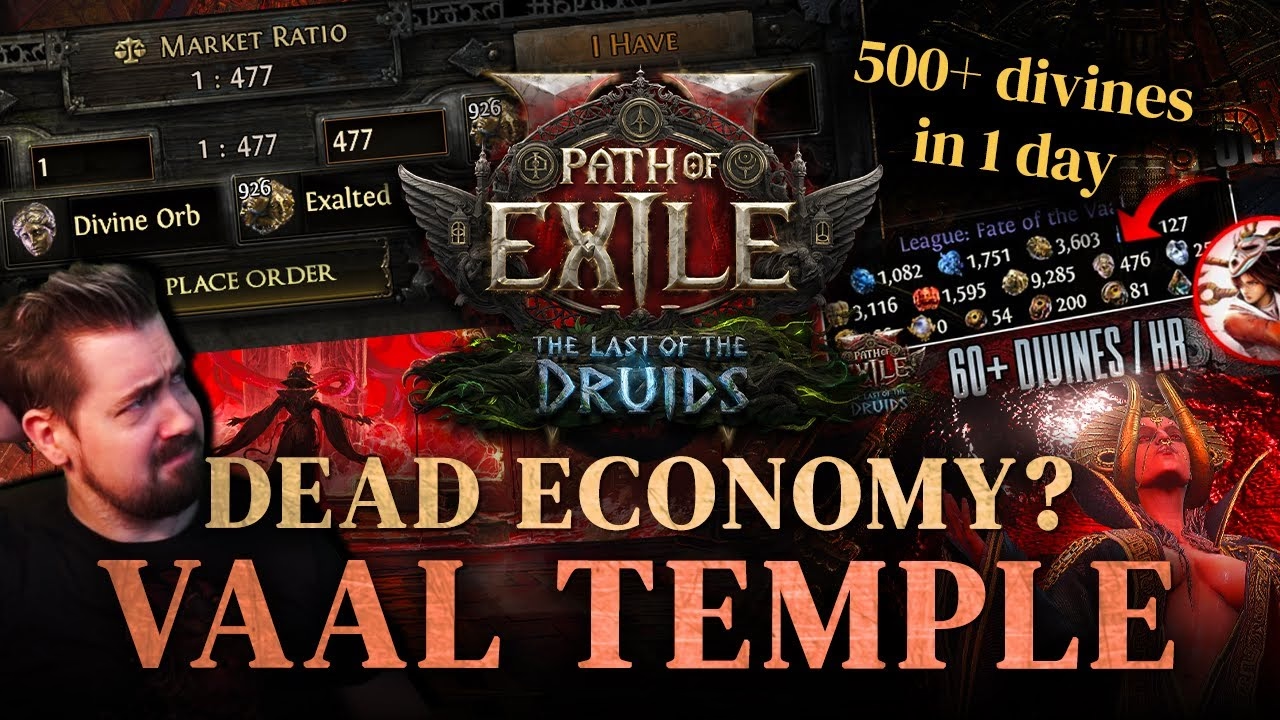
- Path of Exile 2 content creator Fubgun showcased a Vaal Temple farming strategy that produced up to 100 divine orbs per hour at peak efficiency, igniting community debate about whether the method constituted legitimate play or an exploit.
- The PoE 2 Vaal Temple is a build-your-own-dungeon system. Players use Juatalotli's Medallion (prevents room destabilization) and Quipolatl's Medallion (upgrades room tier) to protect high-value room layouts across repeated runs.
- Divine orbs flooded the market as a direct result, driving down their trade value while scarcer items — Abyss crafting items, Omens — rose to fill the gap.
- The strategy is not a software bug — it uses the Vaal Temple's medallion mechanic as intended but optimised to an extreme degree. The debate parallels past ARPG discussions about Mephisto farming in Diablo II and Betrayal safehouse strategies in PoE 1.
- The "exploit vs. legitimate strategy" question remains particularly nuanced during Early Access, when developer intent is less firmly established and community discovery is treated as useful feedback.
This article discusses the PoE 2 Vaal Temple farming strategy that surfaced during the Early Access period, placing it in the context of ARPG farming history and community economics.
The Vaal Temple Farming Phenomenon
Discussions surrounding the Vaal Temple farming strategy in Path of Exile 2 took the community by storm during Early Access. At the centre of the conversation was Fubgun, a well-known PoE content creator whose gameplay showcase raised numerous questions and sparked wide interest. Crucially, no software bug or dupe exploit was involved — the strategy demonstrated an advanced understanding of the game's medallion and room-management mechanics.
Historical Context in ARPGs
Farming tactics such as these have a long history within the ARPG genre. For newer players, some aspects may look contentious, but most represent clever use of existing mechanics rather than exploitation of unintended behaviour:
- Farming Mephisto in Diablo II (Diablo II): Players repeatedly created a new game after each kill — the only way to respawn Mephisto — and used the Durance of Hate Level 2 waypoint for a fast re-entry loop. Classic high-efficiency farming within the game's own rules.
- Quarry Farming in Path of Exile (PoE 1): Players instance-reset Act 9's Quarry for Sulphite and items. Various patches adjusted the mechanic as GGG monitored the impact.
- Betrayal League Mechanics (PoE 1): Targeted strategies in the Immortal Syndicate system — dedicating preparation time to farm specific members like Gravicius in Transportation safehouses — produced lucrative loot including full divination card stacks.
These historical examples share a common thread: a player or small group discovers an efficiency ceiling the developers didn't fully anticipate, the community picks it up, and a conversation begins about intent versus opportunity.
Strategic Setups in the Vaal Temple
Navigating the PoE 2 Vaal Temple efficiently requires understanding its room mechanics. Each room offers specific bonuses — increased rarity, increased quantity, access to the Architect's Chamber — which players can stack throughout the temple build by making smart choices at each junction.
- Medallion Use is Critical: Juatalotli's Medallion prevents a room from being destabilized, protecting a favourable layout once built. Quipolatl's Medallion upgrades a room's tier. Patch 0.4.0c Hotfix 13 restricted medallion placement to tier-three rooms; Hotfix 15 reverted this restriction, restoring placement to almost any room.
- RNG Elements: Room layouts have random components. Skilled players use medallions to lock in favourable configurations when they appear and accept variance on the rest.
- Preparation Time: Standard Vaal Temple optimisation (non-exploit route) requires significant build-up time to accumulate the right medallions and room sequences. The Holten instance-reset variant Fubgun showcased was specifically notable because it bypassed much of this setup on a new character.
Both approaches — patient temple optimisation and the accelerated instance-reset route — converge on the same goal: stacking temple modifiers that produce high-value loot or raw currency at the Architect's Chamber.
Comparisons and Conclusions
Fubgun's own reported figure was roughly 25+ raw divines per run at 3–4 minutes per run — extrapolating to around 100 divine orbs per hour. While some in the community speculate about patches to adjust fairness, this phenomenon mirrors countless past interactions between ARPG players and game mechanics.
Mastering game systems to accumulate wealth and progress is a tradition within ARPGs — a balance between ingenuity and adaptation that players across Diablo II, PoE 1, and now PoE 2 have explored in different forms.
Navigating Game Mechanics and Exploits
In ARPGs like Path of Exile and Diablo II, debates about game mechanics often surface around what distinguishes a legitimate strategy from an exploit. What can be misunderstood as "bug abuse" may simply be a well-established tactic familiar to long-time ARPG players. Diablo II's Mephisto runs were initially criticised by some as unsporting, but were eventually acknowledged as part of the game's core farming loop — subsequent patches refined the surrounding mechanics rather than banning the behaviour.
Ambiguities in Game Design
Determining whether certain strategies are intended by developers can be difficult. In Path of Exile 1, some zones allowed efficient item acquisition within the campaign, though with limitations — lower-tier drops that served as stepping stones rather than endgame wealth sources:
- Experienced players leveraged these mechanics during the campaign for early gearing advantages.
- These opportunities created a skill development environment without materially impacting the live league economy.
This situation illustrates the balance developers must maintain between encouraging creative play and preserving the intended challenge arc.
Economic Impact of Item Farming
The large-scale divine orb farming that Fubgun's showcase highlighted illustrates a recurring theme in ARPG economies: supply inflation.
Table: Item Value Dynamics
| Item Type | Availability | Expected Impact on Value |
|---|---|---|
| Divine Orbs | High (farming influx) | Decrease |
| Abyss Crafting Items | Low | Increase |
| Omens | Low | Increase |
As divine orbs flooded the market their value fell, while less accessible items saw their trade price rise to fill the vacuum. This dynamic is familiar from PoE 1's Affliction league (a PoE 1 league from 2023–2024), where certain strategies created comparable scarcity on specific craft items. Players looking to browse Path of Exile currency options can find current stock across both games.
Community Dynamics
Within the community, opinions varied on whether leveraging the Vaal Temple strategy should result in penalties. Many argued that without clear cheating — such as item duplication — no ban was warranted. Others called for stricter enforcement, particularly in scenarios where the strategy significantly disrupted the early-league economy.
- Players debated the fairness of extreme optimisation versus the majority's more measured pace of play.
- Calls for stricter enforcement came primarily from those most affected by divine orb deflation in their own trading.
- Community experience and developer feedback ultimately shape the final outcome — patches following high-profile farming spikes tend to adjust the mechanic rather than penalise players who used it.
Mastering game mechanics is central to competing in ARPGs, yet that mastery must coexist with an economy and experience that works for the broader player base — the tension between the two is what generates these community conversations.
Navigating Exploits in Early Access Games
The debate over exploiting game mechanics in ARPGs is more complex during Early Access. Some advocate caution — using powerful mechanics risks account penalties if GGG later classifies the behaviour as an exploit. Others argue that Early Access is the ideal time to find and report these interactions, since developer intent is being established through patch notes and community feedback rather than fixed precedent.
Path of Exile 2 leans toward the latter model. GGG has historically patched overpowered mechanics mid-league rather than pursuing account action against players who used them. The Bestiary mechanic in PoE 1, where duplicating influence ranks created a moral quandary, is one example where GGG fixed the dupe but did not ban players who had used it — the line was drawn at third-party software, not creative use of in-game mechanics.
Medallion farming sits on the optimisation side of that line. GGG restricted medallion placement to Tier III rooms in Hotfix 13 — then reversed that restriction in Hotfix 15, effectively confirming that the mechanic itself was not the problem. The efficient floor-stacking was overtuned; using medallions as intended was not an exploit.
The Complexity of Conceptualizing Exploits
One significant challenge in ARPGs is that the same mechanic can appear as a natural extension of play to one player and as game-breaking to another. The beetle mechanic in Path of Exile — where proximity to a waypoint and respawn timing made it notably advantageous for fast clearing — prompted similar debate about what "intended behaviour" actually meant.
Concrete cases from PoE 2 Early Access development suggest that GGG's practical position is:
- Early Access Flexibility: Discovering and discussing powerful mechanics is part of the Early Access feedback loop — players are encouraged to report them, not hide them.
- Developer Communication: GGG's patch notes typically clarify whether a fixed mechanic was unintended or simply overtuned. The language matters: "fixed an unintended interaction" versus "rebalanced X" tells players very different things about how the mechanic was being viewed internally.
- Community Feedback: Broad community discussion of farming strategies like the Vaal Temple method gives developers data on impact at scale — something internal testing often misses.
Understanding the distinction between "overpowered but intended" and "unintended and flagged" is what players navigating these grey areas try to assess in real time.
Balancing Exploit Usage: Early Access vs Full Release
| Aspect | Early Access | Full Release |
|---|---|---|
| Developer Intent | Flexible guidelines, subject to change | Strict and documented precedent |
| Community Engagement | High discovery feedback expected | Standard report channels |
| Penalties for Exploits | Typically minimal; patches preferred | Stricter enforcement |
While powerful mechanics will continue emerging in ARPGs, Early Access stages benefit from a collaborative approach where players engage with the mechanics openly. The ultimate goal for GGG is to reach a balanced experience at full launch — player discovery during Early Access is part of how that balance gets found.
Frequently Asked Questions
What Is the PoE 2 Vaal Temple Farming Strategy?
The PoE 2 Vaal Temple is a build-your-own-dungeon system where players accumulate Vaal crystals across the campaign or maps to build a personalised temple layout. High-efficiency farming focuses on stacking the most lucrative room types — using Juatalotli's Medallion to protect favourable rooms — so the final Architect's Chamber and surrounding rooms generate maximum currency per run.
Who Is Fubgun?
Fubgun is a well-known Path of Exile content creator and streamer who popularised an accelerated Vaal Temple farming method during PoE 2 Early Access (Patch 0.4.0c). His showcase of the strategy producing up to 100 divine orbs per hour sparked the community conversation around the mechanic's fairness and economic impact.
How Much Currency Can You Farm at Vaal Temple?
At peak efficiency using the optimised Holten instance-reset route, Fubgun's own estimate was roughly 25+ raw divine orbs per run at 3–4 minutes per run, extrapolating to approximately 100 divine orbs per hour. Standard temple optimisation without the instance-reset element produces meaningfully lower rates but requires less setup.
Are Vaal Temple Medallions Real Items in PoE 2?
Yes. Juatalotli's Medallion prevents a temple room from being destabilized, protecting a valuable layout. Quipolatl's Medallion upgrades a room to the next tier. Patch 0.4.0c Hotfix 13 restricted medallion placement to tier-three rooms, though Hotfix 15 reverted this restriction.
Is This Strategy Still Available in Patch 0.5?
Patch 0.4.0c Hotfix 13 restricted medallion placement to tier-three rooms. Hotfix 15 reverted that restriction, restoring medallion placement to almost any room. As of Patch 0.5 (Fate of the Vaal league), the full medallion system is active; the extreme efficiency of the Holten instance-reset variant has not been replicated at the same scale in the new league.
Did GGG Patch Out This Strategy?
Hotfix 13 during Patch 0.4.0c restricted medallions to tier-three rooms, but Hotfix 15 reverted this restriction. GGG's public statements framed the original change as a balance adjustment rather than a ban on Vaal Temple farming as a mechanic — and the revert confirmed that interpretation.
What Is the Economic Impact of Divine Orb Farming?
When large volumes of divine orbs enter the market rapidly, their trade value falls. Simultaneously, items that are not easily farmed — Abyss crafting items, Omens — rise in price to compensate for the shift in currency purchasing power. Newer players who relied on Exalted Orbs as their primary crafting currency in PoE 2 Early Access were most affected by the shift.
Is Using Vaal Temple Medallions an Exploit?
No. Medallions are intended game items with documented mechanics. Using them to protect and optimise a temple layout is within the rules as written. The debate centres on whether the efficiency ceiling is higher than GGG intended — a balance question, not a cheat question. GGG's historical response has been to patch the outlier efficiency rather than penalise players who reached it.