Key Takeaways
- Patch 0.5 "Return of the Ancients" reworked Breach completely — it is no longer a splinter-farming mechanic but the gateway to the Genesis Tree, one of the strongest deterministic crafting systems in PoE2's history.
- Success in Breach depends on maintaining the Stability Bar: kill enemies fast enough to extend the timer before the zone collapses; slow clears kill reward quality, not just quantity.
- The Genesis Tree crafting system uses Wombgifts (templates for rings, amulets, belts, and Breach Stones) and Hiveblood (untradeable fuel) to build heavily customized gear with targeted modifiers.
- Breach Rings can now reach 50 quality (versus the standard 20 cap), enabling modifier magnitudes unavailable on any other ring base in the game.
- Four Breach bosses gate the best rewards: Rune (physical/shotgun), Tul (cold), Vun (updated mechanics), and Xesh (pinnacle boss, requires 300 splinters).
- Hive quests — where you break walled zones and protect Ailith while she destroys the Hive interior — are the primary source of Hiveblood and high-tier Wombgifts.
- AoE-focused builds with strong movement speed are the mechanical best fit for Breach; builds that rely on single-target rotations extend Breach zones slowly and lose stability before completing all waves.
Breaking down each mechanic in turn makes the system approachable from Day 1 through pinnacle boss farm.
How Breach Encounters Work
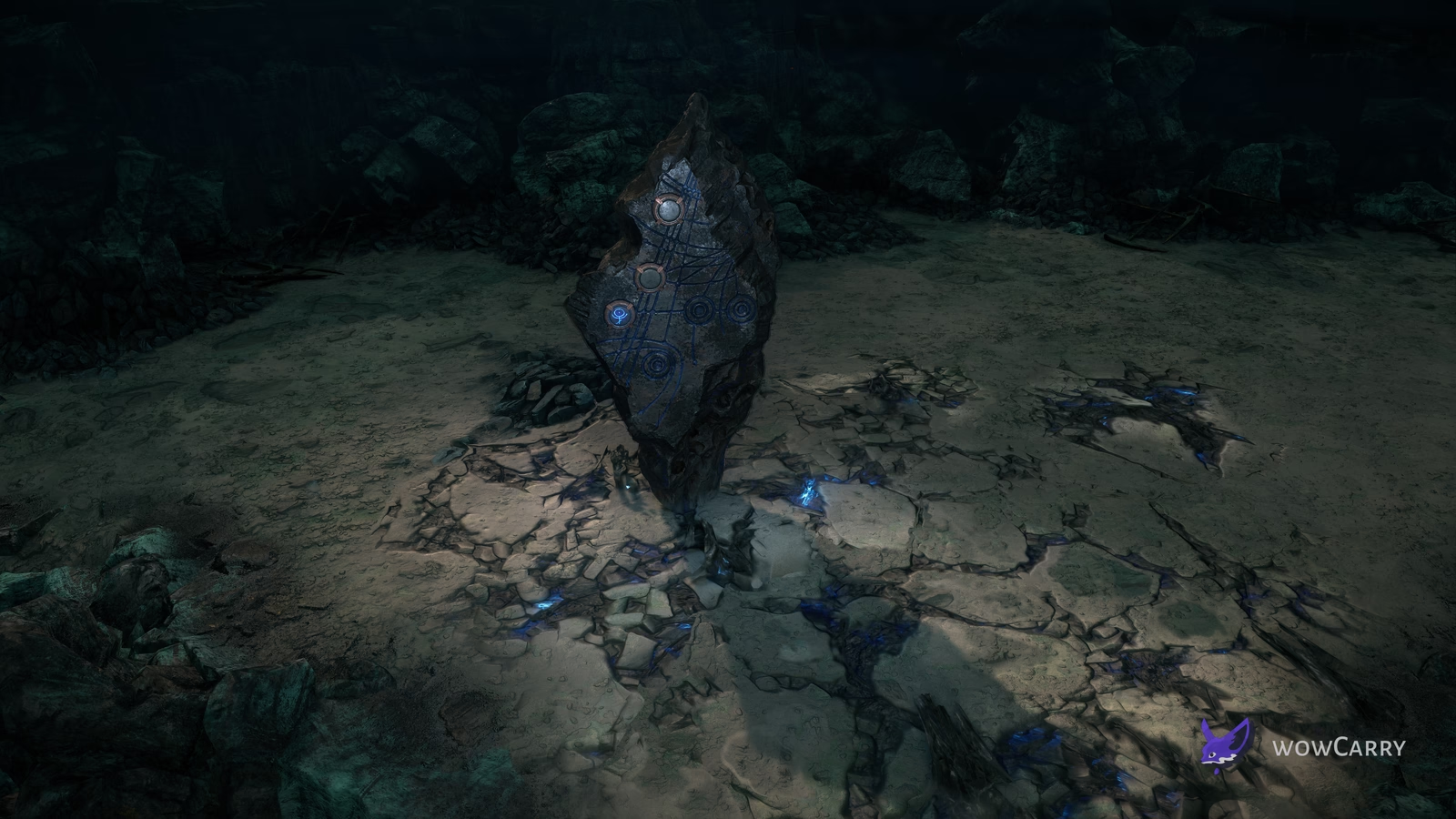
Breach encounters begin when you activate a purple Breach hand icon on a map. A circular zone expands outward from the activation point while enemies pour in continuously. The key mechanic is the Stability Bar: kill enemies fast enough and the bar stays full, extending the encounter and expanding the radius. Let the kill rate drop and the bar drains — when it empties the zone collapses early, cutting your rewards sharply.
Breach encounters scale with Waystone tier and the number of Breach tablets you have applied to your Atlas passives. Stacking Breach tablets is the single most impactful investment for sustained Breach farming — each additional tablet increases encounter density and reward multiplier.
Open-layout maps work better than corridor maps for Breach. The expanding radius needs room to spawn enemies across the full circumference. Maps like Strand, Dunes, and open-field variants outperform tunnel-heavy maps where enemy pathing clusters enemies on one side of the breach hand, creating dead zones that drain Stability faster than you can compensate.
вњЏпёЏ Tip: Activate the Breach hand while moving to the next pack rather than standing still. The zone expands in the direction you are running, and early momentum in the first 5 seconds sets up a larger kill-zone for the mid-encounter wave surge.
The Genesis Tree — Breach Crafting Explained
The Genesis Tree is the new deterministic crafting board introduced in Patch 0.5. It consumes two resources exclusive to Breach content:
- Hiveblood — the fuel that activates the Genesis Tree board. Hiveblood cannot be traded, so every Genesis Tree craft requires the player to earn it through Breach encounters. This is intentional: it ties the crafting power directly to engagement with the mechanic rather than to trade wealth.
- Wombgifts — item-type templates that define what kind of gear the Genesis Tree produces. There are Wombgifts for rings, amulets, belts, and Breach Stones. Each Wombgift has a rarity tier; higher-tier Wombgifts unlock more Genesis Tree board customization options.
The Genesis Tree board itself works like a weighted randomization grid. You place Hiveblood on the board and configure the crafting pass by selecting the target base type, weighting modifiers toward specific attributes, adjusting tiers on target affixes, and setting fractured modifier chances. The result is not a fully deterministic craft — randomness still exists — but the player controls the probability distribution rather than accepting pure RNG.
📌 Common mistake: Spending all Hiveblood on the first set of Wombgifts you find. Early Wombgifts unlock only the basic Genesis Tree configuration options. Save Hiveblood and run more Breaches until you acquire a Wombgift tier that unlocks the modifier-weighting columns — that is where the crafting system's determinism fully activates.
Breach Rings — The 50 Quality Cap
Breach Rings are the most accessible high-value Breach reward in Patch 0.5. Standard rings in PoE2 cap at 20 quality; Breach Rings cap at 50. Quality in PoE2 increases the magnitude of modifiers (not just the socket quality), so a Breach Ring with Life and Resistances at 50 quality has meaningfully higher stat numbers than the same modifiers on a standard ring at 20 quality.
The practical floor for a useful Breach Ring is around 30 quality. Below that, the modifier magnitudes are similar to what a well-rolled standard ring provides. Above 40 quality, the numbers pull ahead of nearly all crafted alternatives, particularly for resistance-stacking builds that are capped or near-capped on Life and need the extra defensive headroom.
Breach Bosses — What to Expect
Breach encounters that fully stabilize can culminate in boss encounters depending on how many Breachstones you collect and consume. The four Breach bosses in PoE2 0.5 are:
- Rune — the most commonly encountered Breach commander. Rune deals heavy physical damage and uses a shotgun-style multi-projectile attack at close range. Cold resistance helps against secondary effects; the fight rewards aggressive play because standing still at mid-range puts you in the worst position for both patterns simultaneously.
- Tul — a cold-based encounter. Tul applies chill and freeze; stacking cold resistance to 75% before this fight is not optional, it is a hard requirement at Waystone tier 10+. The fight is mechanically straightforward once the resistance floor is met.
- Vun — updated in 0.5 with reworked attack patterns. Vun rewards mobility: most of the dangerous telegraphed attacks have a delay window that movement-speed-capped builds can consistently dodge.
- Xesh — the pinnacle Breach boss, accessible only after collecting 300 splinters. Xesh is a damage-test fight; average map-tier DPS is insufficient. Expect to need 25–30 million DPS to complete the encounter on a full-offense timer.
Each boss drops Hiveblood and high-tier Wombgifts at a much higher rate than standard Breach encounters, making them the most efficient Genesis Tree fuel source in the game once your build can reliably defeat them.
⚠️ Warning: Xesh's 300-splinter entry cost is non-refundable. Do not attempt the encounter without a clear DPS benchmark — run a pinnacle boss parse first. A failed Xesh attempt loses the Breach Stones and a significant portion of a farming session's Hiveblood generation.
Hive Quests — Protecting Ailith
Hives are walled sub-regions that appear on select maps during Breach encounters. To reach the Hive interior, you break through the outer walls — the more walls you destroy, the more enemies spawn and the higher the reward multiplier. Once inside, your objective is to protect Ailith while she performs a ritual that destroys the Hive from within.
Ailith has a health bar displayed on the right side of your screen during Hive quests. Enemies prioritise targeting her rather than the player, which means the fight pattern reverses from standard PoE2 positioning: instead of pulling enemies toward yourself and kiting away, you stay between the enemy waves and Ailith's position, acting as a damage sponge and area-denial platform.
Hive quests are the primary source of the highest-tier Wombgifts. Running Hives consistently — rather than treating them as bonus encounters to ignore — is the difference between a Genesis Tree build that reaches T8 crafts and one that plateaus at T4.
Build Choices for Breach
Breach rewards builds that do three things well: wide AoE coverage, consistent movement between packs, and enough survivability to sustain in dense enemy clusters. The following archetypes perform best:
- Lightning Conduit or Arc builds — chain-hit coverage fills the expanding Breach zone without needing manual repositioning.
- Minion summoners with persistent AoE minions — minions target enemies automatically across the full Breach radius; you focus on Stability Bar management and enemy priority.
- Tornado Shot or multi-projectile ranger builds — hit multiple enemies per shot; high base attack speed maintains Stability Bar more easily than slow-cast spell builds.
Builds running single-target skills (Slam variants, Rend without AoE support) struggle in Breach content because the Stability Bar drains if your damage footprint is narrow. If you commit to Breach farming, respec into at least one AoE support gem to widen your effective kill radius. For a continuously updated Breach farming reference including optimal Atlas passive layouts, Maxroll's Breach guide covers current Patch 0.5 mechanics.
Players looking to fast-track Breach progression can combine early Atlas passive investment in Breach tablets with a focused build that reaches Waystone tier 8 before engaging the Genesis Tree system. Tier 8 maps and above provide Hiveblood at a rate that makes regular Genesis crafts sustainable without running dozens of Hive quests per session. For a guided progression path into the full Breach endgame, WowCarry's Atlas Boost service can carry your account through the early-tier gateway efficiently.
FAQ
What is Breach in Path of Exile 2?
Breach is an endgame map mechanic where activating a purple Breach hand spawns a circular zone of continuous enemy waves. Players must kill enemies fast enough to maintain the Stability Bar and extend the encounter. In Patch 0.5, Breach also gates the Genesis Tree crafting system via Hiveblood and Wombgift resources that drop exclusively from Breach encounters.
How do I access the Genesis Tree crafting system?
Complete Breach encounters to collect Hiveblood (the untradeable fuel) and Wombgifts (item templates for rings, amulets, belts, and Breach Stones). When you have both, interact with the Genesis Tree board in your hideout to begin a crafting session. Higher-tier Wombgifts unlock more board configuration options, including modifier weighting and tier selection.
Can Breach Rings be traded?
Yes. Breach Rings are tradeable items and can be listed on the trade site. The 50-quality cap makes them significantly more valuable than standard rings; expect high-quality versions with double-resistance or Life-plus-resistance combinations to trade for multiple Exalted Orbs at peak league prices.
What is the difference between Breach splinters and Hiveblood?
Splinters are consumed in stacks of 100 to open Breachstones, which are used to access Breach boss encounters including Xesh (300 splinters). Hiveblood is a separate resource exclusive to Hive quests and boss kills; it fuels the Genesis Tree and cannot be traded. Both drop from Breach encounters but serve entirely different systems.
Who is Ailith and why do I need to protect her?
Ailith is an NPC character tied to the Hive quest narrative. She appears inside Hive zones and performs a destruction ritual while you defend her from enemy waves. Ailith's health bar is visible during the quest; if she dies, the Hive quest fails and you lose the associated high-tier Wombgift reward. She prioritizes moving toward the ritual point, so your job is to intercept the enemies that path toward her.
What build is best for Breach farming?
AoE builds that hit across the full Breach zone radius maintain the Stability Bar most efficiently. Lightning Conduit, Arc, multi-projectile ranger builds (Tornado Shot, Lightning Arrow), and persistent-AoE minion summoners all perform well. Single-target melee builds struggle with Stability Bar maintenance and should add at least one AoE support gem before committing to heavy Breach investment.
How do I fight Xesh, the pinnacle Breach boss?
Xesh requires 300 Breach splinters to access and demands significantly higher DPS than standard Breach bosses — expect to need roughly 25–30 million effective DPS on a full-timer kill attempt. The fight is a damage benchmark more than a mechanics challenge; clear Rune, Tul, and Vun consistently before attempting Xesh, and run a DPS parse on a training dummy or a 1-phase pinnacle boss kill to verify your output beforehand.
Last reviewed 2026-05-30 against PoE2 Patch 0.5 "Return of the Ancients" (Runes of Aldur league). Maintained by WowCarry's Path of Exile 2 team.