Key Takeaways
- Patch 0.4.0c approximately doubled Vaal Temple modifier values at all tiers, flooding the trade league with high-value crafting materials and triggering the most significant economic disruption in PoE 2 Early Access to that point.
- The Holten zone exploit let players cycle six crystal charges in roughly 90 seconds, generating 50-100+ Divine Orbs per hour before GGG deployed an emergency hotfix to halt the strategy.
- Fracturing Orb values swung from 7.6 Divines each down to parity, then up to approximately 3.5 Divines each — a reversal driven by temple loot flooding the market with everything except Fracturing Orbs themselves.
- Lineage Support Gems Rakiata's Flow and Uhtred's Augury appreciated sharply; they are endgame Lineage gems with demand outpacing supply once the rest of the market inflated around them.
- Reaver Catalysts remained one of the more sustainable niche farms: Breach-sourced at roughly 14 Exalted Orbs each, with steady demand from players exploiting the Vaal Temple meta.
- The shock follows the pattern of Affliction League (Path of Exile 1, 3.23) — initial excitement from easy wealth, then diminishing engagement as uniform access to high-end items erodes the progression loop.
Here is how those events unfolded across the Fate of the Vaal trade league.
The Impact of Patch 0.4.0c on the Path of Exile Economy
The release of Patch 0.4.0c in Path of Exile 2 caused an unexpected upheaval in the game's trade league economy. Initially underestimated, the changes significantly affected the Vaal Temple mechanic, leading to a massive imbalance in loot distribution and item valuation throughout the game.
Key Changes and Immediate Consequences
- Buff to Vaal Temple Mechanics: The patch introduced substantial modifications to the Vaal Temple system, previously thought to yield only minor improvements. The specific changes included a approximate doubling of temple modifier values at all tiers, significantly enhancing loot drops and effectively warping the in-game economy.
- Devaluation of Standard Loot: Standard loot from regular monsters became devalued, pushing players towards content that dropped special, more sought-after items. This shift forced many players to adapt their strategies to remain competitive within the marketplace.
- Emergency Adjustments: To address the emerging issues, Grinding Gear Games rolled out an emergency patch. This aimed to curb exploitative practices, such as endlessly resetting game zones to repeatedly generate temple loot.
- Halted the reset strategy in the Holten zone.
- Increased the frequency at which players can access the Vaal Temple through standard play.
- Boosted loot in high-tier temples, shifting focus towards skillful and progressed gameplay.
Those three adjustments reshaped player behaviour — and immediately distorted what items were worth on the market.
📌 Key term: In PoE 2, this mechanic is called the Fate of the Vaal league encounter, not incursion (a Path of Exile 1 system). The Vaal Temple is PoE 2's equivalent of the Temple of Atzoatl; knowing the correct name matters when searching guides and trade filters.
Inflation in the Economy
As a result of these changes, significant inflation occurred across various in-game items:
- Fracturing Orbs: These crafting essentials saw a dramatic rise in value. Initially, the ratio of divine orbs to fracturing orbs was 7.6 to 1, which balanced to parity by December 20th. Post-Christmas, the tables turned with one fracturing orb equating to 3.5 divine orbs.
- Omen Increases: High-end crafting omens also inflated, with items like the Omen of Sinistral Annulment seeing significant price hikes compared to currencies such as the chaos orb.
- Lineage Gem Spikes: Support gems Rakiata's Flow and Uhtred's Augury witnessed sharp spikes in their divine orb cost, exemplifying the wider inflation trend. Boss access fragments followed suit, significantly affecting the valuation of divine orbs.
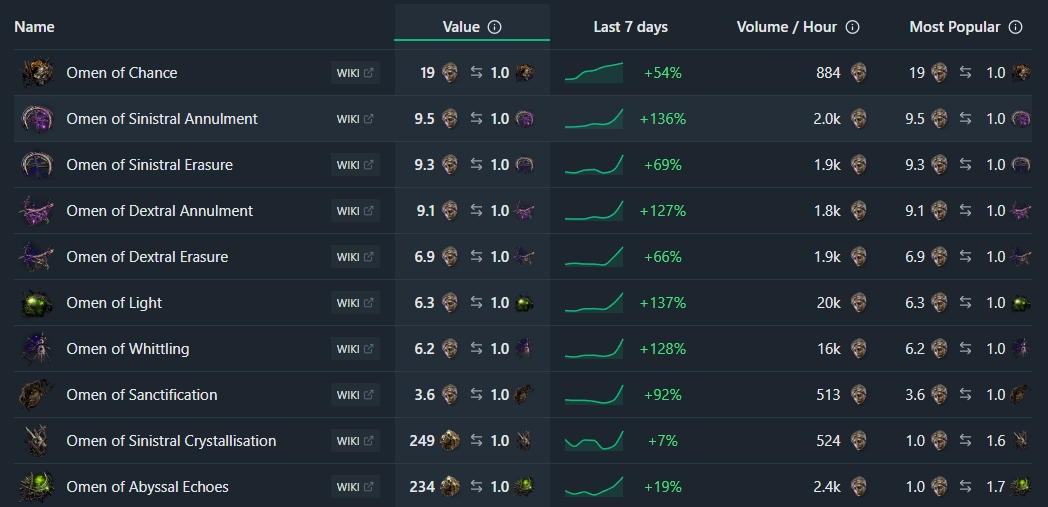
⚠️ Note: The Fracturing Orb exchange ratios cited (7.6:1, parity, 1:3.5 Divines) reflect community trade reports from late December 2025. No independent verification against poe2.ninja price history archives was possible for this window — treat these ratios as directional, not precise.
Taken together, those price movements point to a single root cause: one mechanic became overwhelmingly dominant.
Understanding the Implications
The dramatic increase in availability of specific loot from the Vaal Temple made it the primary source for profitable farming. Traditional loot methods and items, not influenced by these temple bonuses, lost value, highlighting the pivotal role of temple dynamics in the current economic landscape.
Despite attempts to manage the situation through hotfixes and adjustments, the repercussions of Patch 0.4.0c continue to shape player strategies and market trends within Path of Exile 2. Decision-makers and players alike must navigate the evolving economy with strategies that leverage the current mechanics until a more stable adjustment is reached.
Players who want to build stacks without grinding Holten cycles can compare options on our PoE 2 currency delivery page.
✏️ Practical tip: The most stable niche during a broken PoE 2 economy is supplying whatever the top-farming strategy consumes — not what it produces. During the 0.4.0c era, Vaal Temple runners needed Reaver Catalysts; farming them via Breach content delivered steady Exalted Orb income regardless of Divine Orb inflation.
Navigating a Broken Economy
In the current state of Path of Exile 2's economy, the focus has shifted significantly from traditional loot farming. Players are compelled to pursue specific mechanics such as targeting monsters that drop rare items like fracturing orbs and catalysts. This shift has caused certain items, particularly catalysts, to become highly sought after, with their values increasing dramatically. The rise in the value of catalysts, for instance, has led to some of them reaching as high as 36 exalted orbs, which is a significant increase relative to other currencies.
Currency Dynamics
The change in the game's economy has also affected the dynamics among various in-game currencies:
- Currency Inflation: The influx of loot from the Vaal Temple has skewed currency values, making some more accessible than others.
- Exalted Orbs: These remain in less demand due to their limited late-game use despite their overall availability.
- Chaos Orbs: Although they are useful, their utility is currently hampered by the scarcity of fracturing orbs, affecting their demand.
Below is a simplified table illustrating these recent currency trends:
| Currency | Current Trend | Availability |
|---|---|---|
| Exalted Orbs | Less demand | High |
| Chaos Orbs | Lower usage | More available |
| Catalysts | High demand | Limited |
With those currency relationships in mind, player reactions to the broken economy split along predictable lines.
Player Engagement with Economics
The experiences of players with a broken economy can vary widely. For some, the unprecedented access to high-value items and currencies is thrilling, reminiscent of the Affliction League (Path of Exile 1, 3.23) when economic anomalies were first experienced. However, subsequent similar events have demonstrated diminishing excitement, with players expressing dissatisfaction when everything becomes too accessible.
- Initial Enthusiasm: Players often enjoy their first encounter with a broken economy, experiencing milestones like their first mirror drop.
- Subsequent Fatigue: Repeated disruptions that increase loot without new challenges can lead to decreased enjoyment.
Ultimately, whether players find enjoyment in this environment depends on their personal preferences. Those continuing to play the 0.4.0 trade league should consider specializing in niche farming strategies. For example, some may choose to be the supplier of Reaver catalysts for those dominating in Vaal Temples or farm specific ritual content to profit from the inflated prices of certain items. Regardless of your approach, ensuring that you are having fun should be the priority. As the Path of Exile economy continues to evolve, adapting and finding unique ways to enjoy the game is key.
Players who stayed through the disruption found that adapting their strategy was more rewarding than waiting it out.
FAQ
What did Patch 0.4.0c change in Path of Exile 2?
Patch 0.4.0c approximately doubled the modifier values at all tiers in the Vaal Temple encounter, making high-tier temple runs dramatically more lucrative. GGG also applied emergency changes to address the Holten zone checkpoint exploit, raised the frequency of accessible temples, and boosted loot in high-tier runs to reward skilled play over farming shortcuts.
Why did Fracturing Orbs spike in price after Patch 0.4.0c?
The Vaal Temple buff flooded the market with most high-value items, compressing their prices while Fracturing Orbs remained supply-capped. As players acquired mass currency and sought crafting tools to spend it, Fracturing Orb demand surged against unchanged supply — inverting the original Divine-to-Fracturing exchange rate within days.
What was the Holten zone exploit in PoE 2?
Holten is a monster-level-63 Interlude area containing a fixed Vaal Beacon position. Players discovered they could respawn at a nearby checkpoint and run to the beacon, cycling six crystal charges in approximately 90 seconds and generating access to Vaal Temple loot at a rate of 50-100+ Divine Orbs per hour. GGG deployed a hotfix to close the checkpoint loop shortly after the exploit became widespread.
What are Rakiata's Flow and Uhtred's Augury?
Both are Lineage Support Gems in Path of Exile 2 — high-tier crafting items that drop from the endgame Lineage gem pool rather than specific bosses. Rakiata's Flow inverts enemy elemental resistances; Uhtred's Augury grants +3 levels when exactly two supports are active. Both appreciated sharply during the 0.4.0c economy shock as general inflation raised all high-tier crafting demand.
What is the best niche farming strategy in the 0.4.0c meta?
Supplying items that the dominant strategy consumes rather than produces is typically the most stable approach. During the 0.4.0c Vaal Temple era, Breach content farming for Reaver Catalysts — consistently valued at ~14 Exalted Orbs each — offered reliable income that was insulated from Divine Orb inflation because Catalyst demand came from a broad base of players, not just Vaal Temple farmers.
Is Path of Exile 2's trade league balanced?
Balance is a moving target in PoE 2 Early Access. GGG actively hotfixes extreme outliers like the 0.4.0c Vaal Temple spike, but the system's depth means that single-mechanic dominance events will recur. The current Fate of the Vaal league (Patch 0.5) benefits from GGG's response speed established during the 0.4.0c incident, though players should monitor poe.ninja for early price signals when major patches land.