Key Takeaways
- The Poison Animate Weapon Necromancer ranked among the most affordable summoner builds in Necropolis 3.24 and cleared Uber Elder, Shaper, and Sirus without a large currency investment.
- Transfigured Animate Weapon (introduced in 3.23 Affliction) removed the identified/white-weapon restriction; Bladefall-dropped ground blades became the primary summoning source in boss arenas.
- Bone Barrier was the keystone ascendancy node: it provided instant leech and converted 30% of minion physical damage to chaos, directly amplifying poison stack output.
- Mistress of Sacrifice extended Animate Weapon duration and applied Bone Offering effects to both the player and all minions simultaneously, providing a significant defensive multiplier at no extra cost.
- Amulet anointment: Testudo (1x Clear Oil + 1x Sepia Oil + 1x Black Oil) for the block chance bonus that anchors the build's survivability model.
- The Brine King (upgraded) paired with Tempest Shield delivered freeze immunity, a defensive gap commonly missed on summoner builds in the Necropolis environment.
This guide covers how the build worked in Path of Exile 3.24 Necropolis. Some mechanics may have shifted in later leagues.
Build Overview
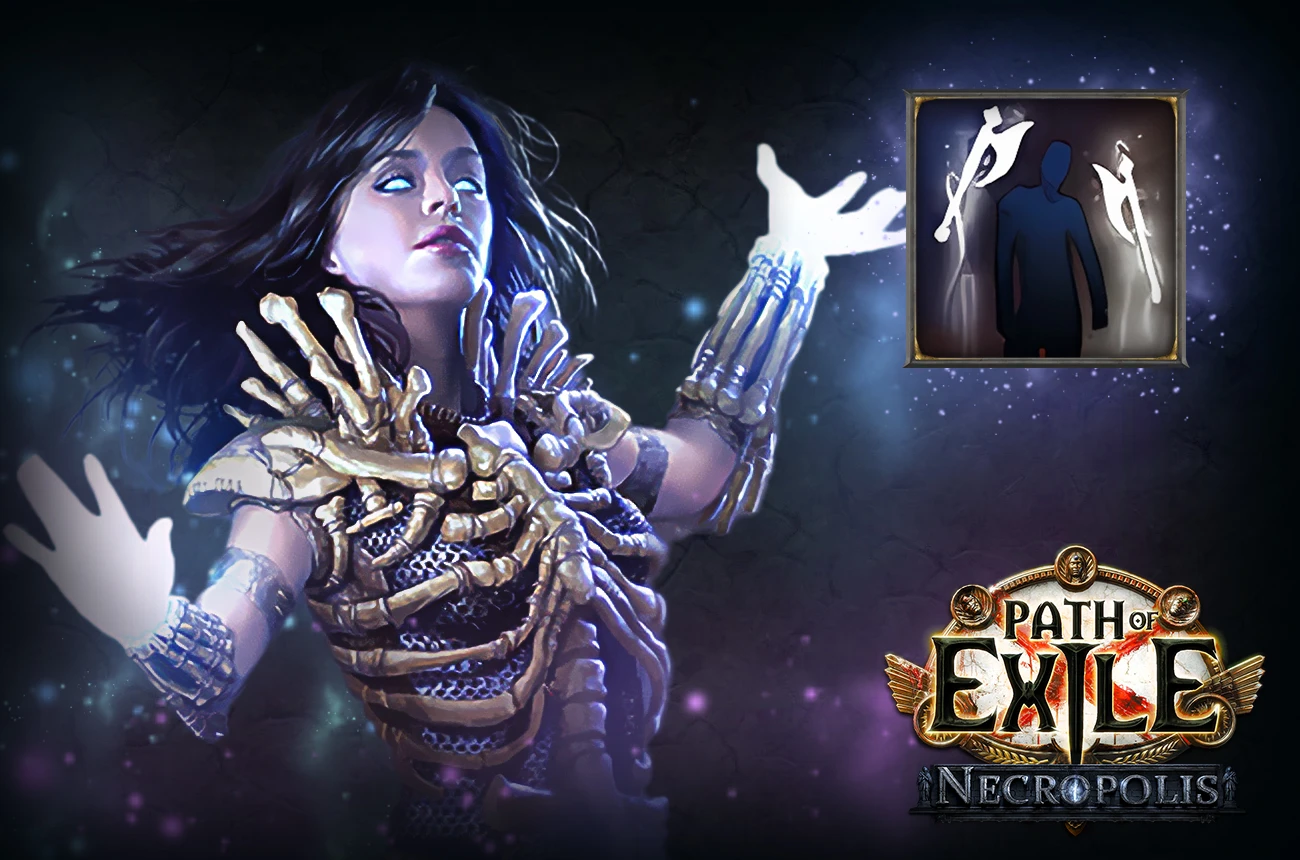
The Poison Animate Weapon Necromancer was one of the signature summoner builds of Path of Exile's Necropolis league (3.24). The build summoned a sustained army of animated weapons conjured from Bladefall ground blades and leveraged their collective poison stacks to destroy both map packs and endgame bosses. Prior to 3.23, Animate Weapon required identified or white-quality weapons on the ground; Transfigured Gems removed that restriction, letting players maintain a full army even during instanced encounters against Uber Elder, Shaper, or Sirus.
The Necropolis expansion added two upgrades that made the build meaningfully stronger: instant leech through Bone Barrier and a convocation modifier option on wands or shields, which freed two ring slots for bone rings. These changes kept the build competitive at low entry cost while allowing it to scale into high-budget territory with white sockets and an advanced Animate Guardian setup.
Pros and Cons
| Pros | Cons |
|---|---|
|
|
Despite its limitations, the build offered a strong damage-to-investment ratio that appealed to players looking for a Hardcore-viable option that still cleared high-tier Necropolis content.
Build Main Mechanics
Playstyle
The Poison Animate Weapon Necromancer operated through a two-part loop: cast Bladefall to drop ground blades, then cast Animate Weapon to summon them into ranged weapons that applied poison on hit. Bladefall's rework left blades on the ground as objects rather than projectiles, solving the long-standing boss-arena weapon scarcity problem. Transfigured Animate Weapon converted those ground blades into ranged animated weapons, giving the army reliable poison delivery from range.
Periodically re-summoning during map clears kept the army healthy and reduced the chance of losing all minions to a single spike. In endgame setups, extended weapon duration gear reduced re-summon frequency to a minor interruption rather than a gameplay chore.
Damage Scaling and Defensive Layers
The build's defensive stack combined a high eHP base with a block-heavy shield and Bone Offering cycling. On higher budgets, spell suppression could be maximised to cap all incoming spell damage. Ghastly Eye Jewels with Blind and Taunt on Hit modifiers reduced the effective threat from enemies by keeping them debuffed. Flask management provided the final armour layer: life recovery flasks compensated for the lack of armour on most gear, keeping the build stable through rough hits.
Damage scaling came entirely from the weapon army's collective output: individual weapon gem level, poison multipliers, and Minion Damage support links. The build did not use player-side leech; Bone Barrier's instant leech on block kept life recovery fast even against fast-attacking enemies.
Gem Links
The build used two distinct Animate Weapon links depending on the league stage and budget. Both versions swapped supports between single-target and clearing modes.
Early version (before Transfigured Animate Weapon): Animate Weapon / Chance to Poison Support / Minion Damage Support / Withering Touch Support / Vicious Projectiles Support / Hypothermia Support. For map clearing, swap Hypothermia and Vicious Projectiles for Greater Multiple Projectiles Support and Pierce Support.
Poison 6-Link (Transfigured version): Animate Weapon / Chance to Poison Support / Minion Damage Support / Withering Touch Support / Pierce Support / Vicious Projectiles Support. Swap Vicious Projectiles for Greater Multiple Projectiles on map clearing.
White sockets at higher budgets removed colour restrictions on support swaps, letting players move between single-target and clearing setups freely without regearing.
Utility and Mobility: Bladefall, Desecrate, Bone Offering, Convocation for utility; Shield Charge and Frostblink for mobility.
Minion Utility and Curses: Raise Spectre, Raise Zombie, Minion Life Support for minion utility; Vulnerability or Despair for curses depending on build stage.
Guard and Animate Guardian: Molten Shell for defence; Animate Guardian ideally slotted in an Unset Ring for enhanced survivability without occupying a 6-link body slot.
Golem and Auras: Summon Carrion Golem with Feeding Frenzy Support; Determination, Tempest Shield, and Divine Blessing Support with Vaal Haste as auras. The final aura slot used Summon Skitterbots (pre-Transfigured version) or Malevolence (poison variant), depending on the build phase.
Ascendancy, Pantheon, and Bandits
Ascendancy (Necromancer)
- Commander of Darkness: Core node. Provided bonus resistances and increased attack and cast speed for all nearby allies, including minions. Freed up resistance slots on gear.
- Mindless Aggression: Gateway node to the preferred path. Boosted minion damage, attack speed, and movement speed.
- Mistress of Sacrifice: Extended Animate Weapon duration and shared Bone Offering's block benefits with the entire minion army. Combined with Bone Barrier, this created a survivability system where both the player and weapons benefited from every Offering cast.
- Bone Barrier: Finalised the ascendancy path. Granted instant leech and converted 30% of minion physical damage to extra chaos damage, amplifying poison stacks from every weapon in the army.
Bandits: Kill all bandits for two additional passive skill points. The passive point value exceeded any bandit reward available to this build archetype.
Pantheon
- Major God: Upgraded Brine King for freeze immunity, complementing Tempest Shield's shock immunity to cover the most dangerous ailment threats.
- Minor God: Shakari for chaos damage reduction (valuable on a build without chaos resistance stacking), or Abberath for ignite protection on fire-heavy maps.
Between the Brine King and Tempest Shield combination, the build had immunity to both freeze and shock, the two most dangerous ailments in Necropolis map mods.
Gear
Gear choices prioritised life and resistances across most slots, with a small number of unique items providing key mechanics. This setup reflects the Necropolis 3.24 recommended gear.
| Item Slot | Item | Rarity |
|---|---|---|
| Head | Rare; life, then resistances and attributes as needed | Rare |
| Amulet | Rare (Life + Res) or The Jinxed Juju | Rare/Unique |
| Chest | Tabula Rasa | Unique |
| Gloves | Rare; life, then resistances and attributes as needed | Rare |
| Boots | Rare; life, then resistances and attributes as needed | Rare |
| Belt | Darkness Enthroned | Unique |
| Rings | Rare; life, then resistances and attributes as needed | Rare |
| Weapon | Rare 1H weapon with +1 to level of Spell or Minion Skills | Rare |
| Shield | The Surrender or rare with life recovery on block | Unique/Rare |
Tabula Rasa provided the 6-link body armour needed for the Animate Weapon main link at minimal cost. Darkness Enthroned amplified Ghastly Eye Jewel modifiers (Blind and Taunt on Hit), increasing survivability indirectly. The Surrender added life recovery on block, stacking with Bone Barrier's instant leech for reliable sustain.
FAQ
Is Poison Animate Weapon Necromancer still viable in current Path of Exile?
The Necropolis 3.24 version used league-specific mechanics and the then-current Transfigured Animate Weapon implementation. In Path of Exile 3.28 Mirage (the current league as of 2026), the core skeleton remains playable but the Necropolis balance context no longer applies. Check poewiki.net and community build threads for up-to-date gem links and gear targets.
What Ascendancy nodes did the build use?
Commander of Darkness, Mindless Aggression, Mistress of Sacrifice, and Bone Barrier, in that order through the Necromancer ascendancy tree. Bone Barrier was the payoff node: instant leech and 30% physical-to-chaos conversion on all minions.
How does Bladefall work with Animate Weapon?
Bladefall's rework left physical blade objects on the ground rather than firing them as projectiles. Animate Weapon targeted those ground objects and converted them into ranged animated weapons. This removed the earlier dependency on finding white or identified weapons in the zone, a critical improvement for boss arenas where weapon drops were scarce.
Is this build Hardcore-viable?
Yes. The combination of high eHP, block via The Surrender, instant leech from Bone Barrier, and Bone Offering shared with all minions through Mistress of Sacrifice gave the build a strong defensive foundation. Higher investment — white sockets and an optimised Animate Guardian — improved the safety margin further.
What bandit choice is best?
Kill all bandits for two additional passive skill points. Summoner builds in Necropolis 3.24 preferred the flexibility of passive points over any individual bandit reward.
What amulet anointment does this build use?
Testudo, which requires 1x Clear Oil, 1x Sepia Oil, and 1x Black Oil. The Testudo notable increased block chance for attacks, the central stat driving the build's defensive layer when combined with The Surrender shield.
Can this build do Uber bosses?
The Necropolis 3.24 version cleared Uber Elder, Shaper, and Sirus. Uber Pinnacle bosses (Uber Maven, Uber Shaper, Uber Elder) were achievable at higher budget levels with a fully decked Animate Guardian and white-socket support flexibility. Low-budget versions were not recommended for Uber Pinnacle content due to the minion wipe risk from high-damage AoE patterns.
What Pantheon should I use?
Major: upgraded Brine King for freeze immunity. Minor: Shakari for chaos damage reduction or Abberath for ignite protection on fire-heavy map mods. The freeze immunity from Brine King was especially important when running Tempest Shield, which granted shock immunity but not freeze immunity on its own.
Last reviewed 2026-06-16 against Path of Exile 3.24 Necropolis — Maintained by WowCarry's Path of Exile team.