Top Midnight PUG Tank: Avoid Copying the Top 1%
Why Guardian Druid is the top PUG tank in WoW Midnight — and how Blood DK, VDH, Prot Paladin, and Brewmaster each hold up in solo-queue keys.
By:
John Langan
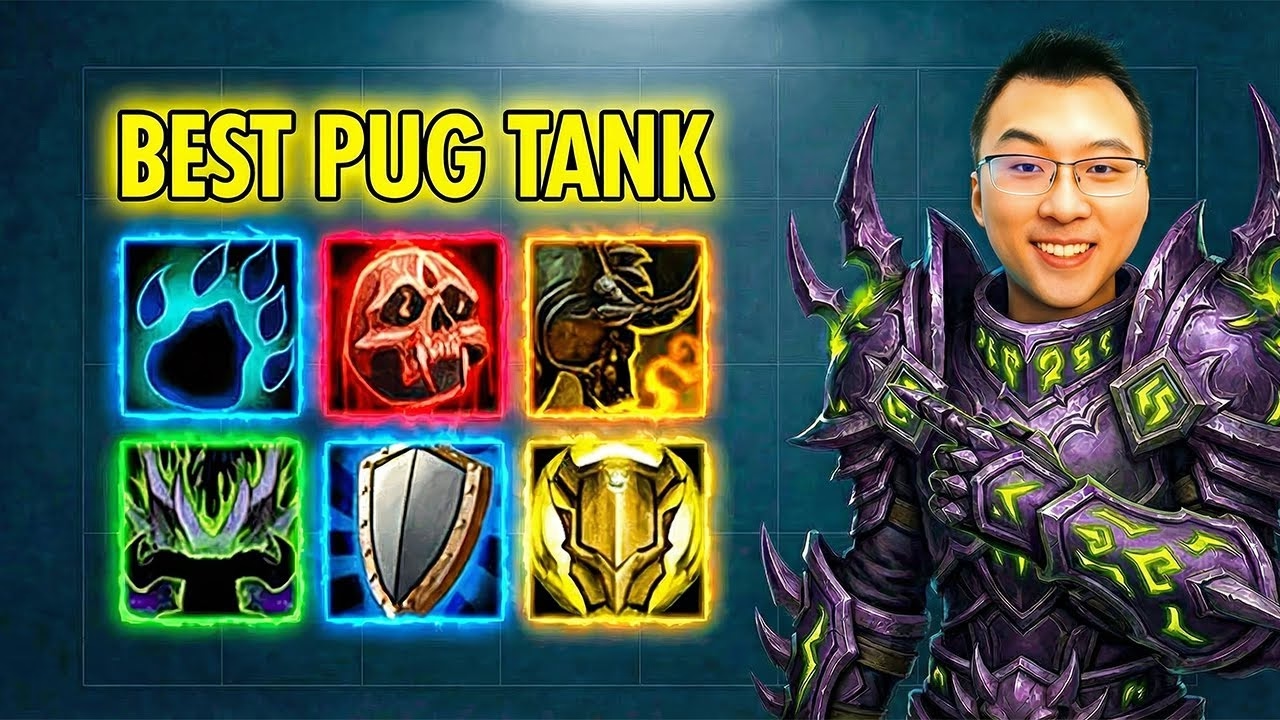
Playing as a tank in Mythic Plus (M+) can be a daunting task, particularly for players who queue alone and rely on the group finder to pair them with strangers. Unlike coordinated groups optimising for damage and synchronisation, solo queuing or "pugging" demands a different approach. In a typical PUG scenario the main goal is variance reduction — minimising unpredictable elements that could lead to failure. In these situations, the choice of tank spec becomes crucial, and it differs significantly from what optimal coordinated groups run.
When pugging, the uncertainties are numerous. You can't always control or predict:
The focus is on optimising your own gameplay to mitigate these uncontrollable factors rather than relying on group coordination.
Here is a breakdown of how different tank specs perform in a PUG environment:
With each spec's strengths and weaknesses mapped out, a few patterns stand out for PUG success.
Blood DKs shine in unpredictable settings through their self-sustain, yet each tank's PUG viability depends as much on the player's familiarity with the spec as on its raw toolkit.
Brewmaster Monks, with their stagger mechanic, face unique challenges in pickup groups. Their low representation among tank specialisations contributes to healers being unfamiliar with how the spec works. This unfamiliarity can result in healers either overcompensating with excessive healing or failing to respond adequately to the Monk's needs. While Brewmasters thrive in coordinated groups due to their offensive capabilities and useful damage buffs, they often require more active management from healers — a significant drawback in PUG environments.
Protection Paladins offer a remarkably high level of utility, making them invaluable in PUGs. They come equipped with a wide array of tools for managing group dynamics:
However, mastering their gameplay involves managing numerous defensive cooldowns. A paladin tank must learn to rotate these efficiently to maintain viability in challenging situations. This complexity creates a dichotomy between experienced players — who can become nearly unkillable — and novices who may struggle.
Protection Paladins reward mastery, but in PUG environments that mastery is rarely guaranteed — which brings us to a spec that trades peak ceiling for consistent reliability.
Guardian Druids are often pegged as "boring" due to their straightforward rotation and simplicity. Yet, in the unpredictable landscape of PUGs, they offer distinct advantages:
These qualities make Guardian Druids particularly forgiving and reliable tank choices for PUG environments where coordination is limited. Their straightforward playstyle lets them focus on leading, which is essential for maintaining order in chaotic dungeons.
| Spec | Key Strengths | Challenges |
|---|---|---|
| Brewmaster Monk | Offensive buffs, challenging gameplay | Requires more healer attention |
| Protection Paladin | High utility, versatile support | Complex cooldown management |
| Guardian Druid | Simple rotation, strong survivability | Perceived as less engaging |
The choice of tank spec in a PUG setting should reflect strategic considerations as well as personal preference. While Brewmaster Monks and Protection Paladins have their merits, Guardian Druids stand out for their ease of play and robustness in unpredictable group dynamics.
For those navigating the complexities of PUG tanking, selecting a specialisation extends beyond raw capability. It involves understanding the dynamics of pickup group environments and valuing stability over individual heroics. While Guardian Druids may not offer the flashy utility of a Protection Paladin or the self-sustain of a Death Knight, their consistency and ease of play make them an excellent choice for players who prefer predictable outcomes in chaotic settings.

Guardian Druids keep aggro steady and simplify rotations, allowing players to focus on leading their party. In PUG scenarios, having a reliable tank often proves more valuable than aiming for the highest performance ceiling. The focus shifts from trying to carry through extreme versatility to maintaining steady, manageable performance that supports group success.
Selecting a Guardian Druid suits various scenarios:
Whether you are building fundamentals or running relaxed keys, the habits formed on Guardian Druid carry into higher key levels as well.
The tank meta fluctuates with each season's buffs and tuning, but the core challenges of PUG environments remain constant. Healer variance, DPS who rush aggro, and unexpected key failures all highlight the need for a tank spec that prioritises consistency and control. Opting for a class that complements these dynamics — rather than following fluctuating meta trends — delivers more lasting success in PUG contexts.
By prioritising a stable tanking experience, players can navigate the unpredictable world of PUGs with confidence regardless of the shifting metagame. Players ready to run keys can browse Mythic+ carry options at every tier from M+0 to Keystone Legend.
Guardian Druid is widely recommended as the best PUG tank in WoW Midnight for its simple rotation, reliable survivability, and low mental overhead. This lets the tank focus on leading the group and handling mechanics rather than managing complex cooldown sequences.
Guardian Druid reduces PUG variance — their defensive toolkit works independently of the healer's attentiveness. Barkskin, Survival Instincts, and Frenzied Regeneration cover most emergency scenarios without requiring healer coordination or complex cooldown timing.
Blood DK is an excellent PUG tank for experienced players — Death Strike self-healing means they can survive without healer support, which covers healer variance perfectly. The trade-off is a fluctuating health bar that can cause healer panic, and slow movement that can be an issue in fast-paced Mythic+ dungeons.
VDH has a high skill floor and requires setup time at the start of each pull — sigils need to be placed before damage peaks. In PUGs where DPS start dealing damage before the tank is set up, VDH's defensive window is often missed. It rewards coordinated groups more than solo-queue environments.
Stagger delays a portion of incoming damage over several seconds rather than absorbing it all instantly. This spreads the healing load across time — but healers unfamiliar with the spec often overcompensate (wasting cooldowns on minor dots) or underreact (missing a spike because the displayed health looks stable). In PUGs, most healers simply have less experience with Brewmaster than with other tanks.
Guardian Druid has the lowest learning curve of any tank in Midnight's Mythic+ pool. The rotation centres on maintaining Ironfur stacks for physical mitigation, with three major personal defensive cooldowns on long timers. There is no complex resource management, no stagger tracking, and no setup-dependent cooldown windows.
Protection Paladins offer some of the highest reactive utility of any tank — Blessing of Protection, Spellwarding, and Lay on Hands can rescue teammates from otherwise fatal mistakes. The trade-off in PUGs is complexity: inexperienced Prot Paladin players who mismanage their cooldown rotation are far more vulnerable than a Guardian Druid with similar skill investment.