Key Takeaways
- Holy Armaments places a ground-targeted reticule; allies who run over it gain either Holy Bulwark (an absorb shield scaling with max health) or Sacred Weapon (a Holy damage proc on spells and abilities).
- The Lightsmith tree is shared between Holy and Protection specs, built around the fantasy of forging weapons of Light inspired by Lady Liadrin and Turalyon.
- Protection Paladins in Mythic+ already manage interrupts, crowd control, and mitigations — Holy Armaments placement added another axis of cognitive load to the role.
- Fear No Evil offered near-zero PvE value in its initial form; Laying Down Arms and Valiance needed clearer alignment with Protection's gameplay loop.
- The core improvement suggested at launch: change Holy Armaments from ground-reticule to player-targeted placement, preserving the social fantasy while cutting visual clutter in chaotic encounters.
The tree's core loop, its cognitive demands in live content, and where the launch version landed relative to expectations all deserve a closer look.
The Lightsmith Hero Talent Tree
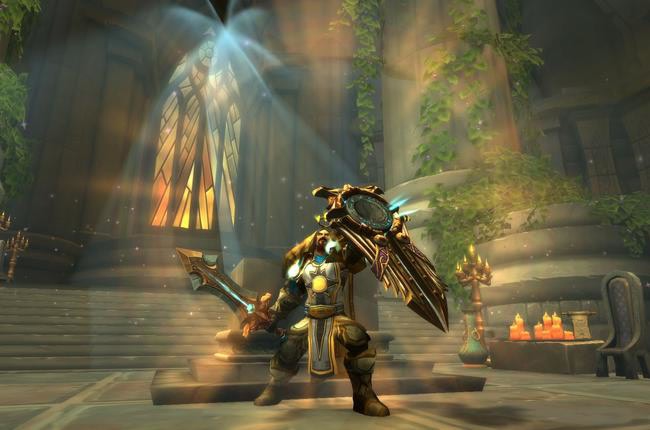
Blizzard's Lightsmith Hero Talent Tree is a shared option for Holy and Protection Paladins, built around the concept of forging weapons of Light to aid allies. Inspired by the stories of Lady Liadrin and Turalyon, the tree frames the Paladin as an agent of the Light who equips allies rather than simply mitigating damage.
The keystone talent, Holy Armaments, places a ground-targeted reticule on the field. When a friendly player runs over it, they receive one of two effects: Holy Bulwark, a scaling absorb shield based on max health, or Sacred Weapon, which adds a Holy damage proc to spells and abilities. Several other talents augment this interaction loop and deepen the Light-forging fantasy.
✏️ Placement tip: Drop Holy Armaments just before your tank cooldown window — the absorb from Holy Bulwark stacks with most external defensives and front-loads mitigation right as the damage pattern spikes. Pre-positioning in the doorway of a pull gives melee DPS a clean pickup without breaking their positioning.
Analysis of Proposed Gameplay
Holy Armaments introduced complexity not present in prior Protection toolkits. The ground-placement mechanic required the Paladin to read encounter positioning and time the drop while managing mitigations, interrupts, and crowd control simultaneously. Managing which armament each player received — absorb vs. damage proc — added cognitive load for both the Paladin and the recipients.
The ability also generated visual clutter in already-busy encounters. Mythic+ dungeons, where Protection Paladins must track enemy casts, cleave timing, and teammate health at once, were the situations where the ground-reticule design felt most costly to the role. Groups running Mythic+ keys reported mixed results depending on how coordinated their roster was with picking up the armaments.
📌 Common mistake: Defaulting to Sacred Weapon for the healer because "they cast spells" misses the better pick. Healers in Mythic+ often benefit more from Holy Bulwark's absorb shield than the damage proc, since their throughput is rarely the limiting factor — surviving a mechanic is. Give Holy Bulwark to whoever is at risk of dying; give Sacred Weapon to a ranged DPS who won't need the shield.
On the positive side, Holy Armaments encouraged active teamwork. Deciding who received the armament, when to drop it, and where to place it required communication that aligned with WoW's group-content social contract. Coordinated groups extracted more value from the talent than random groups.
The Delves system raised an open question at launch: could NPCs like Brann Bronzebeard benefit from Holy Armaments? If not, solo-content Protection Paladins would lose most of the keystone's value in world content outside of group play.
⚠️ Warning: In chaotic pulls with heavy positional movement — such as the final stretch of Darkflame Cleft or the Skarmorak encounter — the ground reticule can be trampled by the wrong player or missed entirely if enemies force the group to reposition mid-pull. Save the armament drop for stationary or predictable phases rather than spacing it evenly across the pull.
Talent Considerations
Several talents in the initial Lightsmith design warranted attention before the expansion's release:
- Laying Down Arms and Valiance, in connection with Shining Light, could be better aligned with Protection's actual rotation priorities.
- Fear No Evil needed re-evaluation — its PvE value was near zero in the initial design.
These were pre-launch observations. Testing through the Alpha and Beta cycles typically refined talent interactions, and the Lightsmith was no exception to that process.
Suggestions for Improvement
The most impactful change would have been making Holy Armaments player-targeted rather than ground-placed. This would have preserved the social fantasy — the Paladin selects an ally and blesses their weapon — while removing the ground-reticule's visual noise and positioning overhead. In chaotic Mythic+ pulls, the difference between "drop it here and hope" and "target the tank" is substantial for both execution and clarity.
Closing Thoughts
The Lightsmith talent tree shipped in WoW's seventh expansion with its core mechanics intact. Holy Armaments, Holy Bulwark, and Sacred Weapon launched largely as described here, though tuning passes through the Alpha and Beta cycles adjusted interaction thresholds and balanced the ability for live raiding and Mythic+ environments. For Protection Paladins interested in the utility-support playstyle, Lightsmith remains a distinct option built around active ally enhancement rather than passive mitigation stacking.
FAQ
What is Holy Armaments in WoW?
Holy Armaments is the Lightsmith keystone talent for Protection and Holy Paladins. It places a ground-targeted object; allies who run over it gain either Holy Bulwark (absorb shield scaling with max health) or Sacred Weapon (Holy damage proc on spells and abilities).
What is the difference between Holy Bulwark and Sacred Weapon?
Holy Bulwark provides a scaling absorb shield based on the recipient's maximum health, making it ideal for tanks or players at risk of dying to a mechanic. Sacred Weapon adds a Holy damage proc to the recipient's spells and abilities, making it the better pick for ranged DPS with high uptime.
Is Lightsmith good for Protection Paladin in Mythic+?
Lightsmith added utility through Holy Armaments, but also raised the cognitive load of a role that already tracks interrupts, mitigations, and teammate health simultaneously. Organized groups extracted more value from the keystone than PUGs where coordination was harder.
Does Holy Armaments work on NPCs like Brann Bronzebeard?
This was an unresolved question in the pre-launch design. Whether Brann Bronzebeard could pick up Holy Armaments in solo Delve content directly affected how much Protection Paladins could extract from the Lightsmith tree in world content outside of instanced group play.
Which spec shares the Lightsmith tree with Protection Paladin?
The Lightsmith Hero Talent Tree is shared between the Holy and Protection specializations. Both specs access Holy Armaments and the surrounding talent line, though the optimal choices within the tree differ by spec role and content type.
Who inspired the Lightsmith fantasy in WoW lore?
Blizzard designed the Lightsmith around Lady Liadrin and Turalyon, two of WoW's most prominent Paladin figures and champions of the Light. The tree frames the Paladin as a forge-master of Light-blessed weapons, equipping allies rather than focusing purely on self-defense.
Last reviewed 2026-06-16 against Patch 11.0 The War Within — Maintained by WowCarry's WoW team.