What WoW Arena Actually Looks Like in Midnight Season 1
WoW Arena in Midnight Season 1 is best entered as a Solo Shuffle queue on the main you already enjoy playing. The bracket loop is straightforward — small-team elimination, ranked rating, weekly Conquest cap — but the on-ramp has more moving parts than the in-game tutorial admits: four active brackets, a separate PvP talent row, a gear track that scales differently inside instances, a Heraldry crafting reagent that drops nowhere obvious, and an addon stack the game does not install for you. This Part 1 walks the brackets, the gear path, the addons, and the rating ceiling so the first 20 hours go toward improving instead of fixing setup mistakes. Part 2 covers comp choice, target callouts, and trading cooldowns.
Key Takeaways
- Four active brackets: 2v2 Arena, 3v3 Arena, Solo Shuffle, and Rated Battleground Blitz. Solo Shuffle is the cleanest beginner entry because it removes the team-formation barrier; Blitz is solo-queue 8v8 with shorter games.
- PvP talents live on a separate three-slot row unlocked at levels 20, 30, and 40. They are active only inside instanced PvP (Arenas and Battlegrounds) — not in open world or PvE instances.
- Honor gear cost ~10,000 Honor for a full set at ilvl 276. Conquest weekly cap starts at 1,600 in Week 1 and rises 800 per week across Midnight Season 1.
- Heraldry is the real PvP crafting reagent. Galactic Gladiator's Heraldry (Conquest tier, scales to ilvl 289 in instanced PvP) and Galactic Aspirant's Heraldry (Honor tier) come from Irissa Bloodstar in Silvermoon or the Calling All Combatants weekly.
- PvP gems are the Heliotrope family: Cognitive Heliotrope for interrupt protection on casters and healers, Enduring Heliotrope for CC damage reduction on physical DPS. Honor buys Infused Heliotrope to craft them.
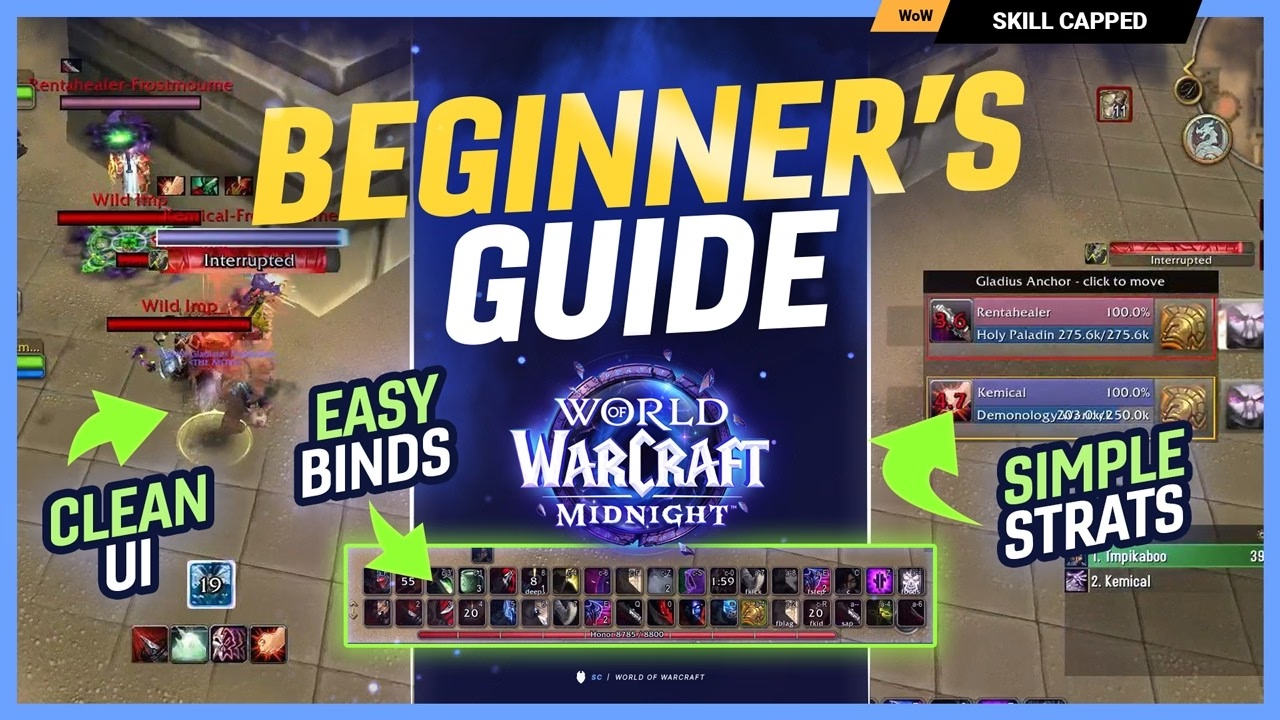
- The addon stack every rated player runs: GladiusEx or sArena (party frames), OmniCD (party cooldown tracking), Diminish (DR tracking), BigDebuffs (large debuff icons). All four are free.
- The Gladiator title in Midnight Season 1 wants Elite rank (2300 in 3v3) plus 50 wins above 2300 during the season; the seasonal mount is the Goredrake.
From here, the guide walks the brackets, the spec picks, the addon stack, the gem and Heraldry path, and the rating ladder in the order a new player actually meets them.
Arena Brackets and How to Pick the First One
The bracket choice below decides the on-ramp; the gear and addon stack that follow are what make any bracket workable.

Midnight Season 1 has four rated arena-family brackets and one unrated practice mode. Each gives separate rating, separate Conquest progress, and slightly different reward tracks.
- 2v2 Arena is the bracket to pick if you already have one friend on the same patch. Fastest games, smallest comp space, heavy on healer + DPS pairs.
- 3v3 Arena is the traditional ladder and the bracket Gladiator titles historically come from. Three roles, deeper comp interactions; queue it once you have a stable trio.
- Solo Shuffle is the default first bracket for a beginner without a team. Six rounds of 3v3 with rotating teammates: Queue Solo Shuffle without a team and the bracket fills the rest of the lobby for you. Player score depends on aggregate round wins.
- Rated Battleground Blitz is the fast-rating option: solo-queue 8v8 across smaller versions of the classic BG maps, 6 to 10 minute games. Queue it if you want rating fast and do not mind objective-based play over kill-the-healer arena.
- Skirmishes is the unrated 2v2 or 3v3 practice queue. No rating, no Conquest, no reward; the bracket exists to test new specs or comps before queueing rated.
For a first bracket, Solo Shuffle is the standard recommendation — no team formation, plenty of games, and the rotating teammates teach what every spec does at a baseline. Players who already have a friend on the same patch can lean 2v2 or 3v3 instead. Whichever you pick, the rating and Conquest you earn there transfers across brackets via Honor gear unlocks, so the choice is not locked in for the season.
Class and Spec Selection for a First Patch
The single best class for PvP in Midnight Season 1 is the one you already play in PvE. Re-learning a class while learning Arena is two mountains at once. If you are starting fresh and want the smoothest on-ramp, the beginner-friendly picks are Fury Warrior, Arms Warrior, Beast Mastery Hunter, Holy Paladin, and Blood Death Knight. They share three traits — strong defensives, simple kill-window structure, and easy match-up rules — that let a beginner survive while learning when to press buttons.
Avoid the high-skill-floor picks (Affliction Warlock, Subtlety Rogue, Mistweaver Monk) for Part 1. They are competitive at the top of the ladder but require comp knowledge to function at the bottom of it. The same logic applies to recently reworked specs — wait until you have 50 games of muscle memory before testing whatever just got a kit overhaul on patch.
📌 Common mistake: re-rolling for the patch tier list. Patch tiers move every six weeks. The class you already trust will out-perform a flavour-of-the-month pick you are unfamiliar with until you have 200+ games on it.
PvP Talents: A Separate Row With Different Rules
PvP talents sit on a three-slot row, unlocked at level 20, 30, and 40. They are active only inside instanced PvP — Arenas and Battlegrounds — and are inert in open world, dungeons, and raids. Most of them are CC, dispel, mobility, and defensive options that PvE does not need.
For Part 1, copy the top-rated PvP talent build for your spec from Murlok.io or Wowhead and keep it the same for the first 50 games. Talent micro-optimisation comes after you understand what each talent does to your match-ups, not before. Players who want to swap talents mid-session need to leave the arena queue first — you cannot change PvP talents while in queue.
Movement, Keybinds, and the Setup You Actually Need
Mouse-turn and keyboard-strafe is the foundation of every rated PvP player's setup. If you currently press A and D to turn (keyboard-turn), rebind them to strafe and turn with right-mouse drag. This single change unlocks burst-and-move execution that is impossible with keyboard-turning.
Bind the following on every spec: every offensive spell, every defensive cooldown, every interrupt, every dispel, and at least four CC abilities. Trinket and racial go on accessible keys (F1-F4 or shift-modifier). Set focus-target macros for your top-priority CC — being able to sap or polymorph a target without retargeting is the difference between landing a kill and watching it stabilise.
Map Awareness in Active Arenas
Each Midnight arena map has its own pillar furniture; Nagrand's wide ring is the cleanest first map for line-of-sight practice.

Midnight Season 1 rotates a mix of legacy arena maps including Nagrand Arena (the open desert ring with pillars on both ends), Hook Point (the rooftop with a corner-camp side), Mugambala (an island with a center bridge and side stairs), and Empyrean Domain (the spire map with the LOS pillar in the middle). Each map has its own line-of-sight (LOS) furniture that decides where the kill window opens.
The general rule is: spend the opening minute scouting where the LOS furniture is from spawn. If you do not know where the pillars are, every fear, polymorph, or instant-cast burst gets dragged behind one you did not see. Wowhead's per-map guides cover the high-LOS spots, the rotation paths, and the danger lanes for each.
Practicing Rotations Before You Queue
Target dummies in any major capital city are free practice for sustained and burst rotations. Run your standard opener three times on each dummy — single-target, AoE, with cooldowns, without cooldowns — until you can land it without looking at your bar. Add a stun into your burst window during practice; arena bursts almost always include CC because the target trinkets out of the first one.
Once dummy reps land cleanly, queue Skirmishes to test the rotation under pressure, then move to rated. Players still deciding which bracket fits their schedule can Climb arena across every bracket on the main they already enjoy; rating and Conquest follow the character, not the queue type.
✏️ Pre-queue checklist: refresh PvP talents, refresh focus macros, check trinket / racial / interrupt are on accessible keys, refresh Heliotrope gem (Cognitive on caster / healer, Enduring on physical DPS), confirm Heraldry-crafted slot pieces are equipped, and load GladiusEx (or sArena), OmniCD, Diminish, and BigDebuffs before clicking Queue.
Gearing: Honor, Conquest, and the Heraldry Path
Midnight Season 1 anchors all of the rewards below — Honor gear costs, Conquest cap progression, Heraldry crafting tiers, and the Goredrake mount.

PvE gear is suboptimal for instanced PvP because the rating system scales PvP gear higher when worn inside an arena or battleground than its tooltip ilvl suggests. The gearing track in Midnight Season 1 is:
- Honor Gear — bought at vendors in Silvermoon's Falconwing Square for Honor. A full Honor set runs roughly 10,000 Honor and lands you at ilvl 276 base. Honor comes from Random BGs, Skirmishes, and the Calling All Combatants weekly quest.
- Conquest Gear bought for Conquest, capped weekly. The cap starts at 1,600 in Week 1 and rises 800 per week across the season. Conquest gear scales to ilvl 289 inside instanced PvP.
- Crafted Conquest Gear using Galactic Gladiator's Heraldry. Crafted slots scale to the same ilvl 289 ceiling in instanced PvP and let you pick exact secondary stats.
The Galactic Gladiator's Heraldry (Conquest tier) and Galactic Aspirant's Heraldry (Honor tier) are the PvP crafting reagents that let an inscriber turn raw materials into upgradeable gear. Both come from Irissa Bloodstar, the PvP quartermaster in Silvermoon, or from the Calling All Combatants weekly. A crafted gear set with the right secondary stats can outperform raw Conquest in a few slots — bracers, belt, and one accessory are the common picks.
PvP Gems: The Heliotrope Family
Midnight Season 1's PvP gem family is the Heliotrope line. There are two completed gems and one raw material:
- Cognitive Heliotrope — interrupt protection. The default pick for healers, casters, and Feral Druids.
- Enduring Heliotrope — CC damage reduction. The default for physical DPS specs that do not need an interrupt buffer.
- Infused Heliotrope — the raw material, bought with Honor and consumed in the recipe. Inscribers craft both completed gems from it.
Socket a single PvP gem in the helm or chest. The match-up rule is straightforward: if you press an interrupt every cast, run Cognitive; if you spend cooldowns to break out of CC instead, run Enduring.
The Beginner Addon Stack
Four addons every rated PvP player runs, none of them paywalled:
- GladiusEx (or sArena) — replaces the default arena enemy frames with target frames you can actually click. Click-to-target is faster than tab-target on every map.
- OmniCD — tracks party cooldowns above your raid frames. You see your healer's defensives and your partner's burst window without asking in voice.
- Diminish — tracks the diminishing returns (DR) timer on every CC category. After a 4-second stun, the next stun on the same target is half duration; after another, immune for 20 seconds. Diminish shows the timer.
- BigDebuffs — enlarges the icon on important debuffs (stuns, freezes, CCs, defensives). Lets you see "they used trinket" or "they're stunned" at a glance.
Install all four before the first ranked queue. The default UI alone is workable for unrated Skirmishes but loses to anyone running the stack in rated.
Rating Brackets and What They Reward
Rating in Midnight Season 1 awards titles at fixed thresholds: Combatant I (1000), Combatant II (1200), Challenger I (1400), Challenger II (1600), Rival I (1800), Rival II (1950), Duelist (2100), and Elite (2300). The seasonal Gladiator title needs 50 wins above 2300 (Elite rank) in 3v3 during the season, rewarding the Goredrake mount. Vicious Saddle drops from filling the seasonal Vicious bar (Conquest contributes to the bar) and buys legacy PvP mounts.
For Part 1, focus on Combatant II → Challenger I (1200 → 1400). That climb teaches positioning, cooldown trading, and target switching without forcing you into match-up theory. Rival and above is where comp knowledge starts gating wins.
FAQ
Which arena bracket should a beginner queue first?
Solo Shuffle. It removes the team-formation barrier, runs six rounds of 3v3 with rotating teammates so you learn every spec at a baseline, and rating climbs at roughly the same pace as standard 3v3. Players who already have a friend can queue 2v2 instead for faster games.
Do PvP talents work in PvE?
No. The three-slot PvP talent row is active only inside Arenas and Battlegrounds. They do nothing in open world, dungeons, raids, or Skirmishes — the rule is "instanced PvP only".
How long does it take to gear up for rated PvP?
A full Honor set runs about 10,000 Honor, which is one weekend of Random BGs or roughly a week of casual play. Conquest pieces fill in over four-to-six weeks because of the weekly cap (1,600 → 2,400 → 3,200 across the early weeks). Crafted Conquest gear with Heraldries can shortcut a few key slots.
Which PvP gem should a healer use?
Cognitive Heliotrope. Healers cast more than they hit, and the interrupt protection from Cognitive reduces the lockout window when a melee gets a kick on you. Casters and Feral Druids follow the same rule. Physical DPS specs run Enduring Heliotrope for the CC damage reduction instead.
What does Conquest gear scale to inside arenas?
Conquest gear scales to ilvl 289 inside instanced PvP, regardless of the lower number shown on its tooltip in the open world. Crafted Conquest gear using Galactic Gladiator's Heraldry caps at the same 289 ceiling and lets you pick the secondary stats.
When does the Conquest cap reset and how high does it go?
The cap resets every Wednesday on US servers and every Thursday on EU. Week 1 starts at 1,600 and the cap rises 800 each week. By the end of Season 1's progression the cap is high enough that weekly grinders can buy a full Conquest set inside one reset.
What's the Gladiator title requirement in Midnight Season 1?
50 wins above Elite rank (2300) in 3v3 Arena during the season. The reward is the Goredrake mount and the Gladiator title. Solo Shuffle awards its own Legend title at 100 round wins at Elite rank but does not award the seasonal mount.
What Part 2 Will Cover
Part 2 of this beginner series picks up where setup ends and gameplay begins — comp choice past Solo Shuffle's randomised teams, target callouts and kill priority, how cooldown trading works against specific match-ups, and the trinket/defensive economy that decides every Rival-to-Duelist game. If Part 1 was "what to install before queueing," Part 2 is "what to press once you are in."
Maintained by WowCarry's WoW team. Last reviewed 2026-05-19 against Patch 12.0.5 Lingering Shadows.