Devastation Evokers in Midnight PvP: What Changed and What It Means
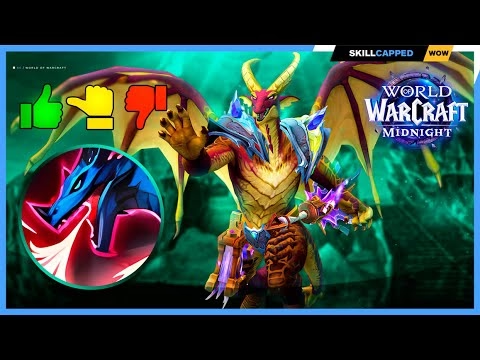
Devastation has cemented its place as one of the most distinctive ranged DPS specs in WoW's competitive PvP scene. Entering Midnight (the third expansion), Devastation carries the same explosive identity it is known for: front-loaded burst inside Dragonrage, sustained pressure from Disintegrate and Pyre, and per-cooldown damage that forces opponents to either interrupt the burst or die to it. Several abilities have been converted from active to passive, lowering the execution floor while preserving Devastation's high-skill ceiling in arena and rated PvP formats.
Key Takeaways
- Dragonrage burst remains Devastation's core win condition — every major talent change in Midnight is designed to extend, amplify, or recover from the Dragonrage window.
- Rising Fury stacks to 20% Haste during Dragonrage (4% per stack × 5 stacks), then adds a 15% damage bonus at max stacks — together they double the payoff of a well-executed burst window.
- Animosity's cap removal is significant but not infinite: diminishing returns cap the practical Dragonrage extension at roughly 30–34 seconds, so sequencing around that window still matters.
- Quell now requires a talent point in the Devastation spec tree — PvP players who skip it have no interrupt, a consequence that did not exist in previous expansions.
- Refined Essence was buffed to 25% in Midnight; pre-expansion guides showing 15% are outdated, and this node is now a near-mandatory damage pick.
- Scalecommander and Flameshaper are the two hero talent trees for Devastation Evoker — Scalecommander synergizes with Deep Breath burst; Flameshaper favors sustained fire-breath-heavy pressure.
- Devastation Evoker sits at A+ tier on the Icy Veins PvP DPS ranking for 12.0.5, rewarding players who master the Dragonrage burst sequence in arena.
Read on for a full breakdown of every major change and what each means for your PvP build.
Major Class Changes in Midnight
Several abilities and talents received significant redesigns at the start of Midnight:
- Renewing Blaze: Renewing Blaze now heals equal to the damage Obsidian Scales mitigated — not 100% of all damage taken. The heal scales with the amount absorbed, tightening the synergy between the two abilities.
- Unravel to Passive: Unravel now triggers automatically when Fire Breath hits enemies with absorb shields, dealing Spellfrost damage against those shields. Classes with heavy absorb mechanics — Death Knights running Anti-Magic Shell, Monks with Zen Meditation — become noticeably harder to shield-stack against a Devastation Evoker.
- Twin Guardian Redesign: The talent that upgrades Rescue, Twin Guardian, no longer provides a defensive shield to the repositioned ally. Instead, it grants 100% movement speed and allows spell-casting while moving for 3 seconds. Rescue itself still functions as a positional save in team PvP.
- Stretch Time: A new defensive talent that converts all damage taken while flying during Deep Breath into a 10-second damage-over-time effect, reducing burst vulnerability mid-channel.
✏️ Expert note: Quell now requires a talent point in the Devastation spec tree in Midnight — it was moved out of the class tree. PvP players who do not invest the point will have no interrupt at all, making this one of the more consequential build decisions in the expansion.
Talent Tree Enhancements
The Devastation spec tree received several pivotal additions:
- Animosity (Uncapped): Animosity no longer has a hard cap on Dragonrage extensions. Each empowered ability cast during Dragonrage extends the window, subject to 25% diminishing returns per successive cast. Well-executed windows reach 30–34 seconds — long enough to dramatically increase sustained output above what was possible with a capped extension.
- Shattering Star (Passive Integration): Shattering Star is now a passive triggered by Eternity Surge. It fires automatically on each Eternity Surge cast, trading standalone burst flexibility for reliable sustain amplification. The ceiling is unchanged; the execution requirement is lower.
- Azure Sweep: When Eternity Surge is cast, the next Azure Strike transforms into a buffed AoE version dealing significantly increased damage to all nearby enemies. Positioning and target density determine its impact.
- Strafing Run: Allows a second Deep Breath cast within 18 seconds of the first. Despite community speculation, Strafing Run has no stun component — it is a cooldown reset for mobility and additional Deep Breath damage, not crowd control.
- Quell Placement: As noted above, Quell now occupies a spec tree node. The talent point cost is a genuine trade-off when optimizing PvP builds around interrupt coverage versus throughput nodes.
📌 Expert note: Animosity has no hard cap, but diminishing returns mean each successive extension buys less time than the last. Plan around a 30–34 second window (not an open-ended one) for reliable burst sequencing in arena.
Rising Fury Talent Synergy
Two spec-tree talents work together to amplify the back half of every Dragonrage window:
- Rising Fury: Grants 4% Haste every 6 seconds while Dragonrage is active, stacking up to 5 times for 20% Haste total. At maximum stacks (reached roughly 24 seconds into a Dragonrage window), Rising Fury also provides a 15% damage increase, compounding with the Haste already accumulated.
- Risen Fury: When Dragonrage ends, Risen Fury activates for 4 seconds per Rising Fury stack accumulated, preserving both the Haste and damage bonuses and generating an Essence Burst every 4 seconds. A full 5-stack exit yields 20 seconds of Risen Fury uptime, sustaining pressure after the burst window closes.
The practical arc: Dragonrage opens with its raw damage bonus, Rising Fury acceleration builds through the middle, and Risen Fury extends the pressure into the aftermath. Opponents need to survive the first 15 seconds or disrupt the ramp before stacks fully build.
⚠️ Expert note: Refined Essence was buffed to 25% in Midnight (up from 15%). Pre-expansion guides and some aggregators still show 15%. The current value for 12.0.5 is 25% increased damage on all essence-spending abilities — Disintegrate is the primary beneficiary in the Dragonrage window.
Hero Talent Trees: Scalecommander and Flameshaper
Devastation Evoker has two hero talent trees in Midnight: Scalecommander and Flameshaper.
Scalecommander amplifies Deep Breath burst through talents such as Command Squadron, which summons two Dracthyr allies to bombard enemies with Pyres during Deep Breath. This mirrors the offensive pressure of previous tier sets and synergizes with Strafing Run's second-charge Deep Breath. Scalecommander is generally preferred for arena formats where front-loaded kill windows matter most.
Flameshaper leans into sustained Fire Breath and essence-spender pressure. The Midnight rework introduced double charges of Fire Breath and improved synergy through Essence Well, Twin Flame, and Fire Torrent. Flameshaper's output does not match Scalecommander's burst peaks, but its sustained rotation provides steadier damage in prolonged fights or mid-bracket play. To push arena rating on Devastation Evoker, high-rating players in 12.0.5 generally favor Scalecommander for its burst kill potential.
Assessing Talent Changes
Not all Midnight talent reworks landed with equal impact in PvP environments:
- Concentrated Power: Mass Disintegrate cleaves an additional target; in arena play this rarely translates to meaningful strategic advantage, since most 2v2 and 3v3 encounters have too few targets for the cleave to change outcomes. Effectively redundant for bracket play.
- Refined Essence: A 25% damage increase on all essence-spending abilities is one of the stronger throughput multipliers available. Disintegrate, the primary filler during Dragonrage, benefits directly — making Refined Essence a near-mandatory pick for damage-focused builds.
- Flameshaper Comparison: Despite its rework, Flameshaper still trails Scalecommander for burst-heavy arena play due to the removal of Engulf's more complex but effective mechanics. The Flameshaper rotation's reliance on Fire Breath and Disintegrate repetition makes its ceiling more predictable, and therefore more counterable, than Scalecommander's Deep Breath burst.
The overall picture: Midnight's talent reworks rewarded specs that already relied on Dragonrage, and Devastation is the primary beneficiary.
New Talent Insights
- Essence Well gives Fire Breath a chance to trigger an Essence Burst, enabling occasional free Disintegrate casts. A consistent minor benefit — adds passive proc pressure without requiring spec changes.
- Twin Flame increases damage on Essence Burst consumption. With a 25% buff to Twin Flame damage in 12.0.5 tuning, it contributes more meaningfully to overall output even without redefining Flameshaper's identity.
- Fire Torrent allows Twin Flame to hit additional targets, providing marginal burst improvement in multi-target PvP scenarios. Base damage remains too low to shift Flameshaper's tier placement on its own.
Taken together, these three talents strengthen Flameshaper's floor without dramatically raising its ceiling. The community response has been measured — useful additions, not enough to displace Scalecommander from its preferred arena slot.
PvP Talent Pool and Viability Assessment
The Devastation Evoker PvP talent pool in Midnight 12.0.5 received fewer updates than the spec tree, a point of ongoing community discussion. Confirmed PvP talents include Unburdened Flight (movement immunity during Hover), Time Stop, Nullifying Shroud, Obsidian Mettle, and Scouring Flame. Strafing Run creates tactical variety by enabling a second Deep Breath within the same engagement window, though key mobility tools like Unburdened Flight feel baseline-worthy rather than opt-in for competitive play.
| Talent Aspect | Insight |
|---|---|
| New Talents | Subtle enhancements — strong individually, not game-changing in isolation |
| Concentrated Power | Redundant in arena; cleave rarely applies in 2v2/3v3 |
| Refined Essence | 25% essence damage increase — near-mandatory for DPS builds |
| PvP Talent Changes | Minimal updates; Unburdened Flight remains essential |
Dragonrage remains Devastation's most recognizable threat — its extended window in Midnight, amplified by Animosity and Rising Fury, makes Evokers high-priority targets during their burst phase. Despite limited PvP talent updates, Devastation holds A+ tier in the current 12.0.5 DPS PvP ranking. Players willing to master the burst rotation will find their opponents underprepared for a spec with roughly 1.3% representation in the current meta. For a full look at WoW PvP boost services, the hub covers both arena and rated battleground formats.
Frequently Asked Questions
Is Devastation Evoker good in PvP in Midnight?
Yes. Devastation Evoker is rated A+ tier on the Icy Veins PvP DPS ranking for Midnight patch 12.0.5. Its Dragonrage burst window — amplified by Rising Fury stacking to 20% Haste and a 15% damage bonus at max stacks — creates one of the highest per-cooldown damage ceilings in arena play.
What are the two hero talent trees for Devastation Evoker?
Scalecommander and Flameshaper. Scalecommander focuses on burst amplification during Deep Breath and Dragonrage, with Command Squadron summoning Dracthyr allies for additional Pyre damage. Flameshaper emphasizes sustained Fire Breath and essence-spender pressure with a more consistent rotation suited to longer fights.
Does Quell require a talent point in Midnight?
Yes. In Midnight, Quell moved from the class talent tree to the Devastation specialization tree. PvP players who do not spend a talent point on it will have no interrupt — a significant trade-off when building around interrupt coverage in arena formats.
How long does Dragonrage actually last with Animosity?
Animosity removes the hard cap on Dragonrage extensions, but each successive empowered ability cast extends it by 25% less than the previous one. In practice, a well-executed Dragonrage window with Animosity lasts approximately 30–34 seconds. Planning around that realistic window (not an infinite one) produces more consistent burst sequencing.
What does Rising Fury actually do?
Rising Fury grants 4% Haste every 6 seconds while Dragonrage is active, stacking up to 5 times for 20% Haste total. At maximum stacks it also provides a 15% damage increase. When Dragonrage ends, the companion talent Risen Fury preserves these bonuses for 4 seconds per stack accumulated (up to 20 seconds at 5 stacks), sustaining burst output after the window closes.
What changed with Rescue in Midnight?
The base Rescue ability is unchanged — it still repositions an ally to safety. What changed is Twin Guardian, the talent that upgrades Rescue. It no longer provides a defensive shield to the repositioned ally. Instead it grants 100% movement speed and allows spells to be cast while moving for 3 seconds, making it a repositioning amplifier rather than an emergency absorb.
Is Scalecommander or Flameshaper better for arena PvP?
Scalecommander is generally preferred for arena in Midnight 12.0.5. Its Deep Breath burst amplification through Command Squadron and synergy with Strafing Run's second-charge mechanic creates stronger front-loaded kill windows. Flameshaper suits sustained pressure styles and matchups where rotation consistency matters more than raw burst ceiling.