Midnight Season 1 Raids: The Working Walkthrough
Midnight Season 1 ships three raids and nine bosses in 12.0.5 "Lingering Shadows," live since April 21, 2026. The Voidspire is the marquee six-boss tier and the only raid that drops tier-set tokens; The Dreamrift is a single-boss intermission raid; March on Quel'Danas closes the season with the cinematic L'ura, Midnight Falls finale. Heroic clears for all three are now routine; Mythic is still the cull for end-game raiders. This is the working walkthrough: what every boss does, what kills pugs, and the order that wins on Wednesday reset night.
Key Takeaways
- Three raids, nine bosses. Voidspire (6), Dreamrift (1), March on Quel'Danas (2). Tier tokens drop in Voidspire only.
- Release windows: Dreamrift Normal/Heroic March 17, 2026 (Mythic March 24); Voidspire and March on Quel'Danas staggered through early April with LFR/Story unlocking April 7.
- The seasonal raid buff ticks +1% per week starting April 15, 2026, giving Mythic prog teams an extra ~5% by mid-May.
- Crown of the Cosmos (Voidspire 6) is Alleria Windrunner. The fight is a three-stage, two-intermission slog with the Devouring Cosmos slice mechanic.
- The S1 finale is L'ura, Midnight Falls, not Belo'ren. Belo'ren is the first MQD boss; L'ura is the second and the tier closer.
- Item-level bands: LFR 237, Normal 250, Heroic 263, Mythic 276 (Dreamrift confirmed; Voidspire and MQD similar within a few ilvls).
With the headline calls in place, the rest of the post walks through each raid in encounter order, plus a closing section on tier-token routing.
Release Schedule and Tier Structure
The Season 1 unlock cadence was the staggered rollout Blizzard piloted in the previous expansion:
| Raid | Bosses | Normal / Heroic | Mythic / RF | Drops tier? |
|---|---|---|---|---|
| The Dreamrift | 1 | March 17, 2026 | Mythic March 24 | No |
| The Voidspire | 6 | Staggered through April | LFR April 7 | Yes (bosses 2, 3, 4, 5) |
| March on Quel'Danas | 2 | Staggered through April | LFR April 7 | No |
The most efficient weekly route for a fresh character is Voidspire bosses 1 through 4 for tier tokens, Dreamrift for the catch-up loot pool, then Voidspire 5 and 6, then March on Quel'Danas for the cosmetic and the final ilvl bump. Single-boss Voidspire clears are common for groups that just need a specific token slot, and you can compare Midnight Season 1 raid carries if the prog calendar is full this week.
Voidspire Boss 1: Imperator Averzian
The opener and the gear check. Averzian's headline mechanic is the tile-claiming board: Abyssal Voidshapers spawn and channel Gathering Darkness to claim arena tiles, building a three-in-a-row that empowers Averzian's next cast. Umbral Collapse drops on tank position with a delayed AoE; the raid moves stacked to avoid claimed tiles.

What kills pugs: ignoring Voidshapers, eating a full three-in-a-row, and tanks dragging Averzian into the raid stack during Imperator's Glory (a buff aura on the boss). Tanks also need to swap on Blackened Wounds when the stack builds high. On Mythic, Voidshapers gain Cosmic Shell that requires a Void Marked dispel before they're killable.
Voidspire Boss 2: Vorasius
The hatchling fight. Vorasius is the broodmother, and the achievement "Hungry Hungry Hatchlings" (feed parasites to the brood) is a clear-night joke; the real fight is the Shadowclaw Slam → Aftershocks cycle. Slam targets the active tank, drops crystals, and reverberates outward in pulses. Stand outside the slam impact and inside the aftershock ring.
Parasitic Creeps spawn on a timer; killing one triggers Blisterburst, a poison cloud the raid needs to side-step. Void Breath is a frontal cone, so face Vorasius away from the raid. Primordial Roar pulls everything in toward the boss and AoEs on the way; pop personals or break the pull with a knockback. If no enemies are within range, Vorasius casts Overpowering Pulse, a punishing raid-wide. Keep the parasites alive long enough to break the pulse cycle.
Voidspire Boss 3: Fallen-King Salhadaar
Salhadaar is the clone puzzle. Fractured Projection splits him into shadow copies, and the raid has to track which one is real while Shadow Fracture drops puddles. Real Salhadaar resumes casting Despotic Command on a tight loop: pulsing AoE that drops puddles and applies a healing-absorb debuff.
Shattering Twilight hits the active tank first, then jumps to the next two players in line, ending with directional shadow spikes. Entropic Unraveling is a long raid-wide window where everyone takes amplified damage and the floor sweeps with Umbral Beams. Healer cooldowns line up on the Entropic window.
Other mechanics to track: Void Convergence spawns Concentrated Void orbs (intercept them), Void Exposure is a dispel-stacking debuff, and Destabilizing Strikes is the tank DoT (swap when stacks get high). On Mythic, Enduring Void adds a soft enrage.
Voidspire Boss 4: Vaelgor & Ezzorak
Twin dragons and the most positioning-heavy fight in the raid. Vaelgor and Ezzorak share an HP pool that must stay roughly even across the fight; let one fall too far behind and the other enrages. Standard kill is split-tank: one tank on each dragon, positioned wide apart, with melee assigned to whichever dragon has the higher HP.
Ezzorak's headline cast is Gloom, a void orb that lands and forms a damage puddle; soakers shrink it, so rotate a soak team. Vaelgor casts Nullbeam as a tank-targeted frontal that drops a permanent Nullzone floor patch; aim it at the wall, not the raid. Both dragons cast Void Howl that spawns Voidorbs; the orbs fire Voidbolts at random players until intercepted. Dread Breath is a random-player fear cone (move out), Tail Lash is the backside cleave (no one behind), and Midnight Flames is the paired AoE that requires the two dragon groups to swap sides on a coordinated count.
Voidspire Boss 5: Lightblinded Vanguard
The council fight. Three Paladin bosses with linked HP, kill priority forced by the encounter:
- Commander Venel Lightblood (Retribution): burst-damage cleaves; first target.
- General Amias Bellamy (Protection): tanks the encounter; mitigation-heavy.
- War Chaplain Senn (Holy): heals the council; interrupt-priority on the cast bar.
The fight reads like an inverse five-mask council from old expansions: kill Lightblood first to remove the burst, then Bellamy to free up DPS, then Senn last because she's the punishment for poor interrupts. The hardest pug wipe is Senn out-healing the early DPS phase. Assign two interrupt rotations to Senn and prioritize her casts even when Lightblood is at low HP.
Voidspire Boss 6: Crown of the Cosmos (Alleria Windrunner)
The tier final. Three stages, two intermissions, and a Devouring Cosmos floor-eating mechanic that makes Stage Three the hardest checkpoint of the season.
Stage One sets up around three Undying Sentinels: Demiar (caster, Interrupting Tremor), Vorelus (Ravenous Abyss damage-reduction cone), and Morium (physical tank-buster with Dark Hand knockback). Sentinels are immune to damage until cleansed by Silverstrike Arrow, Alleria's recurring line AoE. Void Droplets spawn as small adds that explode into Corrupting Essence puddles; designate a soaker and never let them die in the raid stack.
Stage Two is the clone DPS race. Alleria summons her Rift Simulacrum and stacks Empowering Darkness while the clone is alive. Burst the clone's Cosmic Barrier before the empowered window closes; Silverstrike Ricochet chains arrows between players to strip Void debuffs in passing; Rift Slash is the tank stat-reduction stack (swap before the third stack lands).
Stage Three is the floor-eating finale. Devouring Cosmos covers a wedge of the room in a heavy-damage puddle that prevents healing. The escape is Dark Rush: feathers at the puddle edge grant a glide buff to jump slices. Aspect of the End drops tethers on tank, melee, and ranged; break order is Melee, then Tank, then wait for Grasp of Emptiness, then Ranged. The third Devouring Cosmos puddle is the practical soft enrage; land the kill before it. If your group is already at 5/6 and needs just the Crown, you can lock in a Voidspire 6/6 Mythic clear as a single targeted run.
The Dreamrift: Chimaerus, the Undreamt God
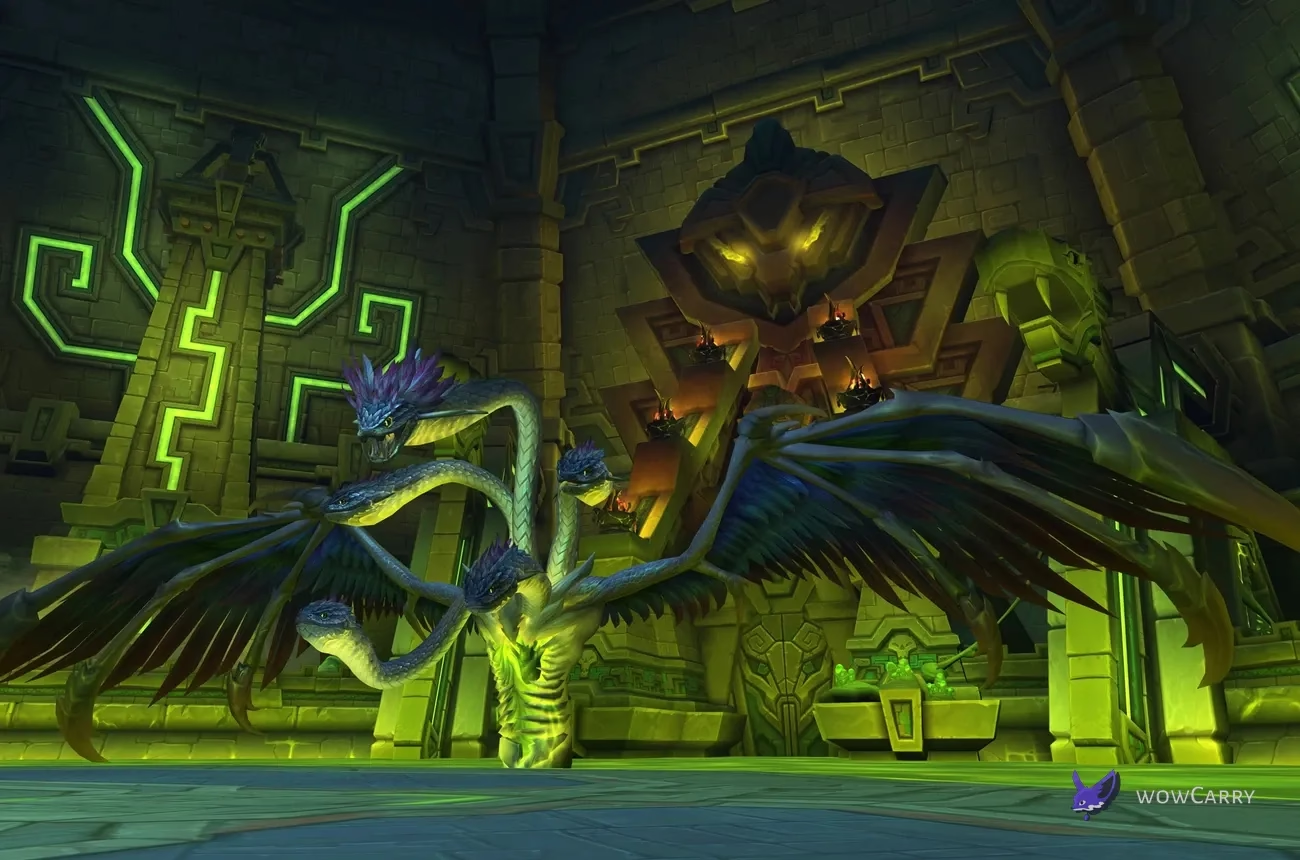
The single-boss intermission raid, located in Harandar. No trash, no warm-up, just Chimaerus on a standard weekly lockout. The fight pairs an above-ground arena with a periodic descent into The Rift, a separate phase plane.

Alndust Upheaval opens with a tank-targeted hole (radial split, airborne, and an Alnsight buff on landing). Rift Emergence sends part of the raid into The Rift, where Manifestations spawn and need to die before Chimaerus casts Insatiable, which consumes living manifestations and triggers Cannibalized Essence, healing the boss heavily (the heal scales up sharply on Mythic). Clear manifestations before Insatiable lands; this is the dominant wipe.
Rending Tear is the frontal cone with bleed and knockback (face away from raid). Caustic Phlegm is the raid-wide Nature DoT with rapid ticks; healers stack cooldowns into the window. Consume is the channel-into-knockback finisher; pop personals on the channel.
March on Quel'Danas Boss 1: Belo'ren, Child of Al'ar
The irradiated phoenix protecting the Sunwell. The Belo'ren fight runs on a Light / Void color split: every player gets a Light Feather or Void Feather debuff, and ability resolution depends on color matching.

Light Dive and Void Dive are color-matched ground AoEs; stand only in your color. Infused Quills are the color-matched beams that fire at random players; if a Light-feather player is targeted, only another Light-feather player can intercept. Radiant Echoes are orbs that ring the arena and apply stacking color buffs. Eternal Burns splits into Light Burn (Holy DoT plus heal absorb) and Void Burn (Shadow DoT plus heal absorb); dispel priority on whichever debuff matches your healer composition.
The egg phase is the second-life mechanic: when Belo'ren hits zero HP the first time, Death Drop resets positioning and the boss casts Rebirth, transforming into the Sunwell Egg that needs to die separately to finish the encounter.
March on Quel'Danas Boss 2: L'ura, Midnight Falls
The Season 1 tier final and the cinematic finale of the patch. L'ura is the fallen Light creature consumed by the Void on Argus, returning to defend the Sunwell. Multiple mechanic layers make this the longest fight of the tier.
Death's Dirge is the Dark Rune memory game: chosen players see runes appear in a sequence; reproducing the order correctly produces Resonance (a raid buff), wrong order produces Dissonance (heavy raid damage). Assign a caller; do not let players guess.
Heaven's Glaives are spinning ricochet blades that bounce off walls; stay mobile, never stop in their path. Safeguard Prism and Safeguard Matrices are interrupt and dispel checks layered through the fight. Black Tide is a frontal that leaves a permanent floor puddle; point it at the wall. Light Siphon opens two soak zones on a recurring timer; failing to fill both produces Stellar Implosion, the encounter's hard wipe.
The headline mechanic is The Dark Archangel: an unconditional wipe unless the raid stands inside Dawnlight Barrier, generated by consuming a Dawn Crystal from the extra action button. One mistimed Dawn Crystal ends the pull. L'ura received targeted nerfs in mid-April 2026; verify any old guides against current tuning. Groups locked at 1/2 can schedule a Quel'Danas Mythic finale run to clean up the L'ura kill without resetting the prog calendar.
Tier-Set Tokens and Loot Routing
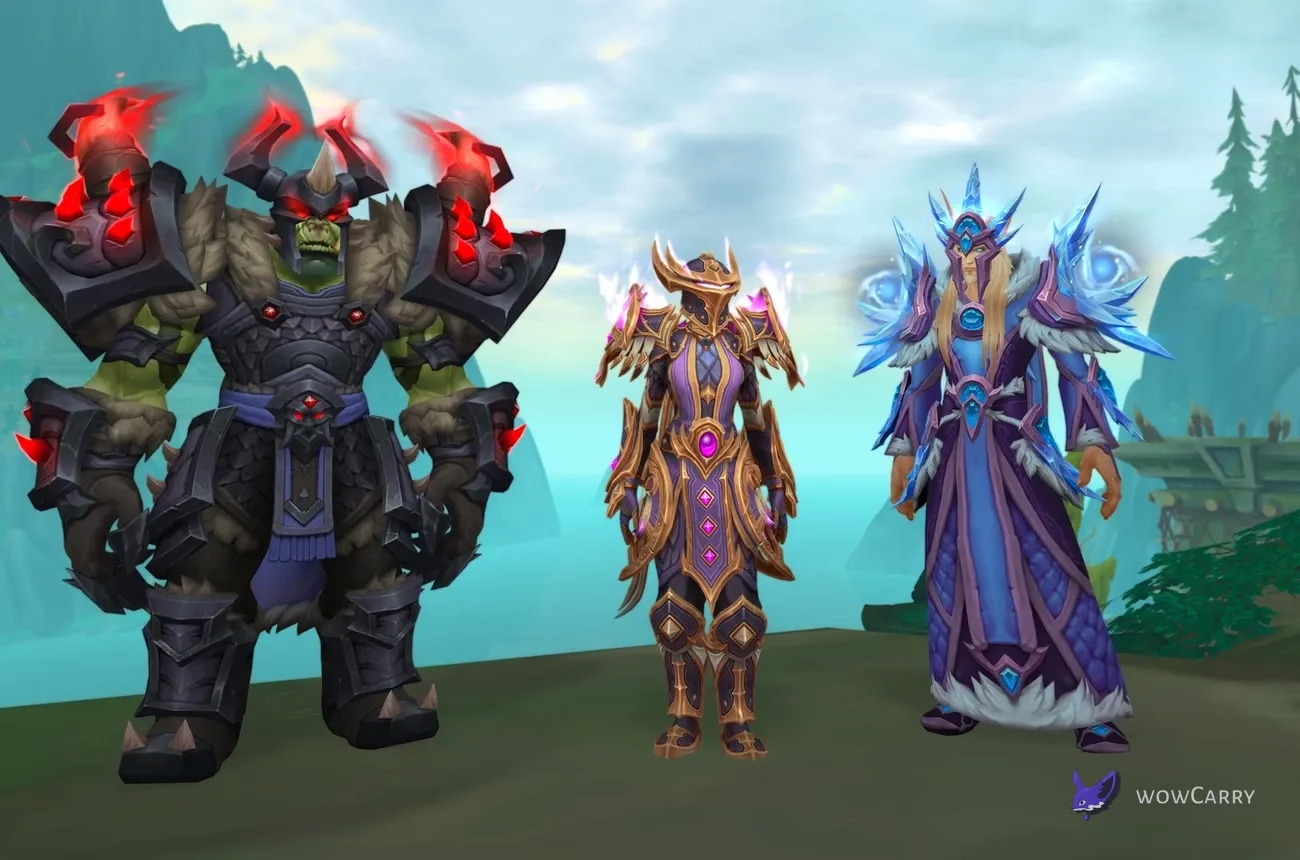
Tier tokens drop from Voidspire bosses 2 (Vorasius), 3 (Fallen-King Salhadaar), 4 (Vaelgor & Ezzorak), and 5 (Lightblinded Vanguard). Crown of the Cosmos and the single-boss Dreamrift and MQD encounters do not drop tier; they drop ilvl-relevant non-set loot and the cosmetic finishers. Plan your bonus rolls accordingly: the Voidforge bonus-roll system is highest-EV on Voidspire 2 through 5.
Item-level bands per Wowhead's confirmed Dreamrift table: LFR 237 / Normal 250 / Heroic 263 / Mythic 276. Voidspire and MQD bands track within a few ilvls of these numbers.
Last reviewed 2026-06-17 against Patch 12.0.5 Lingering Shadows — Maintained by WowCarry's WoW team.
FAQ
How many bosses are in Midnight Season 1?
Nine total across three raids: The Voidspire (six), The Dreamrift (one), and March on Quel'Danas (two). Tier-set tokens drop only in The Voidspire.
Which boss is the actual final boss of Season 1?
L'ura, Midnight Falls, the second boss of March on Quel'Danas. Belo'ren is the first MQD boss; Crown of the Cosmos is the final boss of The Voidspire raid only.
When did the raids open?
The Dreamrift Normal and Heroic on March 17, 2026, with Mythic on March 24. The Voidspire and March on Quel'Danas opened in a staggered window through early April, with LFR and Story difficulty unlocking April 7.
What's the item-level range?
LFR 237, Normal 250, Heroic 263, Mythic 276 (confirmed for The Dreamrift's loot table). The Voidspire and March on Quel'Danas track within a few ilvls of those bands.
Is Sporefall part of Season 1?
No. Sporefall is a single-boss raid (Rotmire) scheduled for patch 12.0.7 on June 16, 2026. It is not live and is not part of Season 1.
Which raid drops tier-set tokens?
The Voidspire only. Tokens drop from bosses two through five: Vorasius, Fallen-King Salhadaar, Vaelgor & Ezzorak, and Lightblinded Vanguard. Bonus-roll EV is highest on those fights.
How long does a full Heroic clear take?
A coordinated guild runs all nine bosses across the three raids in roughly three and a half to four hours on a single night. Pug clears typically split the tier across two nights with The Dreamrift and March on Quel'Danas grouped together.
What's the seasonal raid buff?
A +1% damage and healing buff per week, starting April 15, 2026, with no published cap. Mid-May 2026 raiders are running with roughly a five percent buff stacked.