Key Takeaways
- Fyr'alath, the Dream Render was a two-handed legendary axe exclusive to Warriors, Death Knights, and Paladins -- it could not be equipped by any other class.
- The axe dropped from Fyrakk the Blazing, the final boss of Amirdrassil, the Dream's Hope, introduced in Dragonflight Patch 10.2.
- Drop chances scaled with difficulty: Mythic offered the highest base rate, with a guaranteed drop at approximately 7 Mythic kills, 15 Heroic kills, or 40 LFR kills.
- Bad Luck Protection accumulated week-over-week via Greater and Lesser Embers of Fyr'alath -- collectible tokens that visibly represented a growing cumulative chance.
- Greater Embers came from Fyrakk; Lesser Embers dropped from other Amirdrassil bosses on Heroic or Mythic difficulty.
- Blizzard later updated the system so the cumulative drop-rate increase applied across all difficulties, not just the higher tiers.
- The BLP accumulator was character-specific and did not transfer between alts -- switching mains mid-season meant starting from zero.
Each of these points is covered in detail below.
What Was Fyr'alath, the Dream Render?
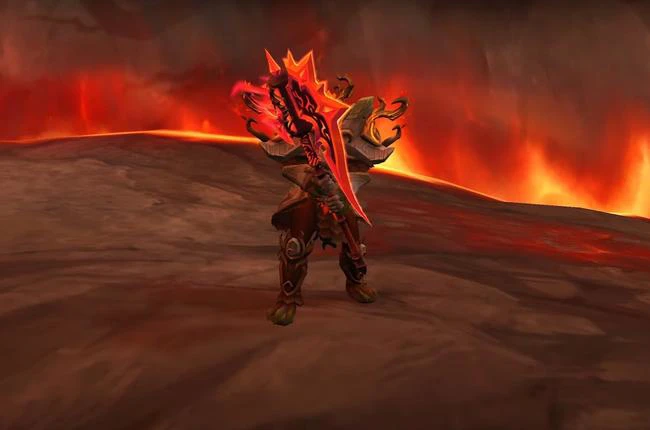
Fyr'alath, the Dream Render was the singular legendary weapon of Dragonflight Season 3. It was a massive two-handed axe wreathed in Shadowflame corruption -- the same dark fire that defined Fyrakk's destruction of the Emerald Dream. The weapon was restricted to three classes: Warriors, Death Knights, and Paladins. For those classes, particularly Arms Warriors and Retribution Paladins, it represented the defining power spike of the entire tier.
Fyr'alath arrived alongside the opening of Amirdrassil, the Dream's Hope in Patch 10.2 -- Guardians of the Dream. The raid was set within the newly manifested world tree Amirdrassil, which Fyrakk sought to corrupt and ignite. Defeating him on any difficulty gave eligible players a chance at the axe, but the journey from that first kill to actually holding the weapon was rarely quick.
Unlike earlier Dragonflight crafting legendaries such as the Onyx Annulet ring, Fyr'alath required no crafting materials or professions. It dropped directly -- or rather, the questline to build it dropped -- making every Fyrakk kill feel genuinely high-stakes for the three eligible classes.
✏️ The axe was not merely a stat-stick: it came with a multi-step questline that unlocked its full power, taking players through lore content tied to Fyrakk's corruption and the Shadowflame.
How the Drop System Worked
Fyr'alath used a layered drop system that combined Personal Loot on most difficulties with an additional Group Loot roll on Mythic. Understanding the distinction mattered for raiders deciding which difficulty to prioritize.
Personal Loot Across All Difficulties
On LFR, Normal, Heroic, and Mythic, every eligible player who killed Fyrakk received an independent Personal Loot roll for the axe. The base rate was highest on Mythic, lower on Heroic, lower still on Normal, and lowest on LFR. Running multiple difficulties in the same week did not stack the base roll -- each difficulty gave its own independent chance, so players genuinely benefited from clearing Fyrakk on every tier they had access to.
Mythic Group Loot
On Mythic difficulty, Fyrakk also had a separate chance to drop Fyr'alath into the raid's Group Loot pool. This rate was actually lower than the Mythic Personal Loot rate, and it competed against all eligible players in the raid needing the item. In practice, most Mythic raiders treated the Group Loot roll as a bonus longshot rather than their primary path to the weapon.
Guaranteed Drop Thresholds
Datamining revealed hard-cap kill counts at which the axe was effectively guaranteed to drop once the BLP system had fully accumulated:
- Mythic: guaranteed by the 7th Fyrakk kill
- Heroic: guaranteed by the 15th Fyrakk kill
- LFR: guaranteed by the 40th Fyrakk kill
These thresholds were datamined rather than officially published by Blizzard, but they aligned closely with player experience over the season.
📌 Running Fyrakk on multiple difficulties in the same week was the fastest way to accumulate BLP. Each difficulty's kill contributed independently to the overall system.
The Bad Luck Protection System
The BLP mechanic for Fyr'alath was one of the most visible implementations Blizzard had ever put into the game -- players could literally see it working in the form of physical loot tokens.
Greater Ember of Fyr'alath
Whenever an eligible player killed Fyrakk and did not receive the axe itself, they instead received a Greater Ember of Fyr'alath. This was the primary BLP token and represented a larger increment to the player's cumulative drop chance. The Greater Ember was a direct substitute for the weapon -- your run contributed meaningfully whether the axe dropped or not.
Lesser Ember of Fyr'alath
The other nine bosses of Amirdrassil, when killed on Heroic or Mythic difficulty, had a chance to award a Lesser Ember of Fyr'alath. This represented a smaller BLP increment than the Greater Ember but still steadily pushed the cumulative chance forward. A full clear of Amirdrassil on Heroic or Mythic was therefore the optimal weekly approach for any player chasing the legendary.
Week-Over-Week Accumulation
Both Ember types fed into a hidden accumulator tied to the player's character. Each week the player used their Embers, this total grew. The system was designed so that over time, the probability of receiving Fyr'alath approached certainty. Players who ran Amirdrassil consistently every week -- across multiple difficulties where possible -- reached the guaranteed thresholds substantially faster than those who ran only Mythic Fyrakk each week.
Blizzard's Mid-Season Adjustment
Initially, the cumulative BLP increase was tied primarily to Heroic and Mythic difficulty kills. Blizzard later updated the system so that the week-over-week accumulation applied from all difficulties -- including Normal. This change was meaningful for players who could not reliably clear Heroic or Mythic Fyrakk, giving LFR and Normal raiders a functional (if slower) path to the weapon.
⚠️ The BLP accumulator was character-specific and did not transfer between alts. A player who switched mains mid-season started the accumulation from zero on the new character.
Practical Tips for Maximizing Your Chances
For players who were actively chasing Fyr'alath during Dragonflight Season 3, the optimal approach combined difficulty selection, kill order discipline, and consistent weekly cadence.
Kill Fyrakk on Every Difficulty You Can Access
Because each difficulty issued its own independent Personal Loot roll, running Fyrakk on LFR, Normal, Heroic, and Mythic in the same lockout week generated four separate chances at the axe, plus four separate Greater Ember drops if the axe did not appear on any given run. This stacked BLP significantly faster than single-difficulty farming.
Full Clear Amirdrassil on Heroic or Mythic
Skipping directly to Fyrakk meant forfeiting up to nine Lesser Ember opportunities per week. The additional BLP from Lesser Embers was smaller per boss, but across a full season those increments added up. Players in progression guilds who cleared the entire raid each week consistently reached the guaranteed threshold before those who only zoned in for the final boss.
Commit to an Eligible Class Early
The BLP system was character-specific. Players who decided mid-season to swap from a non-eligible class to a Warrior, Death Knight, or Paladin started accumulation at zero. It was worth committing to an eligible main before investing heavily in the chase.
Those who raided Amirdrassil during Season 3 can browse Amirdrassil, the Dream's Hope carry options to see what WowCarry offered for the tier.
Last reviewed 2026-06-20 against Dragonflight Season 3 (Amirdrassil, now completed) -- Maintained by WowCarry's WoW team.
Frequently Asked Questions
Which classes could use Fyr'alath, the Dream Render?
Fyr'alath was restricted to Warriors, Death Knights, and Paladins. These were the three strength-based melee classes that could equip two-handed axes. Shamans were not eligible.
Where did Fyr'alath drop from?
The axe dropped from Fyrakk the Blazing, the final boss of Amirdrassil, the Dream's Hope. It was available on all difficulties: LFR, Normal, Heroic, and Mythic.
Was Fyr'alath guaranteed to drop eventually?
Yes. The Bad Luck Protection system placed the guarantee at roughly 7 Mythic kills, 15 Heroic kills, or 40 LFR kills -- assuming steady weekly BLP accumulation.
What were Greater and Lesser Embers of Fyr'alath?
They were the visible BLP tokens. The Greater Ember of Fyr'alath dropped from Fyrakk when the axe itself did not, and represented a larger BLP increment. The Lesser Ember of Fyr'alath dropped from other Amirdrassil bosses on Heroic or Mythic difficulty and provided a smaller increment. Both accumulated week over week.
Did running multiple difficulties in one week help?
Yes. Each difficulty provided an independent Personal Loot roll and its own Greater Ember if the weapon did not drop. Running Fyrakk on LFR, Normal, Heroic, and Mythic in the same week generated four separate chances and four BLP contributions.
What did Blizzard change about the BLP system mid-season?
Blizzard adjusted the cumulative drop-rate increase so that it applied across all difficulties, not just Heroic and Mythic. This meant Normal and LFR kills of Fyrakk also contributed to the accumulating BLP, making the legendary more accessible to players outside high-end raid teams.
Did the BLP accumulator carry over between characters?
No. The accumulator was character-specific. Switching to an alt or rerolling to an eligible class mid-season meant starting the BLP accumulation from zero on that new character.
Was Fyr'alath still obtainable after Dragonflight ended?
Amirdrassil remains in the game as a legacy raid, and eligible players could still defeat Fyrakk for a chance at the axe in later expansions. The BLP system as it functioned during Season 3 was specific to that content cycle.