Blizzard Backs Down: Potential Ripcord Pull Imminent
Blizzard's Midnight beta add-on debate: why combat restrictions were introduced, how developers found workarounds, and whether Blizzard would pull the rip cord before launch.
By:
John Langan
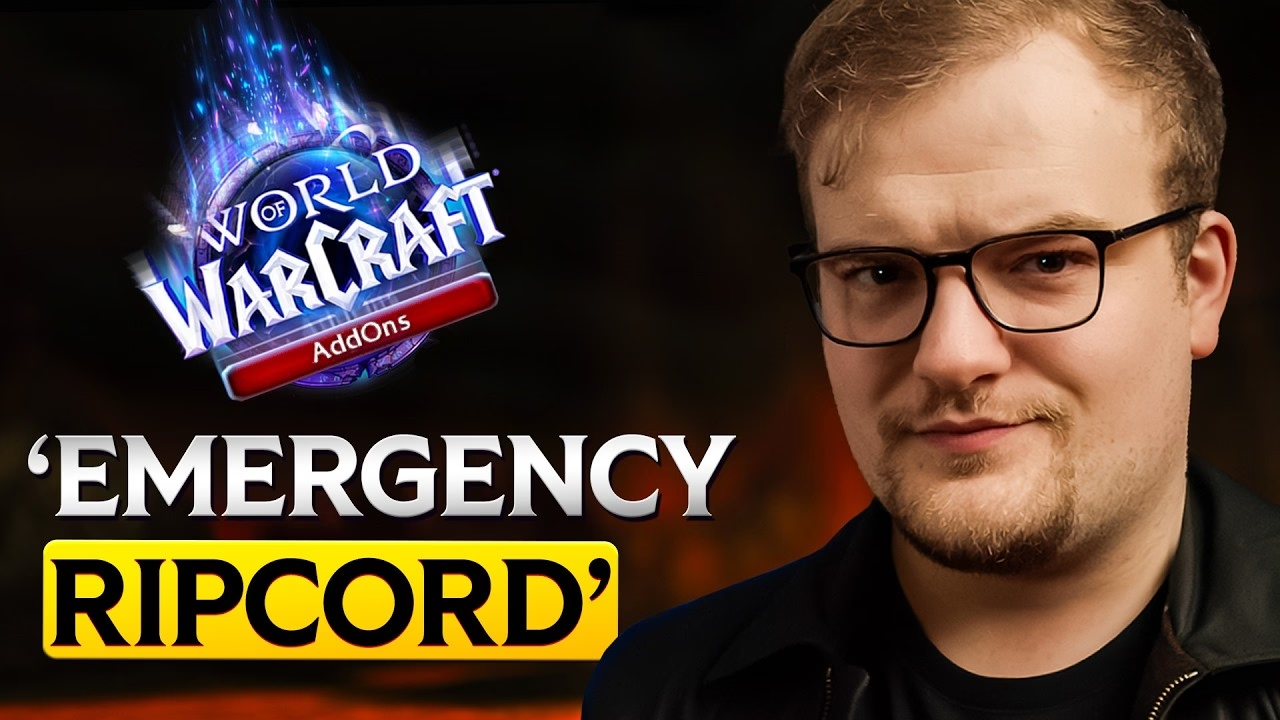
The first Warcraft news of early 2026 centered on a significant policy shift: Blizzard, just back from the holidays, had already sparked a community debate about add-on restrictions in the Midnight beta. After initially tightening controls on combat automation, Blizzard reversed course on some restrictions, restoring features for unit frames and nameplates. That reversal opened a gap that add-on developers moved quickly to exploit.
With that context established, here is how the add-on situation evolved through the beta period.
Blizzard's original stance was clear: add-on customization should address visual preference and accessibility, not provide a competitive edge. The restored unit-frame and nameplate features were intended strictly for aesthetics.
The complication arose when Blizzard allowed developers to implement a workaround that tags mobs as casters via nameplate data. Several add-ons emerged from the Midnight beta using this capability:
The key distinction is that these add-ons use non-game data to deliver strategic hints — a gap that sits squarely in the grey area of the policy.
The central question: do these add-ons provide an unfair advantage?
Blizzard's design direction through the Midnight beta has been to slow encounter pacing, integrate voice lines for mechanical cues, and reduce the cognitive reliance on third-party tools. These add-ons push directly against that direction.
✏️ Context: Blizzard's core concern is not the tools themselves but their aggregate effect on encounter design. When every progression raider runs the same automated cooldown caller, Blizzard must inflate encounter difficulty to compensate — starting a cycle that historically ends with WeakAuras-style arms races and eventually another round of restrictions.
The balance between customization and competitive fairness is the central tension in this debate. Accessibility is a genuine argument on the pro-add-on side: for players with visual impairments or slower reaction times, audio cues and strategic prompts can be the difference between participating and sitting out. Blizzard integrated native voice lines for mechanics in Midnight specifically to address this without requiring third-party tools.
However, widespread use of these strategic-hint add-ons in high-end content would pressure Blizzard to design around their existence. That accelerates the original cycle: harder encounters, more add-on dependency, more restrictions. Blizzard's move toward slower casts and clearer visual cues was an attempt to break that cycle.
If the workaround-enabled add-ons become standard in Mythic raiding, Blizzard faces two options:
Both scenarios keep the current UI direction intact. The third option is the "rip cord" — reversing the new UI system entirely before live launch.
📌 Community split: Some guilds reported player departures during the beta specifically because of the add-on restrictions. Players who built their gameplay around WeakAuras customization found the new environment meaningfully different, and the disruption was real for established raid teams. That friction is part of what makes the "rip cord" scenario credible.
The deeper issue is what add-ons contribute to the playing experience versus what they detract from it. For many players, a customized UI is an expression of craft — the same way a keyboard layout or display resolution is personalized. For others, running advanced add-ons in competitive content removes the skill expression Blizzard is trying to preserve.
The Midnight beta workaround illustrates how the gap between these positions stays live even after Blizzard draws a line. A nameplate tag that signals caster mobs is a small data hook, but add-on developers built real-time CC management out of it. Other games manage this with external overlay systems — Guild Wars 2 and Final Fantasy XIV allow overlays that WoW would not sanction. That context matters for how Blizzard calibrates its response.
The "nuclear option" — halting all custom combat displays — remains on the table but is the least likely path. It would alienate the accessibility use case, generate significant bad press ahead of launch, and discard data from players who are not exploiting the workarounds at all.
A more targeted enforcement pass, closing the specific nameplate-data hook, is the most likely near-term action. Whether that holds depends on how quickly the add-on ecosystem finds the next gap in whatever restrictions replace the current ones.
One outcome the beta pointed toward: ongoing restriction changes have made the add-on ecosystem more fragmented. Managing multiple partially-functional add-ons is a higher barrier than running a single WeakAuras package, which may naturally reduce adoption among casual players. Key potential effects:
The complexity barrier cuts both ways — it raises the floor for players who want a personalized UI while reducing the ceiling for how sophisticated that UI can get.
Reports from the beta period suggested Blizzard's primary target throughout this cycle was WeakAuras specifically. Blizzard outlined the underlying philosophy in their World of Warcraft expansion announcement. With the platform-level automation layer of WeakAuras curtailed, some signals pointed toward a more permissive stance on other add-ons that do not replicate WeakAuras' scripted-response capabilities. If that interpretation is correct, the restriction landscape in Midnight may settle into a more stable state than the beta period suggested — narrower in scope than the original restrictions, wider than the traditional open ecosystem.
The uncertainty as of the beta period was significant. Reports from players with Blizzard connections suggested active internal debate about how far to roll back restrictions ahead of launch. The caster-nameplate data access — which Blizzard allowed and then watched be exploited — was cited as a specific example of decisions that contradicted earlier statements about competitive equilibrium.
Three plausible outcomes were circulating in the community at the time:
| Scenario | Impact |
|---|---|
| Pulling the "Rip Cord" | Limits real-world usage data and delays the transition to native tooling. |
| Revising Add-on Policies | Rebuilds trust with customization-focused players while preserving core restrictions. |
| Strict Policy Continuation | Maintains design direction but accepts ongoing friction with a vocal segment of the playerbase. |
With Midnight having since launched, Blizzard's eventual choice became clear from the live game's state. This article documents the debate as it stood during the beta period, when the outcome was still undecided.
The "rip cord" is community shorthand for Blizzard reversing a major gameplay or UI system change before or shortly after launch. In this context, it referred to the possibility that Blizzard would suspend the new Midnight UI restrictions entirely and return to the pre-Midnight add-on ecosystem rather than push through a contested beta situation.
Blizzard's stated goal was to limit customization to visual preference and accessibility, not provide computational advantages. The specific target was add-ons like WeakAuras that automated combat responses — cooldown calls, spell sequences, and encounter scripts — removing skill expression from high-end content.
WeakAuras' combat-automation layer was restricted under the Midnight add-on policy. The aesthetic and tracking uses of WeakAuras were effectively absorbed by alternatives like NefUI and Battery Ability Timeline. The scripted-response and automation features that made WeakAuras the dominant competitive add-on are what Blizzard targeted.
Blizzard allowed a workaround that lets add-on developers tag mobs as casters using nameplate data. This was intended for visual differentiation but was quickly used to build strategic-hint tools — CC management suggestions, cooldown callers using pre-set timelines, and caster-priority indicators — that extended beyond the visual-only use case Blizzard authorized.
WeakAuras scripts can read live game state and trigger automated responses in real time. The caster nameplate workaround uses pre-configured data rather than live game feeds, which technically falls outside Blizzard's "no computational advantage from game data" restriction. The strategic effect is similar; the technical mechanism is different enough to sit in a grey area.
Guild Wars 2 and Final Fantasy XIV allow external overlay programs that display additional combat information without reading game memory directly. WoW's add-on ecosystem has historically been more open, which is partly why the Midnight restrictions felt jarring. The overlay model is one approach Blizzard could adopt to allow information display without enabling scripted automation.
Maintained by WowCarry's WoW team. Last reviewed 2026-05-28. This article reflects the state of the add-on debate during the Midnight beta period (early 2026) before the expansion launched.