Learn the Power at the Blacksmith, Then Imprint at the Occultist
Salvage an unwanted Legendary at the Blacksmith to learn or improve its Aspect in the Codex of Power. Use that learned power at the Occultist to imprint compatible equipment. The learned Aspect is reusable; you do not consume a single-use Aspect from an inventory tab each time you replace a piece of gear.
This is the system introduced by Season 4: Loot Reborn. Guides that send you to the Occultist to extract and store individual Aspect items describe the older workflow. The Blacksmith learns the power through salvage; the Occultist applies a learned power to another item.
An Aspect is the item's Legendary effect, distinct from its ordinary affixes. Read the entire effect: a useful number attached to a skill, condition or resource your build never uses will not solve your gearing problem. Before salvaging a promising drop, decide whether you need the actual item or its learned power.
Decide Whether the Drop Is Gear or a Codex Upgrade
Salvage destroys the equipment. Learning its power does not preserve its affixes, sockets or completed crafting work. Keep an equipped item that your build still needs until a replacement can perform its job.
| What the item offers | Useful action | Check before committing |
|---|---|---|
| A useful item you can wear now | Keep it and compare the whole item with your equipped piece. | Does the replacement preserve the effects and affixes your build relies on? |
| An unwanted item with a new or stronger learned power | Inspect its Codex upgrade indication, then salvage it at the Blacksmith. | Are you certain you do not need this particular item for the current or another setup? |
| A good replacement that needs a different power | Inspect an imprint preview at the Occultist using a learned Aspect. | Is the power compatible, is its learned value useful, and can you pay the displayed cost? |
A powerful Aspect roll and a good equipment base can appear on different drops. You can keep the better base while learning a power from an unwanted item, then combine them through imprinting. Check that the intended combination is available before destroying your current solution. For broader salvage and equipment handling, read the Blacksmith guide.
Find the Actual Unlock Source for a Missing Aspect
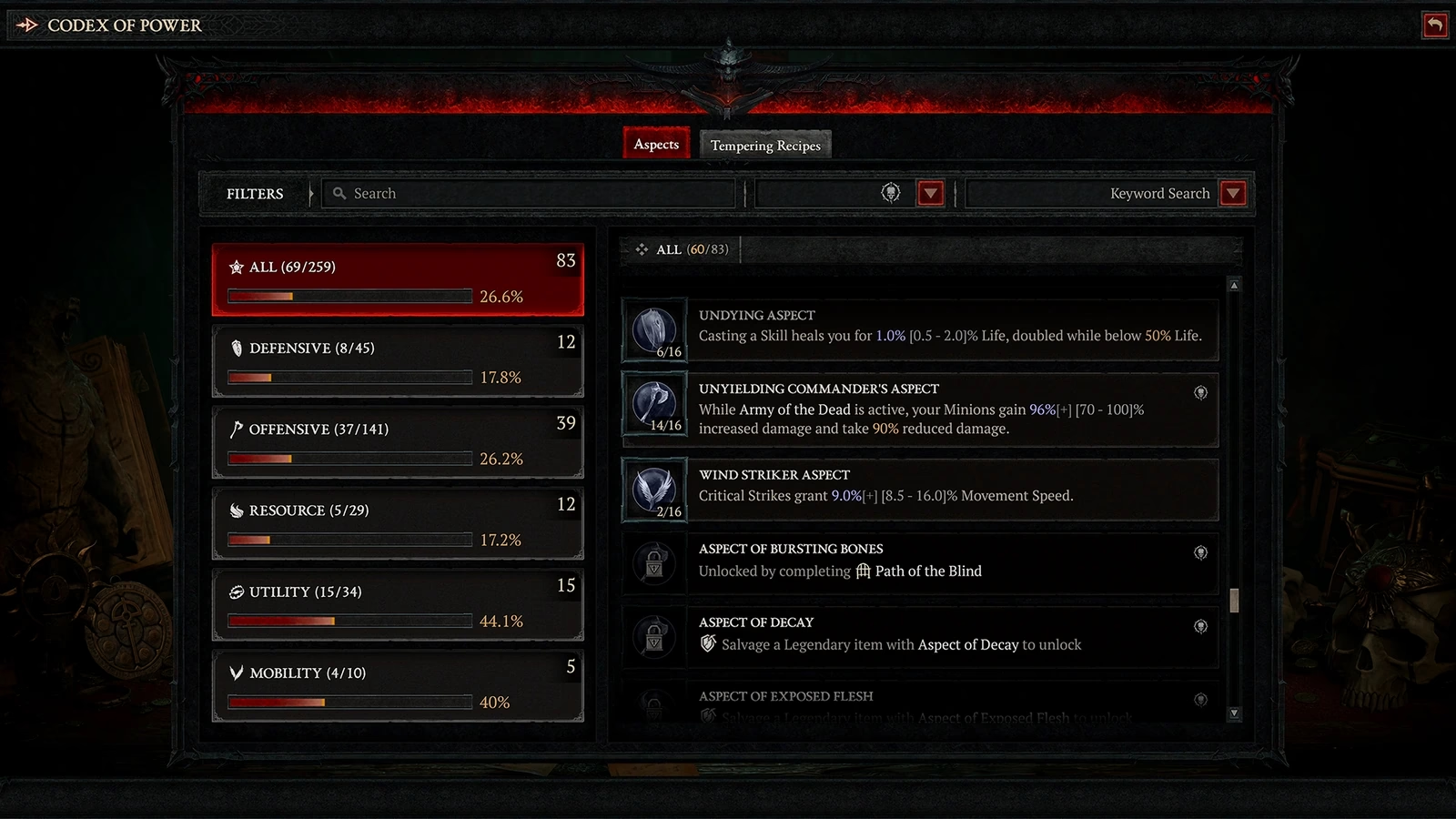
Open the Aspects section of the Codex of Power, search for the effect you need and inspect its entry. Clear restrictive filters if the search appears empty. A displayed entry and a learned power are different states: seeing a power in the collection does not mean you can imprint it yet.
Follow that entry's acquisition instruction. If it names a dungeon completion, complete the named dungeon to obtain its unlock. If it calls for salvaging a Legendary carrying the power, you need an eligible drop to salvage. There is no dungeon unlock for every Aspect. Repeating a different dungeon because an old guide says all powers have dungeon rewards will not supply the missing unlock.
Cover: Blizzard's official Codex of Power screenshot from the 2024 Loot Reborn announcement. The Aspects tab shows both dungeon and salvage unlock instructions. Displayed names, rolls, rank fractions and collection totals are historical. Credit: Blizzard Entertainment. Open the original Codex screenshot.
The distinction between the two acquisition routes is the useful part of that example. For a current build, use the current entry's name and instructions. A random Legendary reward is an opportunity to find a power, rather than a guarantee of the exact Aspect you are missing.
Improve the Learned Value Instead of Stockpiling Aspect Items
When an unwanted Legendary carries a stronger version of a learned Aspect, salvaging it can improve the value stored in the Codex. Future imprints use the learned power. A dungeon unlock can therefore be a starting point rather than a permanent restriction to the weakest roll.
Compare the selected power's learned value and progression with the drop before deciding what it is worth. The current Codex entry is the reference for that particular power. Do not infer a universal rank cap from the cover's 16-rank examples: the released 2.5 patch notes already included powers increased to 21 ranks.
Reusable powers remove the need to save a consumable Aspect for one perfect item. They do not make imprinting free. For gear you expect to replace soon, decide whether the immediate build benefit justifies the price shown by the Occultist.
Preview the Imprint on the Intended Replacement
Use the Occultist's imprint service after checking the equipment base. Blizzard's released Codex and imprint updates added an equipped-power indication to help you see powers already in use. Review that indication when planning which slot should carry an effect.
- Select the equipment you intend to change and inspect which learned powers the service offers for it.
- Choose the required Aspect and read the resulting effect, including any activation condition and class or skill restriction.
- Compare the preview with the effect already on the selected item. Confirm that replacing it will not remove another function your build needs.
- Read the complete Gold and material bill. Confirm the imprint only after the item, power and preview are correct.
- Inspect the finished item and your equipped powers before salvaging the equipment it replaces.
If the desired power is unavailable, first separate an unlearned Aspect from an incompatible item. Search its Codex entry, check its learned state and class restriction, then review the selected equipment's eligibility. An item sharing the same slot name as another item does not by itself prove the service will accept it.
Use the Five Categories to Solve a Build Problem
Aspect categories describe the effect's role and help organize the search. They also matter when choosing compatible equipment. Some powers serve several builds, while class-specific powers require the appropriate class and supporting skills. Read the actual effect rather than treating a category as a promise that it suits your character.
| Category | Build problem to consider | Read the effect for |
|---|---|---|
| Offensive | Damage or a change to how an attack works. | The affected skill or damage source and the condition needed to benefit. |
| Defensive | Survival while carrying out your build's normal actions. | How protection activates, how long it lasts and when it is unavailable. |
| Resource | Generating or sustaining the resource needed by your rotation. | Which resource is affected and what you must do to gain the benefit. |
| Utility | Control or supporting interactions that make the build function. | The targets, triggers and supporting skills required by the effect. |
| Mobility | Repositioning or movement that helps you keep playing safely. | The movement condition and whether your build can maintain it. |
Check the current Aspect entry and the Occultist's eligible equipment instead of copying an old category-to-slot list. Compare previews for the slots you can actually use. Plan the complete loadout before committing a flexible slot to a less important effect, especially when several required powers compete for your remaining equipment.
Check the Character's Realm Before Relying on a Learned Power
Reusable does not mean that every character mode and every new season shares one unrestricted collection. Check the learned power on the character you intend to equip, in that character's realm, rather than relying on what another character can imprint.
Blizzard's published Loot Reborn transfer rule sends the seasonal Codex to the Eternal Realm when the season ends. Where the same Aspect is already learned there, the higher value is kept. That describes a transfer to Eternal; it is not a promise that an Eternal collection is imported into a fresh season. Confirm the available collection before planning an early seasonal build around a previously learned roll.
Recheck an Old Build's Powers After the Itemization Overhaul
The 3.0 skill and item overhaul moved some former Legendary powers into skill variants and moved many passive effects onto gear. Existing Eternal equipment could also change to new effects. A familiar item or Aspect name in an older build is not enough to establish its current function.
If a recommended power is missing or no longer works as expected, compare the current skill tree, Codex entry and item tooltip with the guide's date. Check that your selected skill variant still has the tags and behavior the effect needs. Blizzard's live patch notes are the reference for later changes. Rebuild the required interaction before spending materials on a stronger roll of an effect your revised setup no longer uses.