Key Takeaways
- Blizzard's pre-launch promise for the Midnight stat squish — "your power level relative to enemies will remain the same, only the numbers change" — did not survive contact with the pre-patch launch on January 20–21, 2026.
- Players immediately found dungeon runs taking 2–3 times longer than before the squish, low-level potions restoring 0 or negative health, Auction House commodity purchases broken, and legacy raid scaling producing incorrect rewards.
- The "developer count" angle in community discussion connects to Blizzard's claim of a 20% larger development team than the previous expansion — a figure that has never been independently verified and that many players felt wasn't reflected in the pre-patch execution.
- The only confirmed headcount figure on record is "over 500 workers" from the July 2024 WoWGG-CWA union announcement — predating Midnight's launch by more than a year, with no update since.
- Blizzard and Microsoft do not publish WoW subscriber counts in quarterly earnings; third-party estimates for Midnight's launch window suggest approximately 8–9 million monthly active players, but these are extrapolations from Google Trends and raid-log data, not official figures.
- Most of the pre-patch squish bugs were patched via hotfix within the first week; the dungeon-length issue required targeted balance adjustments in the March 17 post-launch tuning pass.
Each of those threads — the squish execution, the developer team claims, and the subscriber estimates — deserves a closer look, because they pulled in opposite directions during the weeks that mattered most for Midnight's launch reputation.
What Blizzard Promised
Stat squishes are not new to WoW. Blizzard has compressed the game's inflating numbers at the start of expansions several times over the past decade. Each time, the stated goal is the same: make the numbers smaller without changing how powerful your character feels relative to the world. The in-game experience, Blizzard says, should be identical; only the digit count on your health bar and damage numbers changes.
For Midnight, the stat squish accompanying the Patch 12.0.1 pre-patch (live January 20–21, 2026) was described in those familiar terms. Blizzard's internal testing cleared it. The PTR reported a handful of edge cases. The official guidance before launch: expect some legacy content to feel different, but current-content dungeons and raids should feel identical to pre-squish performance.
The pre-patch also coincided with a significant class tuning pass: the "L-shape" beta balance wave that redistributed power from passive Hero Talent procs to active rotation buttons. Players were trying to sort out two simultaneous changes at once: their rotation felt different and the numbers were radically smaller. Parsing which problems came from the squish and which came from the tuning pass proved difficult in the first 24 hours.
What Players Found Instead
The gap between Blizzard's promise and live-game reality surfaced within hours of the pre-patch going live. PC Gamer reported on low-level potions and food items restoring 0 health — or in some cases registering as negative healing. The Auction House commodity system broke for certain purchase quantities. Legacy raid scaling produced incorrect item level rewards for players farming transmog or mounts in old content.
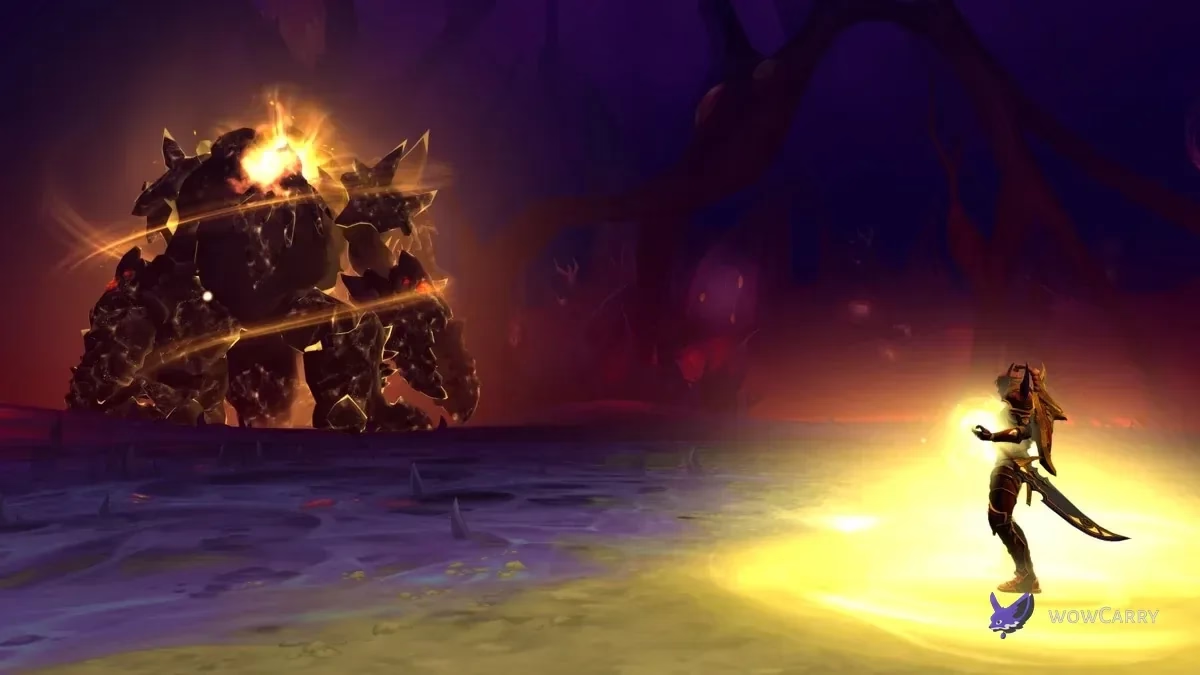
The most impactful discrepancy, though, was dungeon difficulty. A number of players reported Midnight's early dungeon runs taking roughly 2–3 times as long as an equivalent run before the squish, not because the content was mechanically harder, but because the relative damage scaling between players and enemies had shifted. The squish was supposed to be neutral on relative power; in several dungeon environments, it wasn't. Blizzard's known issues list at pre-patch launch acknowledged several of these scaling problems explicitly.
⚠️ Why dungeon-time mattered more than potion bugs: Broken low-level potions are a nuisance for players farming old content. Dungeons taking 2–3 times longer directly affected weekly Great Vault progress, M+ key depletion rates, and the gearing cadence that the Season 1 launch raid tier assumed. Players running keys to prepare for Voidspire found their per-run time and resource costs inflated by a squish the developers said wouldn't change anything.
The Developer Team Context
The "developer count" thread in community discussion traces back to a specific claim made during WoW's marketing lead-up to Midnight: Blizzard described the Midnight development team as approximately 20% larger than the team that built the previous expansion. Community forum threads pointed to this figure when cataloguing the pre-patch issues — the argument being that a larger team should have caught scaling problems that had occurred in previous squishes.
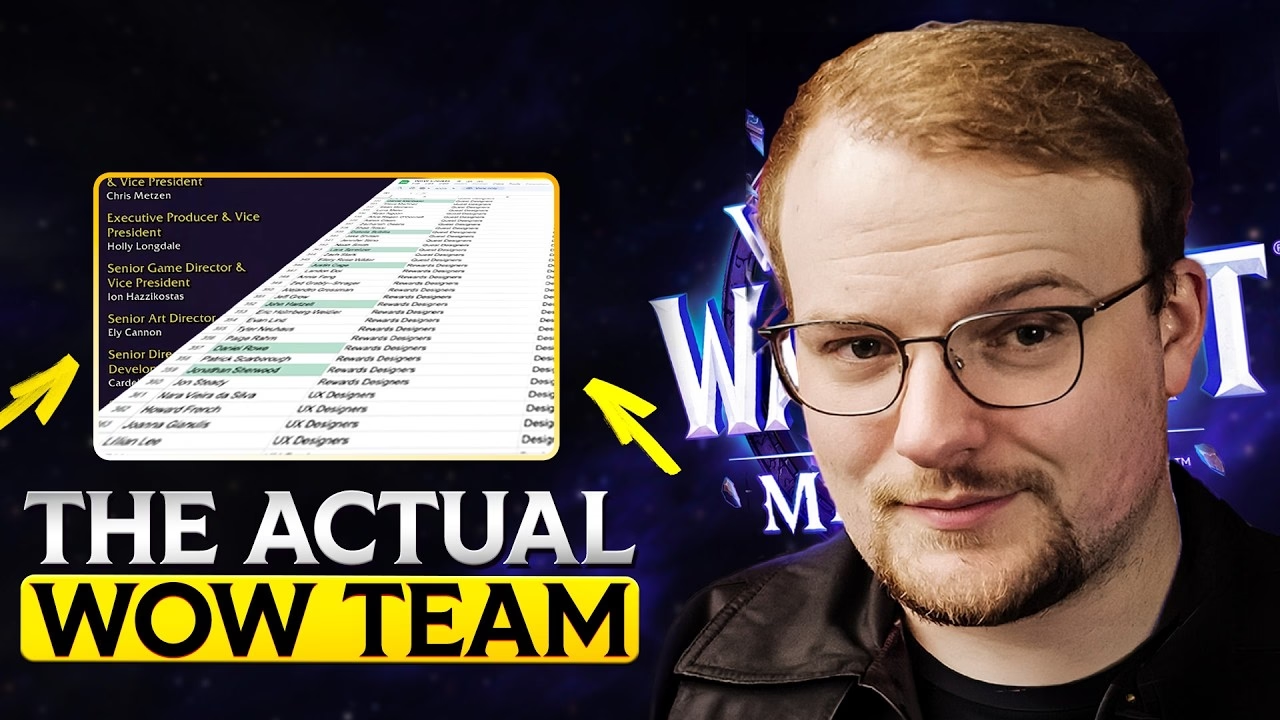
The verifiable numbers are limited. The most concrete headcount figure on record is from July 2024, when the entire WoW development team at Blizzard formed the World of Warcraft Game Makers Guild (WoWGG-CWA), affiliated with the Communications Workers of America. The union filing documented "over 500 workers" — designers, engineers, artists, QA testers, and producers. No exact figure was published; "over 500" is the ceiling of public knowledge, and no update has been released since.
That figure predates Midnight's launch by more than a year and predates the January 2026 Microsoft layoff announcement. The January 2026 layoffs targeted WoW's social media and marketing team specifically — key community-facing members were let go, and social media management moved largely to an outside agency. The core development team's headcount was not publicly confirmed as reduced; the cuts landed on the peripheral functions around the game, not the engineers and designers building it.
📌 On the "20% larger team" claim: Blizzard's development headcount claims are not independently audited. The July 2024 union figure ("over 500") is the only verifiable data point. Whether that number represents 501 or 700 workers is unknown; whether the composition changed between the union filing and Midnight's launch is unknown. Treating the 20% larger claim as a confirmed fact — or as confirmed fiction — goes beyond what the public record supports.
Subscriber Numbers: What We Know and Don't Know
The parallel "numbers discrepancy" in the community centres on subscriber counts. WoW's peak subscription figures (12 million in 2010) are well-documented. Microsoft's acquisition of Activision Blizzard in January 2023 brought a significant change: Microsoft does not break out WoW subscriber counts in its quarterly earnings reports the way Activision had occasionally done previously. The number Blizzard most recently disclosed publicly — 9.1 million subscribers (October 2019) — is nearly seven years old.
Third-party trackers attempt to fill the gap using Google Trends correlation, WoW Armory API sampling, and Warcraft Logs raid participation data. As of May 2026, estimates for WoW Midnight's monthly active player base run between 8 and 9 million — consistent with an Icy Veins analysis that read 9 million into the language of a Microsoft earnings call without an explicit disclosure. These are extrapolations, not confirmed figures.
What Blizzard did confirm at Midnight's launch: the opening weekend generated 6.7 million Twitch hours watched — a 112% jump over the comparable the previous expansion launch period. Viewer numbers suggest strong launch interest; they don't translate directly to subscriber counts.
Resolution and What It Means for Your Progression
Most of the acute pre-patch squish bugs were resolved via hotfix within the first week of the pre-patch window. Potion and food item restoration values were corrected. Auction House commodity purchases were restored. Legacy raid rewards were recalibrated. The dungeon-length issue required the more targeted March 17 post-launch tuning pass to correct — Blizzard's first scheduled balance window after the expansion launched.
For players who started Midnight during the pre-patch chaos (January 20 through March 2), the practical impact varied. Players who avoided the pre-patch and waited for the March 2 expansion launch experienced a significantly smoother scaling environment. Players who ran M+ keys in the pre-patch window found their run times had normalized by early February.
The broader lesson from the pre-patch squish: the number changes Blizzard describes as neutral always carry edge-case risks in a game with 20 years of layered content. The more content layers the squish has to touch (legacy raids, heritage armor quests, crafted gear from nine previous expansions), the more surface area for unexpected interactions. Midnight's squish was less severe than some previous iterations (the Shadowlands squish was particularly disruptive) but more impactful than Blizzard's pre-launch testing suggested.
For players ready to engage with Midnight's live content past the pre-patch window, explore our WoW Midnight services for current-season options across raids, Delves, Mythic+, and housing.
Last reviewed 2026-05-27 against WoW Midnight Patch 12.0.5 "Lingering Shadows." Maintained by WowCarry's WoW team.
FAQ
What is a WoW stat squish?
A stat squish is Blizzard's periodic compression of WoW's numbers (health pools, damage values, and item levels) which inflate over successive expansions. Rather than players dealing millions of damage per second in current content and thousands in old content, a squish resets the scale. Blizzard's stated goal is always to keep relative power between players and enemies identical; the numbers change, the gameplay feel should not. Midnight's squish shipped with the Patch 12.0.1 pre-patch on January 20–21, 2026.
Why did dungeons feel harder after the Midnight pre-patch?
The Midnight stat squish was supposed to preserve relative player-to-enemy power scaling. In several dungeon environments, it didn't; runs took 2–3 times longer because scaling coefficients for player damage and enemy health didn't compress in a perfectly matched ratio. This was a bug, not intentional design. Blizzard's post-launch March 17 tuning pass addressed the residual dungeon-length discrepancy.
Why were low-level potions restoring 0 or negative health?
The stat squish reduced low-level item values to the point where some potions and food buffs rounded down to 0 in the post-squish number system. In edge cases the game registered the value as a small negative number. Both were bugs reported in the pre-patch known issues list and hotfixed within the first week.
How many developers work on WoW Midnight?
The only confirmed figure is "over 500 workers" from the July 2024 WoWGG-CWA union announcement, which covered the full WoW development team including designers, engineers, artists, QA, and producers. No exact breakdown was published, and no update has been released since. Blizzard's claim of a 20% larger team than the previous expansion has not been independently verified. Microsoft's January 2026 layoffs targeted WoW's marketing and social team, not the core development team; the development headcount impact was not publicly disclosed.
What is the WoWGG-CWA union?
The World of Warcraft Game Makers Guild (WoWGG-CWA) is a wall-to-wall union formed in July 2024 by the entire WoW development team at Blizzard Entertainment, affiliated with the Communications Workers of America. It covers all disciplines on the WoW team — designers, engineers, artists, QA testers, and producers — and represents over 500 workers. It is the first studio-wide union in Blizzard's history covering a single game's team.
How many players are playing WoW Midnight?
Blizzard and Microsoft do not publicly disclose WoW subscriber counts. The last official figure published was 9.1 million (October 2019, pre-pandemic). Third-party tracker estimates for Midnight's launch window suggest approximately 8–9 million monthly active players, based on Google Trends correlation, Armory API sampling, and Warcraft Logs data — these are extrapolations, not confirmed numbers. Midnight's opening weekend produced 6.7 million Twitch hours watched, a 112% increase over the previous expansion's comparable launch period.
Did the stat squish affect legacy raid farming?
Yes, temporarily. Legacy raid reward scaling produced incorrect item levels for transmog and mount farming runs during the pre-patch window. Blizzard acknowledged this in the known issues list at pre-patch launch and issued a hotfix within the first week. Players who waited until after the hotfix experienced normalized legacy scaling. The Auction House commodity bug (preventing purchase of certain legacy crafting materials) was resolved in the same patch window.