Key Takeaways
- Hero Talents unlocked at level 71 and filled in one point per level up to level 80, so a character owned all 11 nodes of its chosen tree at max level.
- Every class carries three Hero Talent trees, and each specialization draws from two of them, which means each tree is shared by two specs.
- Druid is the only class with four trees; Demon Hunter is the only class with two, Reaver's Glaive being the signature payoff of its Aldrachi Reaver tree.
- Warriors chose between Slayer, Colossus, and Mountain Thane, with Mountain Thane's Thunder Blast a clear keystone identity.
- Death Knights picked up Deathbringer, San'layn, or Rider of the Apocalypse, and Deathbringer's Reaper's Mark became a raid-cooldown staple.
- Each tree opens on a keystone node and ends on a capstone, with choice nodes splitting the path in between.
- Hero Talents went live with The War Within on August 26, 2024, shipping 39 trees across the game's classes.
When Blizzard first previewed Hero Talents during The War Within alpha, the pitch was a permanent, always-on layer of class progression that sat on top of the existing class and spec trees. Two years on, the system shipped almost exactly as previewed, so this recap covers both what Blizzard promised and how it actually landed for players.
What Hero Talents Actually Are
Hero Talents are self-contained talent trees that a character unlocked at level 71. They build on the abilities a specialization already uses rather than replacing them. Each character activates a single Hero Talent tree at a time, and swapping between trees works the same way as swapping class talents out of combat.
The point economy is simple. The first node unlocks with the system at level 71, and a character earned one talent point per level from 71 through 80. That adds up to every node in an 11-node tree by the time a character hits the level cap. Saved loadouts keep their Hero Talent selection, and Blizzard shipped starter builds so a fresh character was never staring at an empty tree.
📌 The most common early mistake was treating a Hero Talent tree like a second spec you rebuild constantly. In practice you slot one tree, fill it out by level 80, and only revisit it when your content type changes.
How the Trees Are Organized
The structure is the part people most often get wrong, so it is worth stating plainly. Every class has three Hero Talent trees. Each specialization can pick from two of those three, and every tree is shared between two specs. That is three trees per class, not three trees per spec.
Warriors are the cleanest example. Their three trees are Slayer, Colossus, and Mountain Thane. Fury chooses between Mountain Thane and Slayer, Protection chooses between Mountain Thane and Colossus, and Arms chooses between Colossus and Slayer. No spec sees all three; each tree still finds a home with two specs.
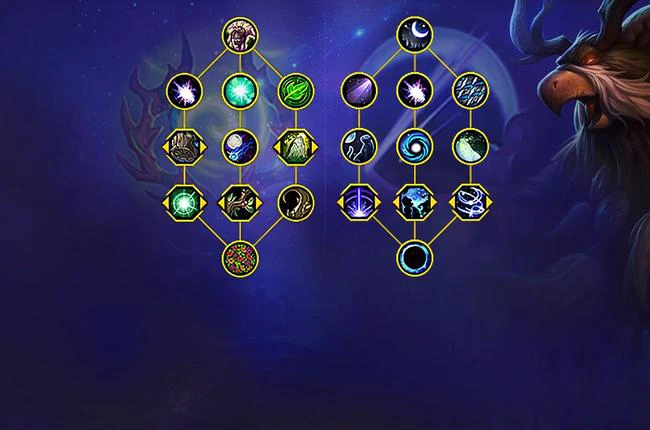
Two classes break the three-tree pattern. Druid has four trees (Keeper of the Grove, Elune's Chosen, Druid of the Claw, and Wildstalker) because it is the only class with four specs. Demon Hunter has two (Aldrachi Reaver and Fel-Scarred), and both Havoc and Vengeance can run either one. Across every class the launch roster came to 39 trees.
Keystones, Capstones, and Choice Nodes
Every Hero Talent tree begins with a keystone, the top node that introduces the tree's core idea. That might be a new ability, a rework of an existing cooldown, or a buff the rest of the tree feeds. Mountain Thane's Thunder Blast turns a Warrior's Thunder Clap into a charged lightning hit; Deathbringer's Reaper's Mark drops a debuff that detonates for a chunk of the target's health.
At the bottom sits the capstone, the biggest single payoff, which usually amplifies whatever the keystone started. In between, choice nodes let a player pick one of two options at set points, so two people running the same tree can still tune it differently. Every tree also folds in some class utility and defensive value, with tank specs getting a little extra survivability by design.
Why Blizzard Built Them This Way
Blizzard set a few rules for itself when choosing which concepts became trees. Each concept had to fit both specializations that would share it, whether by leaning on an ability the two specs already had in common or by introducing a theme that suited both. Iconic Warcraft archetypes, like a lightning-wreathed mountain king or a soul-reaping death knight, drove the fantasy, but anything that clashed with a class's real toolkit was cut.
The team also kept an eye on gear. Hero Talents were built so that two specs sharing a tree would not suddenly compete for a brand new stat or item type. And the stated aim was extra throughput or healing without burying the class and spec trees underneath, so players did not have to learn a whole new rotation or add a row of buttons to their bars.
✏️ Some Hero Talent nodes require a specific class or spec talent to function. Check the tree's requirements before committing a build, since a single missing prerequisite can leave a keystone doing nothing.
Staying Viable Across Content
The design goal Blizzard repeated most was flexibility. Every tree was meant to feel viable in raids, Mythic+, and PvP, so a player could run the tree that matched their taste in visuals or playstyle without feeling forced into one for a given content type. In practice the balance is never perfect and some trees pull ahead in specific fights, but the framework held: no single tree was mandatory across the board.
If you are pushing endgame content and want the tree tuning handled for you, you can Compare our WoW raid carries, Browse our Mythic+ dungeon boosts, or See our PvP rating packages to match the right setup to the content you care about.
Frequently Asked Questions
At what level do Hero Talents unlock?
Hero Talents unlocked at level 71 in The War Within. From there a character earned one point per level through level 80, ending with all 11 nodes of the chosen tree filled in at the level cap.
How many Hero Talent trees does each class have?
Every class has three Hero Talent trees, with each specialization picking from two of them. The exceptions are Druid with four trees and Demon Hunter with two. The full launch roster was 39 trees.
Can I switch Hero Talent trees?
Yes. A character runs one active Hero Talent tree at a time, and you swap between them out of combat the same way you swap class talents. Saved loadouts remember which tree you had selected.
What is the difference between a keystone and a capstone?
The keystone is the first node in a tree and introduces its core mechanic, like Mountain Thane's Thunder Blast. The capstone is the final node and delivers the tree's biggest single payoff, usually building on what the keystone set up.
Do Hero Talents replace my class abilities?
No. Hero Talents add to what a spec already does, often by resetting cooldowns, boosting existing abilities, or easing buff upkeep. Most of the complexity stays in the class and spec trees, and you do not need new action-bar buttons to use them.
When did Hero Talents go live?
Hero Talents launched with The War Within. Patch 11.0.2 delivered the systems on August 13, 2024, but because the first point lands at level 71, players reached them as they leveled through the expansion after its August 26, 2024 release.
Last reviewed 2026-07-19 against Patch 11.0.2 The War Within. Maintained by WowCarry's WoW team.