Key Takeaways
- Fire Mage's Dragonflight loop revolved around stacking Hot Streak procs into Pyroblast and maximizing uptime on Combustion.
- The talent trees started rocky but improved sharply with the Patch 10.1.5 rework, which removed Rune of Power and added Mass Barrier and Ice Cold.
- Sun King's Blessing was the only viable Fire capstone in PvE, locking the spec into an uptime-or-die identity that punished interruptions harder than most.
- Dead capstones like Hyperthermia, Deep Impact, and Unleashed Inferno sat unused all expansion, leaving Fire's talent "choices" mostly illusory.
- The War Within's Sunfury tree realized the Phoenix fantasy through Arcane Phoenix and restored Fire's burst window, exactly as the original wishlist hoped.
- The Frostfire tree delivered both predicted ideas: a frost-recolored Frostfire Bolt and the spell-combo feel of Meteor and Comet Storm triggering each other.
Each verdict traces back to how Fire actually played across Dragonflight, so the retrospective starts with the core loop.
Fire Mage's Dragonflight Retrospective
Fire Mage spent Dragonflight as a spec that looked simple on paper and demanded constant attention in practice. Its evolution is best read through the talent tree and the changes it absorbed over the expansion, which point straight at the direction the spec took into The War Within. This retrospective walks the core loop, the talent system, the dead capstones, and the Hero Talent wishlist that, two years on, the game actually answered.
The Core Fire Gameplay Loop
Fire was simple at a glance: cast as many Pyroblasts, or Flamestrikes, as possible while holding buffs and keeping Combustion on cooldown. Hot Streak was the vehicle that launched Pyroblast into enemies' faces, and weaving Fire Blast during Combustion generated the crits that converted Heating Up into Hot Streak. That core loop predates the Dragonflight talent system and survived intact through the whole expansion.
✏️ Banking two charges of Fire Blast before Combustion was the quiet skill check of the spec. Pre-loading guaranteed crits at the start of the window was the difference between a clean Combustion and a fumbled one.
The Dragonflight Talent System
Dragonflight introduced the new talent tree system, and Mage players had plenty of time to get familiar with it. The system was a success overall, but it did not start that way. Mage talents had a rocky launch, and the Patch 10.1.5 rework was the turning point that pulled the trees into a good place. The class tree carried genuinely fun choices: Mass Barrier let Mages support the group beyond Arcane Intellect, food, and portals, and Ice Cold gave a needed alternative to Ice Block when immunity was not the goal. The removal of Rune of Power was widely welcomed even though the burst it provided was missed.
For raid, Fire's talent choices tended to standardize into a cookie-cutter build, with a few situational options like Flame Accelerant and Alexstrasza's Fury that performed well in the right spot. Meteor drifted in and out of the tree across patches, so it was a build-dependent pick rather than a constant fixture. Mythic+ was where Fire actually had variety: the Flamestrike build blasted short-lived packs, helped along by Fuel the Fire giving Flamestrike real feedback through Heating Up, while the Ignite build turned a primary target into spreading fuel through Mastery: Ignite for packs that lived longer.
Sun King's Blessing and the Uptime Spec
Combustion uptime was everything to Fire, which made Sun King's Blessing the single most defining talent in the spec. It traded increased Combustion uptime and Hot Streak generation for a self-reinforcing loop: consuming Hot Streak built stacks, more stacks meant more Combustion, more Combustion meant more Hot Streaks, and around it went. The bottom line was that Fire needed constant uptime to reach its ceiling and was easily derailed by interruptions. Every spec loses damage when a fight goes sideways, but Fire was punished harder than most.
Because Sun King's Blessing was activated by hard-casting Pyroblast or Flamestrike, the spec was often forced into long casts. High haste levels softened that, but a fresh expansion meant a heavy loss of secondary stats, leaving Shimmer and Ice Floes to cover the casting. The real complaint was that talents are supposed to offer choices, and Sun King's Blessing was the only way to play Fire in PvE because of tuning.
📌 The most common Fire mistake was letting Combustion uptime lapse on a movement-heavy fight. Because Sun King's Blessing fed itself, dropping the loop once cost far more than the single global it took to recover, so planning casts around mechanics mattered more than raw APM.
Time Warp and Temporal Warp
Time Warp is a group cooldown, so when to use it was usually a group decision. Temporal Warp let Mages grant themselves a second one that stacked, pushing haste well past 100% with good gear, and Fire made full use of haste. The friction was that the talent was tied to the Time Warp button, and sometimes the right call was to hold Bloodlust for a key moment of the fight. That left Mages with a cooldown they wanted to press immediately but needed group permission to use, which created avoidable tension in group play.
The reason it was bolted onto Time Warp at all traced back to Legion. The legendary ring Shard of the Exodar baked the effect into an existing spell because legendaries faced stricter limits then. When it was copy-pasted into Shadowlands as Memory of a Temporal Warp and then into Dragonflight, the flavor of tying it to Time Warp came along for the ride. The alternative, Time Anomaly, was a downgrade that mostly announced itself by handing out buffs at useless moments.
The Dead Talents
Every class carries dead talents, and Fire suffered most below the capstone line. Once Hyperthermia was changed so it no longer procced during Combustion it fell out of use, Deep Impact read as a downgrade in most situations, and Unleashed Inferno was badly outclassed by Sun King's Blessing. Those talents sat dead the entire expansion, effectively collapsing Fire's capstone "choice" down to Sun King's Blessing alone. They saw play only in PvP, a mode that already rebalances spells separately, which raised the obvious question of why they could not be tuned for PvE in the same way. Hyperthermia's story did eventually change: it left the main tree entirely in Midnight and survives only as a Sunfury hero-talent payoff after Combustion.
Buff and Debuff Juggling
Fire also carried a surprising number of stacking buffs and debuffs to maintain. Many abilities had to be used strategically to hold those stacks while still interacting with Hot Streak, which meant juggling them without munching procs and reinforced Fire's reliance on constant uptime. The list that mattered most:
- Improved Scorch stacks, held at 3 during execute.
- Feel the Burn stacks, also held at 3.
- Firemind, mostly passive, kept at 3 stacks from Hot Streak.
- Fevered Incantation, a short window that a non-crit canceled, stacking up to 4.
- Season 2 through 4 tier-set bonuses, which added their own debuffs to maintain.
Some players enjoyed the added difficulty of holding those stacks without wasting resources, but as more effects piled on, the bloat started to show.
⚠️ The trap with so many maintenance buffs was tunnel vision. Chasing perfect Improved Scorch and Feel the Burn uptime while munching Hot Streak procs lost more damage than the stacks were ever worth, so Hot Streak always came first.
Flamestrike's Reticle Problem
Flamestrike used a reticle, the green circle that appears on cast. Reticles are fine for occasional spells, but Flamestrike builds cast it constantly, which pushed players to macro it to the cursor. Playing that way effectively anchored the mouse to one spot, since every other cast was a Flamestrike, forcing players to flick around between globals. Flamestrike also created wasted procs when it interacted with Sun King's Blessing, and as a ground effect it lost damage to movement. Fuel the Fire smoothed the build considerably, but it still trailed Pyroblast for fluidity.
The Hero Talent Wishlist
Heading into The War Within, Fire was set to gain access to the Sunfury and Frostfire Hero Talent trees. The details were unknown at the time, so the original wishlist was a hope: new talents that could break Fire out of its flattened, uptime-bound damage profile and bring back the strong two-minute burst the spec was once known for. The tree names each carried heavy fantasy to pull from, so the author daydreamed about what they might become.
Sunfury
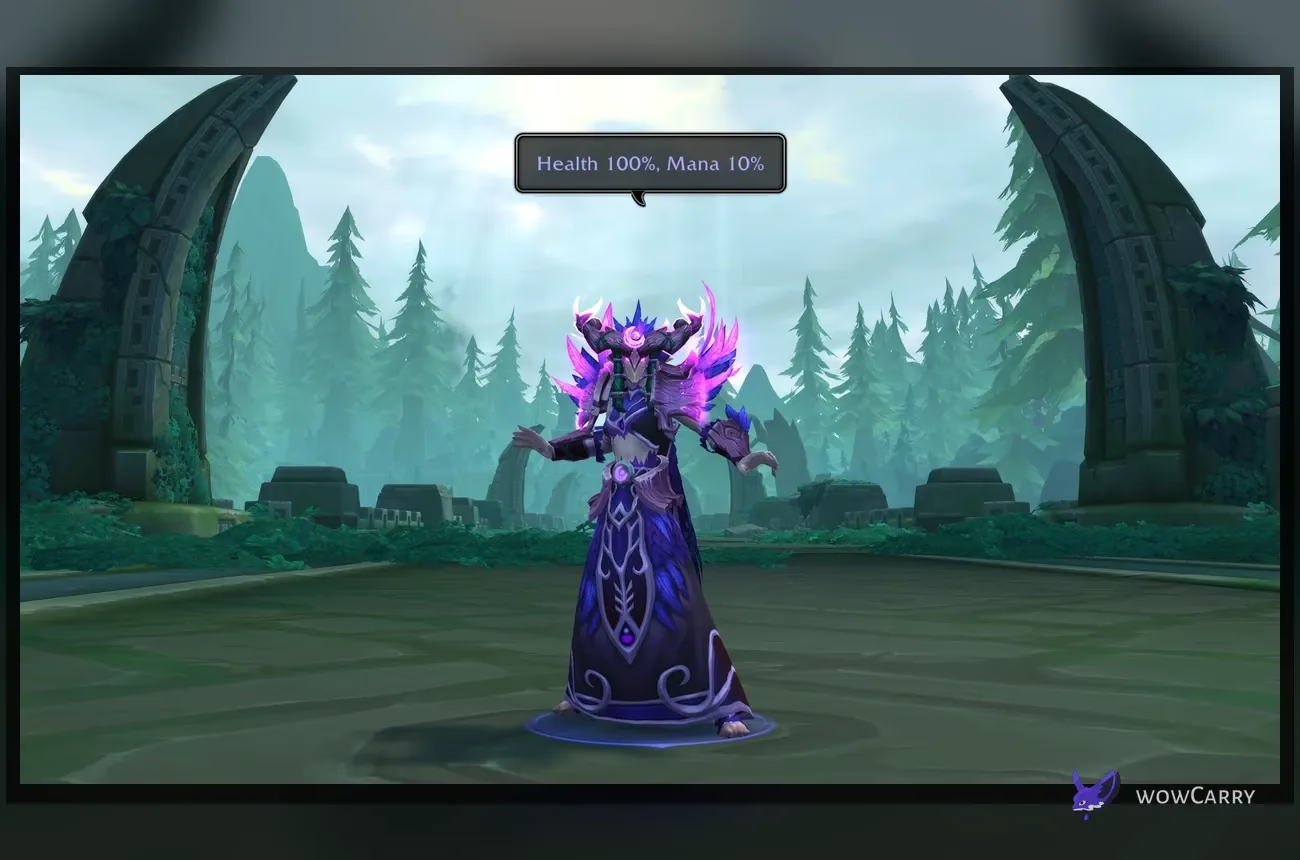
No figure embodies Sunfury more than Kael'thas Sunstrider and his Phoenix, Al'ar, a firebird with the power of rebirth. The safe bet was that these talents would lean on Phoenix imagery, possibly summoning Phoenix guardians or calling down pillars of flame, with an upgrade to Blazing Barrier and a heavier area-of-effect emphasis. The deeper hope was that Sunfury would give Combustion a benefit that restored Fire's old high-burst self, moving it away from pure cooldown reduction and the uptime-spec trap.
[Editor's note, 2026: Sunfury did better than the daydream. Its capstone, Arcane Phoenix, literally summons a Phoenix when Combustion is cast, and the tree's Codex of the Sunstriders turns Combustion back into a true burst window by consuming the new Spellfire Spheres resource. The Blazing Barrier upgrade arrived too, just under a different name. The Phoenix fantasy and the burst-window wish both landed, though the hook turned out to be Spellfire Spheres rather than Phoenix Flames specifically.]
Frostfire
Frostfire is a contradiction that only works in a fantasy world. Mage once had Frostfire Bolt as a spell that scaled with both the old Frost and Fire trees before it was moved to Frost and later replaced. The hope here was modest: a blue recolor for some spells, perhaps a tie into primalist volcanic magic, and ideally a dip into multicasting or spell combos that felt distinct from Sunfury while staying competitive.
[Editor's note, 2026: both concrete Frostfire predictions landed. Frostfire Bolt shipped as exactly the frost-recolored hybrid the author pictured, replacing Fireball and dealing combined Frostfire damage, and the Isothermic Core talent delivered the spell-combo feel by making Meteor and Comet Storm trigger each other. For a 2024 daydream, the hit rate was remarkable.]
Conclusion
Fire Mage left Dragonflight as a well-understood spec with a clear ceiling and a clear cage: a self-reinforcing uptime loop anchored by Sun King's Blessing, a row of dead capstones, and a wishlist for variety that the talent system never quite delivered. What makes this retrospective unusual is how completely The War Within answered it. Sunfury restored the burst identity through Arcane Phoenix, Frostfire brought the recolor and the spell-combo gameplay, and Fire finally had hero-talent choices worth weighing. If you would rather bring a geared Fire Mage into current group content than rebuild secondary stats from scratch, you can see our WoW raid boost options and skip the grind.
Frequently Asked Questions
Was Fire Mage good in Dragonflight?
Fire was a solid, well-rounded spec for most of Dragonflight, especially after the Patch 10.1.5 talent rework. Its weakness was structural rather than numerical: the Sun King's Blessing uptime loop punished interruptions and movement harder than most specs, so Fire shone on patchwork fights and struggled where it could not keep Combustion rolling.
What did the Patch 10.1.5 Mage rework change?
Patch 10.1.5 reworked all three Mage talent trees and pulled them from a rocky start into a good place. For Fire, the headline changes were the removal of Rune of Power, the addition of Mass Barrier and Ice Cold to the class tree, and Flamestrike becoming baseline, which together cleaned up the tree and added genuine utility choices.
Why was Sun King's Blessing so dominant?
Sun King's Blessing created a self-reinforcing loop: consuming Hot Streak built stacks, which generated Combustion uptime, which produced more Hot Streaks. No other Fire capstone came close in PvE tuning, so the talent row that was meant to offer choices effectively had one answer. That made Fire an uptime spec that lived and died on uninterrupted casting.
What were Fire's dead talents in Dragonflight?
Hyperthermia, Deep Impact, and Unleashed Inferno all sat unused below the capstone line. Hyperthermia fell off once it no longer procced during Combustion, Deep Impact was a downgrade in most cases, and Unleashed Inferno was outclassed by Sun King's Blessing. They saw play only in PvP, where spells are tuned separately.
Did the Sunfury Hero Talents bring back Fire's burst?
Yes. The Sunfury tree's Arcane Phoenix capstone summons a Phoenix on Combustion, and Codex of the Sunstriders consumes Spellfire Spheres to spike damage during the Combustion window. That restored the strong burst identity the original wishlist asked for, fulfilling the Phoenix fantasy through a new resource rather than through Phoenix Flames itself.
What is Frostfire Bolt?
Frostfire Bolt is the signature spell of the Frostfire Hero Talent tree introduced in The War Within. It replaces Fireball for Fire Mages, deals combined Frostfire damage, and applies a damage-over-time effect. Paired with Isothermic Core, which links Meteor and Comet Storm, it delivered both the frost-recolor and spell-combo ideas the original article predicted.
Last reviewed 2026-06-30 against Patch 10.2.7 Dark Heart — Maintained by WowCarry's WoW team.