Key Takeaways
- Unholy's Dragonflight talent tree shipped under-refined and split into rigid single-target and AoE halves, forcing the "hyper-specialization" the community complained about all expansion.
- The Defile single-target build became players' self-made bridge between AoE and single target, but Defile's ground visual buried boss mechanics, making it a genuine risk to run.
- Too much of Unholy's power lived in pet cooldowns like Apocalypse, Army of the Dead, and Dark Transformation, leaving the player mostly pressing Death Coil with little pet interaction.
- The Season 3 Amirdrassil set was the best Unholy tier set in years, giving Magus of the Dead real AoE value, yet a dwindling Death Knight population saw little of it.
- Unholy's raid spot leaned almost entirely on Death Grip, since Blood did nearly everything Unholy could but better, with Gorefiend's Grasp and a larger Anti-Magic Zone.
- The wishlist's core ask was to reunite Death Knight identity across specs, pinning its hopes on the shared Hero Talents arriving with The War Within.
Each of those verdicts grows out of one question the spec kept raising across the expansion.
What Makes a Death Knight a Death Knight?
With Dragonflight winding down and The War Within still on the horizon at the time, this retrospective looked back at Unholy Death Knights through the course of the expansion, and where the spec could head next. Before we begin, here is a question worth holding onto while you read: what makes a Death Knight a Death Knight? It is a question Unholy's Dragonflight kept asking and rarely answering, and it sits underneath almost every problem below.
Infected Claws Run Deep
Start the retrospective with one of Dragonflight's biggest new features and its evergreen system: the talent trees. Unholy Death Knights got off to a rocky start, being one of the first trees shown off in the pre-alpha previews, and that early tree was a mess. The new concepts were very RNG, placed a ton of emphasis on Festering Wound, and had no clear theme or structure. While a lot of those core concepts carried into the final tree, the Unholy tree never felt as if it got the same refinement as the trees revealed later, and it ended up full of nodes people just did not care about. That lack of polish carried through the whole expansion, with the tree essentially split in two.
The Unholy tree pushed talents for different scenarios to opposite sides. The right side focused on single-target benefits, boosting Death Coil or buffing pets. The left side focused on AoE, with many Festering Strike and wound-related talents. The center was the middle ground, holding the talents you wanted in any scenario. That separation was one of the tree's biggest pain points, since its layout alone dictated what you could do with a limited number of points and forced Unholy into choosing strictly AoE or strictly single target. Without much of a bridge between the two, Unholy got shoehorned into what the community called "hyper-specialization." That on its own is not the worst thing, but when you are told to choose, and then handed a scenario the choice should excel at, you should not feel mediocre. Other specs did both at once, so why couldn't we?
An Outbreak of Concerns
Our choices did not matter. When Dragonflight released, Unholy underperformed in almost every scenario, which bred a suffocating feeling across the player base and real unrest among players who wanted their choices to count. No matter which route you took, single target or AoE, you excelled at neither. The tree had misled us: too much power sat in specific talents for specific scenarios, with little value elsewhere, alongside an abundance of talents that did nothing or barely deserved to be talents (looking at you, Unholy Command). They cluttered the tree, wasted points, and robbed us of real choice, which is why we stuck to the same builds all expansion.
There were small moments of hope. Death Coil got weak enough that you could give up almost every talent boosting it and still gain enough damage elsewhere to mitigate the loss. The community coined this "Disease Single Target," snagging Plaguebringer, Unholy Blight, and Ebon Fever in a more single-target setup to bridge the gap. Looking back, it almost would have been better if it had stayed.
Then talent changes made things worse. In an attempt to bridge single-target and AoE setups, the tree was adjusted: Epidemic and Unholy Blight swapped places to give easier access to our main AoE Runic Power spender. Ironically, that had the opposite effect, since the new Unholy Blight position killed the single-target Disease build. Epidemic gave good AoE value but did nothing in single target, unlike Unholy Blight, which benefited both. Now there was a node that gave us nothing on the path to Ebon Fever, and back to the "you only get one or the other" jail we went.
In the only other tree change all expansion, Unholy Pact and Defile split from a choice node into individual nodes, with Defile replacing Pestilent Pustules and getting a drastic Mastery buff. The power Defile suddenly had was terrifying: it increased AoE potential and gave the AoE section a node that could counteract the Death Coil talents (Improved Death Coil and Coil of Devastation), birthing the Defile single-target build. It came with a cost, though. Using Defile again after years of obscurity brought back one of its biggest issues: its visual sits on top of almost every other ground effect in the game, covering up swirlies and important mechanics. So we faced a predicament, bridge the gap and risk dying to a hidden mechanic, or give up and play around the tree's shortcomings.
⚠️ The Defile single-target build was a real damage gain, but Defile's ground visual smothered boss swirlies underneath it. Running it on a heavy-mechanic fight meant trading throughput for the very real chance of standing in something you could not see.
The Unholy Bond With Our Army of the Dead
When you think of an Unholy Death Knight, what comes to mind first? Most likely an undead army of minions, with some plague and pestilence thrown in. Hitting those core themes well, and making the player feel immersed, is hard. Unholy did it reasonably through its pets, but that became a double-edged sword: nearly every minion came from pressing a cooldown. In the opener you summoned four ghouls with Apocalypse, eight with Army of the Dead, a Magus of the Dead from each (two from Apocalypse with the Season 3 tier set), and a gargoyle or arbiter from Summon Gargoyle. You then buffed them all by pressing Dark Transformation to turn your main ghoul into a Monstrosity, Empower Rune Weapon for haste, and Unholy Assault for damage. During that window the pets did an incredible amount of damage, while the player was left mostly pressing Death Coil and Clawing Shadows, with no meaningful interaction with the army at all.
So where was the core engagement? Pressing every cooldown and watching the pets blast was fun, but the novelty wore off fast, and once it did the core loop had to carry the game on its own. There was a hole there, a vacuum opened up by pushing so much power into pets you could not rotationally engage with. The most engaging part of the loop was building and bursting Festering Wounds, and that wound system carried issues that had not been solved since its introduction in Legion. For the unfamiliar, the wounds were essentially Rogue combo points stuck to a single target: press Festering Strike to generate them, press Clawing Shadows or Scourge Strike to consume them, and press Death Coil to spend the Runic Power generated along the way. That was the whole of it.
There was no interaction with the pets and none with the diseases. Just press your cooldowns and watch the army work without you. The most engaging part of the rotation, building and bursting wounds, had stayed mechanically thin since Legion, and for a spec built on one of the most iconic fantasies in gaming, that felt like a huge missed opportunity. The state Unholy was in could not be salvaged by simple talent-tree changes; the foundation itself needed addressing rather than another round of patches over an unstable base.
A Vile Infusion of Tier Sets
Season 1's 2-piece was simple but effective: bursting a Festering Wound granted your main ghoul Vile Infusion, increasing its damage and haste. The 4-piece, which I always thought of as a kind of "Ghoulish Infusion," gave the player the same sort of benefit we gave our ghoul, but procced off the ghoul's attacks instead. Since the ghoul controlled the 4-piece, it could not really change how the spec played. All told the set did its job, and it was at least different from the usual Unholy tier sets that simply buff Death Coil or Dark Transformation, which is exactly where the Season 2 set fell back to.
Season 2's 2-piece buffed Death Coil and Epidemic and made them grant stacks of a buff that Dark Transformation then consumed for Mastery. The 4-piece instantly granted max stacks on Army of the Dead and made Sudden Doom grant extra stacks. Honestly, this set was disappointing in a season full of transformative tier sets for other specs. Where was the gameplay-changing aspect, or the change of pace to shift into different builds?
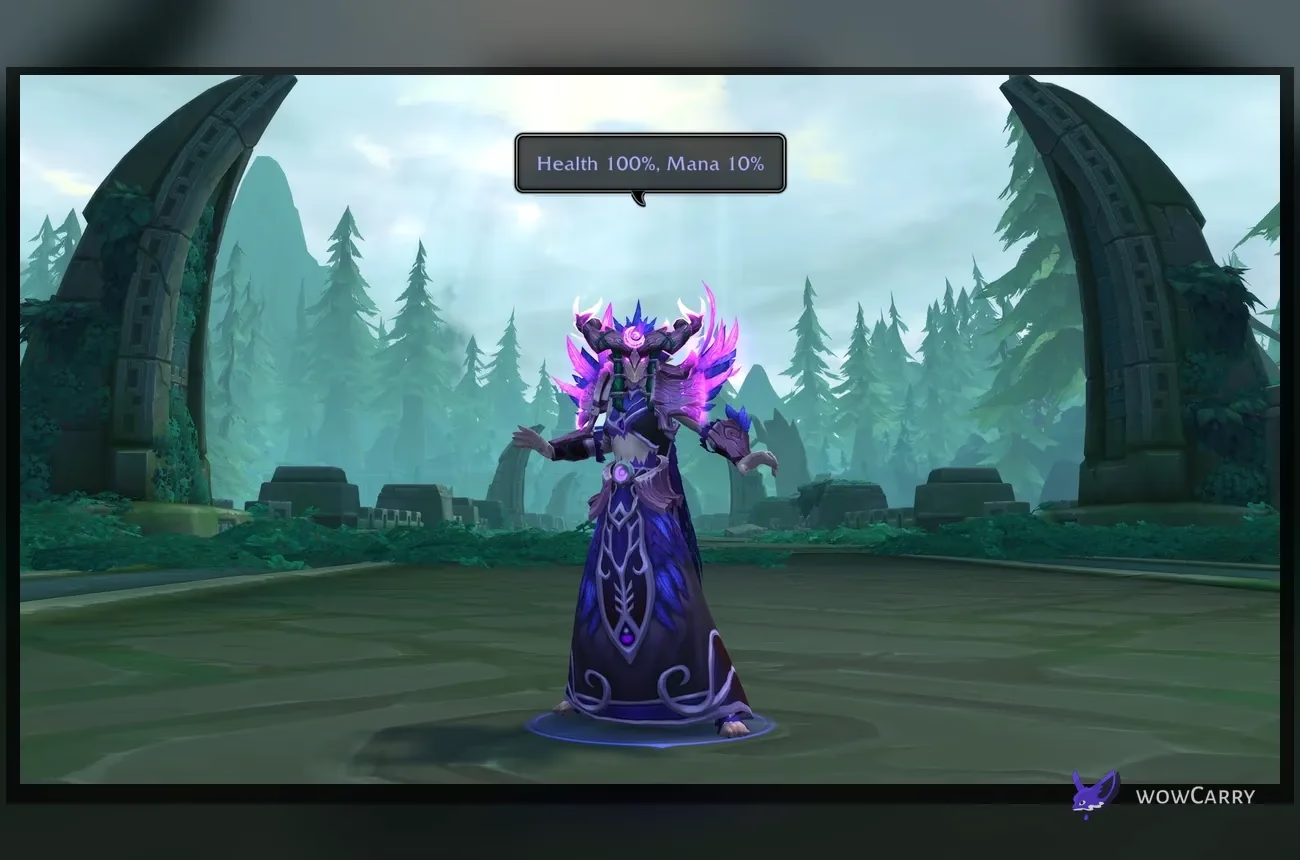
Season 3 was a return to grace. The set specifically targeted one of Unholy's long-standing problems by bridging single target and AoE: the 2-piece let Magus of the Dead cleave and summoned a second Magus with Apocalypse, and the 4-piece extended Magus duration by spending Runes. Apocalypse's main issue had always been its lack of AoE value, and the set flipped that perception: Magus of the Dead now did a massive amount of AoE damage and was buffed by most of the single-target build's abilities. It changed up the gameplay, if only minorly, filled a real gap, and did it by subverting an ability's expectations. It was the best tier set Unholy had ever had, and it was not close. Sadly, it saw little play, because the Death Knight population had been dwindling, which raised the harder question of why.
A Death Grip on Utility
Entering Season 3, a lot of Unholy players were concerned. We had just gotten ability rebalancing meant to reduce reliance on cooldowns, and it failed: we ended up doing just as much burst as before. On top of that, through PTR raid testing we had not seen a single boss where Death Grip mattered beyond minor convenience, and Fyrakk was our only hope of keeping a foothold as a spec raids wanted. Instead, top guilds like Echo and Liquid scoured old enchantments to avoid bringing a DPS Death Knight at all, which set the tone hanging over Unholy all of Season 3.
Death Grip had a literal death grip on our utility: we could not have more, because when Death Grip was useful it was instrumental, and when it was replaceable, what did we bring? You could point to Anti-Magic Zone, but why bring an Unholy DK for it when Blood had roughly 50% more health and a correspondingly larger absorb? What reason was there for us to exist in a raid beyond damage, when a Blood Death Knight did everything Unholy could but better, with a shorter Death Grip cooldown, access to Gorefiend's Grasp, a larger Anti-Magic Zone, and a near-zero DPS loss from Insidious Chill? When it came to unique utility, Blood got Gorefiend's Grasp, Frost got Absolute Zero, and Unholy got nothing comparable. Unholy could not even run Control Undead without sacrificing huge damage, since it replaced our main ghoul.
We were suffocating under the pressure Blood put on us, and without competitive damage there was no reason to be there. It is a shame for Death Knights to be in that state when the class brings some of the most unique utility in the game, though it would be unfair to expect encounter designers to make Death Grip useful in every raid tier. If you would rather skip that fight for a raid spot entirely, you can browse our WoW raid carries and clear it with a team.
A Need for Assimilation
Since the Legion reworks to every class, a gap has grown across all of them, and Death Knights suffer from it the most because of who they are. The Legion reworks split the classes up, removed much of their class identity, and focused far more heavily on specialization identity. That can be fine for many classes, but it did not end well for Death Knights. Core mechanics across the three specs grew too different: if a new player picked up Blood, almost none of that knowledge transferred to Unholy. We shared no core themes, abilities, or gameplay anymore. So, again, what makes a Death Knight a Death Knight?
When I think of a Death Knight, I think of an embodiment of Arthas, an unstoppable harbinger of death using its rune weapon to become an imposing specter of death itself, whether through the frozen embrace of death, blood and bone and gore, or armies of undead and plague. The core of the class should include all those themes, yet a freshly leveled Death Knight's baseline damage came down to Rune Strike, Death Coil, and Death and Decay, and nothing more to convey those themes. The class lacked a core. A new player should not have to learn three different classes to play the one they chose, which is likely why Death Knight players stick so firmly to their chosen spec: the others feel like a different class entirely. Bring the core of the class back together. Let a Frost Death Knight summon an army of the dead, let a Blood Death Knight shatter bones with the icy touch of death, and let Unholy and Frost have Gorefiend's Grasp so we can step out of Blood's shadow.
With The War Within bringing a new system in Hero Talents, the hope at the time was that this little dream could come true. With Hero Talent trees shared between specializations, it looked like the perfect moment to make sure the core of the class worked with all of them. Feedback was going to matter, so the call was to get out there during alpha and beta and tell the designers how Death Knights felt, the good and the bad, and help refine them into something people genuinely wanted to play.
[Editor's note, 2026: Hero Talents arrived with The War Within, and Death Knights received three shared, cross-spec trees, Deathbringer, San'layn, and Rider of the Apocalypse, exactly the shared-between-specializations system this wishlist hoped for. The deeper ask of merging the class's baseline rotational core across specs was not granted in the same way.]
Frequently Asked Questions
Was Unholy Death Knight good in Dragonflight?
It was an inconsistent expansion for Unholy. The spec underperformed at launch, lived in a rigid single-target-or-AoE split most of the way through, and ended Season 3 with its best tier set in years but a shrinking population. Its raid value leaned heavily on Death Grip, since Blood often did the same job better.
What was the "hyper-specialization" problem with Unholy's talent tree?
The Dragonflight Unholy tree pushed single-target talents to the right side and AoE talents to the left, with little connecting the two. With limited talent points, players were forced to commit to one or the other and still felt mediocre at the chosen role, which the community called hyper-specialization.
What was the Defile single-target build?
After Defile split into its own node and gained a Mastery buff, it became strong enough to anchor a single-target build that bridged Unholy's AoE and single-target setups. The catch was Defile's ground visual, which covered swirlies and other mechanics, making the build risky on heavy-mechanic encounters.
What was Unholy's best tier set in Dragonflight?
The Season 3 Amirdrassil set, Risen Nightmare's Gravemantle, was the standout. It let Magus of the Dead cleave, summoned a second Magus with Apocalypse, and extended Magus duration by spending Runes, finally giving Apocalypse real AoE value and bridging single target and AoE.
Why was Blood Death Knight favored over Unholy in raids?
Blood brought roughly everything Unholy's utility offered but stronger: a shorter Death Grip cooldown, Gorefiend's Grasp, a much larger Anti-Magic Zone absorb thanks to its higher health, and near-zero DPS loss from Insidious Chill. Without clearly better damage, Unholy struggled to justify a raid slot over Blood.
Did Death Knights get shared Hero Talents in The War Within?
Yes. The War Within introduced three Death Knight Hero Talent trees, Deathbringer, San'layn, and Rider of the Apocalypse, each shared between two specs. That delivered the cross-spec, shared-tree direction this editorial hoped for, even if it did not fully reunite the class's baseline rotation.
About the Author
This editorial is part of a WowCarry series in which our guide writers reviewed their specs across Dragonflight and shared a wishlist for The War Within, written from the perspective of a dedicated Unholy Death Knight main.
Last reviewed 2026-06-30 against Patch 10.2.7 Dark Heart — Maintained by WowCarry's WoW team.