Key Takeaways
- Deephaul Ravine was a 10v10 battleground introduced with The War Within expansion (Patch 11.0.2, August 2024), set in The Ringing Deeps zone of Khaz Algar.
- The first team to reach 1,500 points won; points came from two sources: escorting mine carts along tracks and capturing the Deephaul Crystal at elevated control points.
- An elevated vehicle cart transit system ran above the battlefield, letting players reposition across the map far faster than travelling on foot.
- Battleground Blitz was made permanent as a rated solo-queue mode in The War Within, running this map in an 8v8 format alongside the standard 10v10 queue.
- Controlling both mine carts simultaneously shut down the enemy team's passive scoring, widely regarded as the highest-priority play in the battleground.
- Six named achievements rewarded mastery of the map, capped by the Deepholla meta-achievement that awards the "Deephauler" title.
- Deephaul Ravine remains part of the permanent battleground rotation in the current Midnight expansion; players can still queue for it today.
The sections below cover each mechanic in detail, from scoring and mine cart control to the transit system, achievements, and how to queue today.
What Was Deephaul Ravine?
Deephaul Ravine was one of the new battlegrounds introduced in World of Warcraft's The War Within expansion, launching with Patch 11.0.2 on August 13, 2024. The map was set in The Ringing Deeps, a subterranean zone of Khaz Algar home to the Earthen — WoW's ancient mechanical dwarves. Blizzard framed the conflict around two factions competing for ore and crystals underground: Ruffious the Unbound Earthen, seizing gems and ore for his own ends, versus the Machine Speakers of the Earthenworks led by Foreman Uzjax. Alliance and Horde players were pulled into this industrial rivalry, fighting over mine carts and a central crystal on a symmetrical underground map.

The battleground ran in a standard 10v10 format across level range 71–80. It was also available in the solo-queue Battleground Blitz pool at 8v8 — one of the standout PvP features that expansion added. Players will find Deephaul Ravine still part of the active Blitz rotation in Midnight.
How to Win: Scoring to 1,500 Points
Victory in Deephaul Ravine went to the first team to accumulate 1,500 points. Two independent scoring systems ran simultaneously, and the most effective teams juggled both rather than committing entirely to one.
The two scoring tracks were:
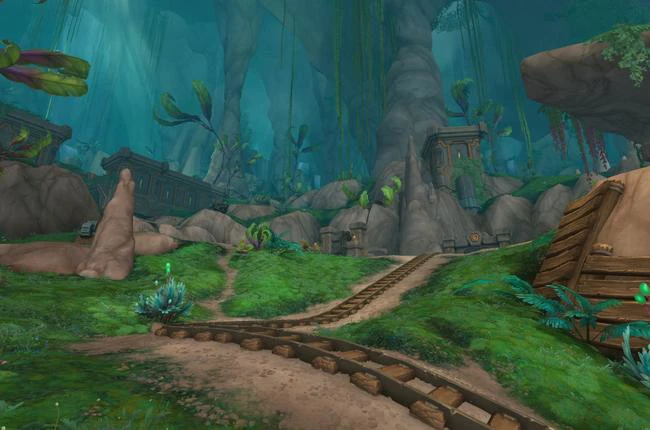
- Mine cart escort: controlling a cart awarded periodic point ticks for as long as your team held it. Capturing a cart after it completed its route granted an additional point burst. Two carts ran on opposite sides of the map, so a team holding both generated a steady, compounding resource lead.
- Deephaul Crystal delivery: a crystal spawned at the center of the map (Ironhaul Station). A player could pick it up and carry it to an elevated capture point on the opposing side. A successful delivery granted a lump-sum point reward. Blizzard did not publish exact per-tick or per-capture numbers before launch, and no official verified values were released post-launch either — treat any specific figures from unofficial sources as unconfirmed.
⚠️ Teams that ignored the crystal in favor of pure cart control often found that a coordinated opponent could make up a large point deficit with a string of fast crystal runs, especially in the final minutes of a match.
Mine Cart Escort Mechanics
Deephaul Ravine's mine cart system was the closest structural match to Silvershard Mines, the payload-style escort battleground first added in Mists of Pandaria. Each team had a cart that spawned at a fixed starting node on their side. The cart followed a fixed track through the underground tunnels and could not be steered — it moved on its own once players stood near it to provide an escort presence.

Key cart mechanics that shaped how the battleground played:
- Presence-based control: a cart advanced (and ticked points for your team) while more of your players were standing near it than the enemy. Outnumbering the opposition at the cart node was more important than raw kill pressure.
- Dual-cart windows: because two carts ran simultaneously on opposite flanks, there were moments when both carts were in motion. Teams that split their roster to hold both carts locked the enemy out of passive cart scoring entirely.
- Cart denial: contesting the enemy's cart without committing enough players to also progress your own cart was a common mistake. The most effective defenses were ones that leveraged terrain chokepoints and crowd control to slow the enemy escort rather than engaging in an open-field fight.
✏️ If your team held both carts at the same time, the enemy team's only remaining scoring path was the Deephaul Crystal. This made the central capture point — and denying crystal pick-ups — a secondary priority immediately after locking dual-cart control.
Deephaul Crystal and the Central Capture Points
The Deephaul Crystal spawned at Ironhaul Station, the center of the map. To score from it, a player had to pick up the crystal and carry it across the map to an elevated capture point on the opposing side — a route that passed through contested territory and up elevated terrain. A successful delivery awarded a significant point reward and reset the crystal's spawn timer.
📌 The crystal carrier could not perform most offensive actions while holding the crystal, so escort positioning around the carrier mattered. Opponents prioritized burst-killing or knocking back the carrier before they reached the elevated delivery zone. Knockback abilities — Shockwave, Typhoon, and similar displacement effects — had disproportionate value for disrupting crystal runs near the delivery point.
If your team called the crystal pick-up the moment it spawned and had someone already rotating, you owned the map. Teams that waited to see where it went lost 200 points before the callout was even typed.
Map Layout and the Transit Cart
Deephaul Ravine was designed symmetrically. The two base areas were called Earthenworks (one faction) and Waterworks (the other), connected through the central Ironhaul Station. Cart tracks ran along the outer flanks, one on each side of the map, with the crystal spawn and transit zone occupying the elevated center.
The most underused feature of the map was the vehicle cart transit — an elevated track system that ran above the main battleground. Players could board one of these transit vehicles and ride it across the full length of the map, arriving on the far side far faster than running on foot. The transit became essential for two specific scenarios: covering the far cart flank without burning 20+ seconds on foot through contested mid, and arriving at the crystal delivery zone when your team was already committed on the opposite flank. Players who boarded on cooldown rather than situationally got far more value out of it.
⚠️ Teams using the transit were routinely arriving at the far flank in time for the crystal intercept — teams running on foot simply weren't. Forum feedback from the live battleground consistently noted this positioning gap in the first weeks after launch.
Strategy Tips for Deephaul Ravine
Here's what the community figured out after the first few weeks of live play:
- Cart control before crystal. Mine carts generated passive point ticks for the duration of a match. A team that consistently held both carts rarely needed crystal deliveries to win. Prioritize cart control in the opening minutes.
- Don't over-commit to cart denial. Sending too many players to contest the enemy cart while leaving your own cart undefended was a common mistake. Establish cart parity first, then contest.
- Use the transit system for mid-fight rotations. If a Deephaul Crystal run was happening while your team was contesting a cart on the opposite flank, the transit cart was often the only way to arrive at the delivery zone in time.
- Chokepoint discipline near capture circles. The elevated delivery zones for the crystal had natural chokepoints on the access ramps. Defenders positioned at those chokepoints rather than on the delivery circle itself got more value from displacement and crowd-control abilities.
- Silvershard Mines experience transfers directly. If you came up playing Silvershard Mines, the proximity-to-cart logic carries over. The only new read is the crystal — a team that locks both carts but ignores a fast crystal carrier can still lose 200 points in under a minute.
Deephaul Ravine also rewarded dedicated players with a set of achievements — from a single win to a 100-match grind.
Achievements in Deephaul Ravine
| Achievement | Requirement |
|---|---|
| Deephaul Ravine Victory | Win one match in Deephaul Ravine |
| Deephaul Ravine Expedience | Win Deephaul Ravine in under 7 minutes |
| Deephaul Ravine Shutout | Win without letting the enemy team capture a mine cart |
| Deephaul Ravine Veteran | Complete 100 victories in Deephaul Ravine |
| Resilient Runner | Capture the Deephaul Crystal 3 times in a single victory without dying |
| Sprinting in the Ravine | Capture the Deephaul Crystal 50 times |
| Deepholla (meta) | Complete the six achievements above; awards the "Deephauler" title |
The Deepholla meta-achievement combined all six sub-achievements and served as the full mastery benchmark for the map. Deephaul Ravine Veteran at 100 wins was the slow one — realistically a multi-month commitment for players who weren't queueing Deephaul specifically. Players still working through these achievements can queue for Deephaul Ravine in the standard battleground or Battleground Blitz rotation in Midnight.
How to Queue for Deephaul Ravine
Queue through the Group Finder PvP tab like any other BG — 10v10 for standard, Blitz solo-queue for 8v8. If you're new to the map, queue Blitz first: the smaller team size means you'll feel the cart-vs-crystal decision pressure immediately rather than hiding in a 10-player zerg.
Deephaul Ravine remains in the permanent battleground rotation in Midnight. The fastest way to climb PvP ranks across all battlegrounds is to understand the objectives — and for players who want to push further, browse WoW PvP carry options for rated formats.
Frequently Asked Questions
What is Deephaul Ravine in WoW?
Deephaul Ravine was a 10v10 battleground introduced with Patch 11.0.2 (August 2024) and set in The Ringing Deeps zone of Khaz Algar. Teams competed to reach 1,500 points by escorting mine carts along tracks and delivering the Deephaul Crystal to elevated capture points on the opposing side of the map. The battleground remained in the permanent rotation and is still available to queue in the Midnight expansion.
How do you win Deephaul Ravine?
The first team to accumulate 1,500 points won. Points came from two sources: holding mine carts (which ticked points over time and granted a burst on capture) and delivering the Deephaul Crystal from the central Ironhaul Station to an elevated capture point on the far side of the map. Controlling both mine carts simultaneously was the strongest point-generation play, as it blocked the enemy from passive cart ticking entirely.
What is the Deephaul Crystal?
The Deephaul Crystal was a central objective that spawned at Ironhaul Station in the middle of the map. A player could pick it up and carry it across the battlefield to a specific elevated delivery point on the opposing side. Delivering the crystal scored a lump-sum point reward for the carrying team and reset the crystal's respawn timer. Crystal carriers could not attack freely while holding it, making escort positioning and disruption from the defending team a central part of crystal-objective play.
Is Deephaul Ravine still available in Midnight?
Yes. Deephaul Ravine was added to the permanent battleground rotation during The War Within and continued into the current Midnight expansion. Players can queue for it through the standard battleground queue (Group Finder, PvP tab) or through the Battleground Blitz solo-queue pool, which runs the map in an 8v8 format.
What are the Deephaul Ravine achievements?
Deephaul Ravine had six named individual achievements: Deephaul Ravine Victory (one win), Deephaul Ravine Expedience (win in under 7 minutes), Deephaul Ravine Shutout (win without the enemy capturing a mine cart), Deephaul Ravine Veteran (100 victories), Resilient Runner (capture the crystal 3 times in one victory without dying), and Sprinting in the Ravine (capture the crystal 50 times). The Deepholla meta-achievement required completing all six and awarded the "Deephauler" title.
What is the Battleground Blitz format for Deephaul Ravine?
Battleground Blitz was made permanent as a rated solo-queue PvP mode in The War Within, running battlegrounds in an 8v8 format. Deephaul Ravine was part of the Blitz map pool. Pre-made groups were not permitted; players queued alone and were matched with others. One healer going down in 8v8 hurt more than in 10v10 — there was less margin to cover a lost support role, which made individual decision-making on objectives more consequential than in the standard queue.
What battleground is Deephaul Ravine most similar to?
Deephaul Ravine most closely resembled Silvershard Mines, a payload-style escort battleground first added in Mists of Pandaria. Both maps centered on escorting mine carts along fixed tracks using proximity-based control. The difference is that Deephaul forces a constant split decision: the carts generate passive ticks, but one good crystal run can swing 200 points before your team notices. Silvershard was one thing. This was two things at once.
How does the transit cart work in Deephaul Ravine?
An elevated vehicle cart system ran along tracks above the main battleground. Players could board a transit cart to travel across the full length of the map much faster than moving on foot. Catching the enemy cart on the far flank when your team was stacked near Earthenworks — on foot that was a 20-second run across open ground, on transit it was a free ride over their heads. Many players overlooked the transit system early in that expansion, which gave map-aware players a consistent rotation advantage.
Last reviewed 2026-06-19 against Patch 12.0.5 Lingering Shadows — Maintained by WowCarry's WoW team.