Key Takeaways
- Penance + Evangelism remains the Discipline Priest's Atonement burst anchor in Midnight 12.0.5: Evangelism triggers an instant Radiance window and, in dungeons, also delivers a group heal on cast.
- Plea is live as an instant Atonement applicator in the Disc class tree — it fills the same niche Renew held in Legion without the HoT mana drain, making it the standard Atonement-stacking tool in sustained healing phases.
- Power Word: Barrier and Ultimate Penitence share a choice node; Ultimate Penitence offers niche throughput but does not apply Atonement, so most Disc builds default to Barrier except in specific encounter designs.
- Shadow Tap boosts Mind Blast damage by 150% at +40% mana cost — the enabler for shadow-path builds that want a higher Mind Blast damage contribution.
- Inner Light and Inner Shadow are a live toggle: Inner Light cuts healing spell mana by 15%; Inner Shadow adds 10% spell damage and 10% Atonement healing. Swapping by encounter phase is the standard play pattern.
- The Harsh Discipline talent causes Power Word: Radiance to make the next Penance fire 3 extra bolts, stackable to 2 charges — the core burst setup for Atonement windows.
- For Holy Priest: Oracle hero tree favors single-target; Archon pushes AoE coverage. Cosmic Ripple received a significant healing increase in Midnight and is a cornerstone passive for both paths.
Each of those points is covered in the sections below.
Discipline and Holy Priest Talents in WoW Midnight
WoW Midnight launched March 2, 2026, and the Discipline and Holy Priest talent trees delivered most of what alpha previews suggested — with refinements. This guide covers the key talent changes live as of patch 12.0.5 "Lingering Shadows," drawing on the confirmed skill descriptions from Icy Veins' 12.0.5 Disc Priest guide and Method's talent analysis.
Key Talent Changes for Discipline Priests
- Plea: Once a crucial Atonement applicator back in the Legion era, Plea returns in Midnight as an instant-cast, single-target ability that applies Atonement with a small direct heal. It serves as a more mana-efficient Atonement tool than Renew for Disc builds — Renew's heal-over-time model was rarely optimal in the Disc rotation, and Plea cleanly replaces that function in the Disc class tree while Renew remains available for Holy.
- Power Word: Barrier vs. Ultimate Penitence: These two significant talents sit on the same choice node. Barrier remains the dominant defensive cooldown for most content. Ultimate Penitence offers niche throughput in specific scenarios but no longer applies Atonement, narrowing its use cases compared to earlier development builds.
- Shadow Tap: Mind Blast's damage is increased by 150% but the mana cost rises 40%. This restores Mind Blast to a meaningful damage source and directs players toward shadow-path builds that lean on Atonement healing through increased damage output.
Disc's shadow-damage identity was one of the most requested design directions heading into Midnight, and Shadow Tap is the talent that makes or breaks whether a shadow-path build is competitive with the Atonement-management path.
✏️ Rotation tip: In M+ packs, pre-apply Atonement via Plea on your 3-4 lowest-health allies, then chain Shadow Tap Mind Blast → Penance to spike Atonement healing across the group. Don't cast Shadow Tap into a dry Atonement roster — you need the healing hooks first.
Shadow Path Talents
The shadow-ability cluster in the Disc tree offers a distinct damage-amp path:
- Pain and Suffering: Increases Shadow Word: Pain damage by up to 30% at max rank. The older mechanic of extending DoT duration (a Wrath-era interaction) is not present in this talent in Midnight — the benefit is purely a damage amplifier.
- Abyssal Reverie: Increases Atonement healing when the triggering spell is shadow-school. Specifically, it procs from Mind Blast, Mindgames, Dark Reprimand, Shadow Word: Death, Shadow Word: Pain, and Schism. Purge the Wicked (fire/holy school) does not trigger it — an important distinction for spell-priority decisions in the shadow path.
- Mindbender + Inescapable Torment cluster: Mindbender is now a passive talent rather than an active ability. The Inescapable Torment package (Mindbender + Death's Torment + Inescapable Torment) forms the confirmed damage-build path for players who want their pet summon to contribute meaningfully to throughput.
- Shadow Mend: Shadow Word: Pain ticks have a proc chance to upgrade the next Flash Heal into Shadow Mend, which heals for roughly 1100% spell power and retains Atonement application. Spreading SW:P on multiple targets to maximize Shadow Mend procs is a core M+ technique on larger pulls.
📌 Common mistake: Players new to the shadow path often treat Abyssal Reverie as a general healing buff. It is not — it only amplifies Atonement healing from shadow-school casts. If you are running Inner Light (mana-conservation stance) in a phase with no Mind Blast casts, Abyssal Reverie contributes nothing during that window.
The shadow path suits healers who prefer to earn their healing output through proactive damage rather than pure reaction. It rewards knowing when a pack or boss phase will allow sustained casting windows.
Holy and Atonement Enhancements
- Holy Ray: Each successive Penance bolt during a single channel deals 5% increased damage or healing. This creates a strong synergy with Harsh Discipline, which forces the next Penance to fire 3 extra bolts — the combined effect makes each Penance cast a meaningful Atonement healing spike when both talents are active.
- Inner Light and Inner Shadow: A live toggle ability in Midnight. Inner Light reduces healing spell mana cost by 15% — best used in mana-conservation phases or on bosses with long enrages. Inner Shadow increases spell damage and Atonement healing by 10% each — best used in burst-damage phases where your Atonement roster is pre-applied. Swapping between the two based on encounter phase is the standard recommended play pattern.
These two talents together define the reactive and proactive halves of the Disc Priest's burst cycle in Midnight Season 1 content.
New Talent Highlights
| Talent |
Description |
| Greater Smite |
Increases Smite damage by 15% per stack (up to 2 stacks, lasting 2 seconds). Stacks refresh on each Smite cast. |
| Inner Light / Inner Shadow |
Toggle: Inner Light gives −15% mana cost on healing spells; Inner Shadow gives +10% spell damage and +10% Atonement healing. |
| Evangelism |
Makes the next 2 Power Word: Radiance casts instant. In dungeons, also delivers a group heal on cast. Designed for Atonement window management. |
These talents collectively expand the playstyle options available to priests, letting Disc builds tune toward sustained shadow damage, burst Atonement windows, or mana-conservative throughput depending on the encounter.
Talents and Adjustments for Discipline Priests
The Discipline talent tree in 12.0.5 centers on two management loops: Atonement uptime and mana economy. Abilities like Inner Light, Inner Shadow, and Evangelism each address a different constraint in that loop.
- Atonement Duration and Management: Atonement doesn't auto-extend — it requires deliberate application through Plea, Power Word: Shield, and Power Word: Radiance. Enduring Luminescence extends Atonement from Radiance casts, and maximizing the healing output during each Atonement window means aligning Penance, Holy Ray, and Harsh Discipline charges before bursting.
- Stance Flexibility: Swapping between Inner Light and Inner Shadow by encounter phase is a real competitive habit in Season 1. Inner Light handles sustained healing when the group is below half health and mana is the constraint; Inner Shadow handles burst phases where damage-to-healing conversion is the priority.
- Inner Light: Reduces mana costs on healing spells — best in sustained healing phases.
- Inner Shadow: Increases damage output and Atonement healing — best in burst damage phases.
- Radiance Management: Evangelism and Harsh Discipline together enable the highest-return Atonement burst windows.
Notable class-tree talents like Master the Darkness and Void Shield provide offensive and defensive layering. Master the Darkness enhances shadow damage and Atonement healing; Void Shield reflects damage and applies Atonement healing on the reflected portion.
With those inner stance and Atonement management fundamentals covered, the next layer is the broader synergy chains that amplify output across a full dungeon or raid tier.
Enhancements and Synergies
Midnight's Discipline toolkit includes several notable synergy chains:
- Double Penance Charge: Allows more frequent Penance use, augmenting both healing and damage output significantly across a dungeon run.
- Purge the Wicked: Increases holy damage and forms synergies with other talents for maximizing Atonement throughput — though note it does not trigger Abyssal Reverie (fire/holy school only).
Precise balancing around these synergy chains defines the difference between a mechanically average Disc Priest and one who maximizes output — knowing which spells interact and in what order is the core skill expression of the spec.
| Talent |
Effect |
| Void Shield |
Shields target, reflects damage, applies Atonement healing on reflected amount |
| Blaze of Light |
Increases damage from Smite and Penance |
| Master the Darkness |
Enhances shadow damage and Atonement healing output |
Talents like Piety and Twin Sight provide passive healing throughput, enhancing both Discipline and Holy branches. Overall the Midnight tree succeeds in offering meaningful choices at most major nodes.
Holy Priest Talent Updates
The Holy Priest's talent tree in Midnight refines the pre-existing structure while introducing several noteworthy additions. The core Holy Word abilities remain the framework:
- Core Abilities and Minor Adjustments:
- Serenity, Sanctify, and Guardian Spirit: These foundational abilities remain unchanged, preserving their established utility as the Holy Priest's identity spells.
- Prayerful Litany: Boosts the primary target healing from Prayer of Healing by 125%.
- New and Enhanced Abilities:
- Cosmic Ripple: Received a significant healing increase in Midnight, becoming a pivotal passive. It triggers bursts of light upon Serenity or Sanctify resetting via Holy Word: Amen, healing nearby allies. The heal increase makes this a core value driver for both Oracle and Archon builds.
- Critical Hit Probability: Serenity and Sanctify have an increased critical strike chance, offering greater potential for impactful healing moments on target-spike encounters.
- Cost Reduction and Streamlined Casting:
- Flash Heal and Prayer of Healing: Optional talents provide a 15% mana cost reduction for sustained casting on longer encounters.
- Prayer Circle removal simplifies Prayer of Healing casting by eliminating the prior reliance on Sanctify for the cost reduction to apply.
⚠️ Warning: Cosmic Ripple's healing burst is passive and procs off Holy Word resets. On encounters with frequent target-spread, Holy Priests can over-rely on Cosmic Ripple procs and lose active decision-making in response to spike damage. Track which Holy Word is resetting to pre-position Cosmic Ripple healing toward the targets most likely to need it.
Significant Talent Advancements
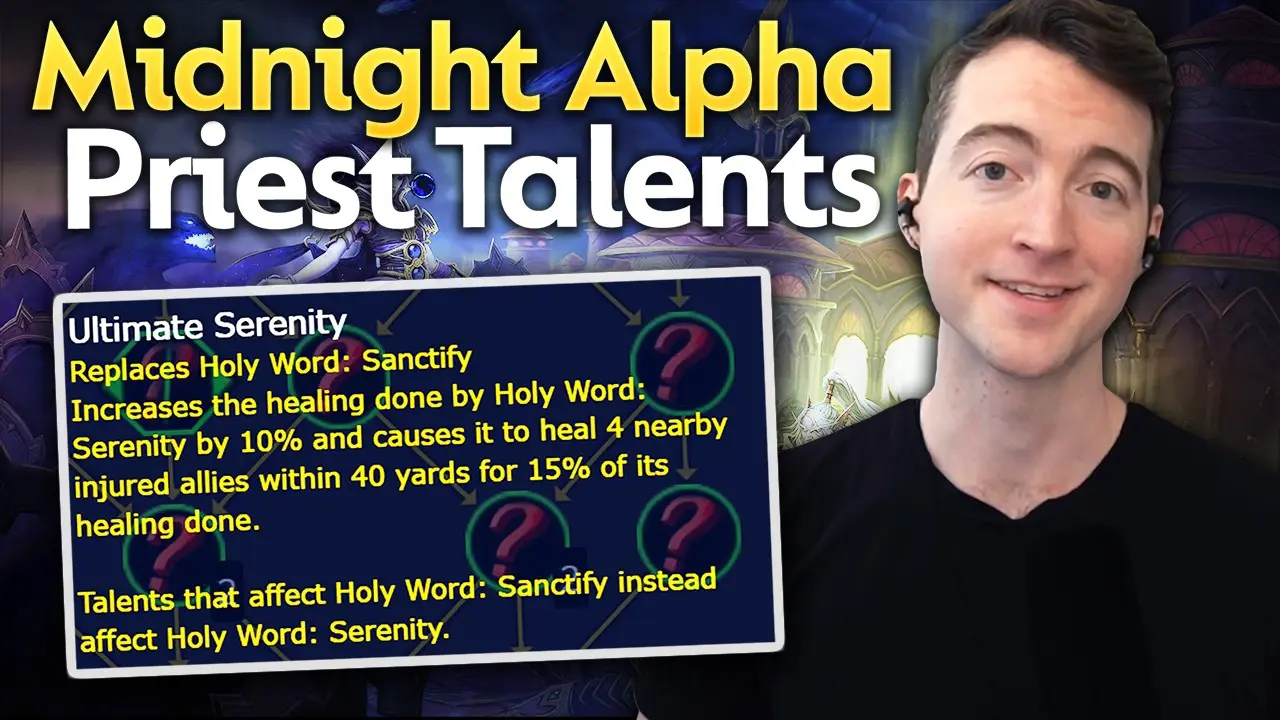
- Ultimate Serenity: A significant talent that enhances Holy Word: Serenity to affect additional allies within 40 yards. Most valuable on encounters with stacked positioning, particularly Mythic+ where the AoE application can cover the whole group on a well-timed cast.
- Divinity: Refocused onto Prayer of Healing, aligning with the established play pattern where Heal was used infrequently.
- Eternal Sanctity: Provides a static Apotheosis duration increase rather than scaling with Holy Word casts — a simplification that makes the cooldown more predictable.
Those three talents collectively redefine Holy Priest cooldown architecture in Midnight — Apotheosis duration, Sanctify behavior, and mana costs are all meaningfully different from The War Within.
Talent List
- Restoration Enhancements:
- Trail of Light: Spreads healing from Flash Heal to a secondary nearby target.
- Crisis Management: Boosts critical strike chance for Flash Heal and Prayer of Healing by 15%.
- Flexibility and Passive Synergies:
- Benediction: Upgrades Flash Heal when triggered by Prayer of Mending, improving Cosmic Ripple effectiveness through increased Flash Heal output.
With those passive synergy options catalogued, the practical question is how to balance them against active decision-making during a pull.
Balancing Active and Passive Healing
The Holy Priest tree balances active and passive healing options more deliberately in Midnight:
- Passive Healing Strength: Cosmic Ripple's significant healing increase in Midnight means passive proc healing contributes more to total throughput than in prior expansions.
- Challenge in Focus: With more passive options, concentrating healing precisely when the group spikes requires active management of Holy Word charges — the passive floor is high, but the ceiling requires deliberate cooldown deployment.
Holy Priests need to find the right balance between leveraging passive throughput and deploying high-impact active abilities at the right moment. The Oracle path rewards single-target focus; the Archon path amplifies AoE Halo coverage.
Enhancements to Holy Abilities
Prayer of Mending received meaningful upgrades in Midnight, giving Holy Priests more flexibility on pull-heavy encounters:
- Additional Charges: More charges mean more readily available reactive healing on high-movement encounters.
- Cooldown Reduction: Shorter reset windows allow more frequent deployment.
- Increased Synergy: Twin Sight enhances Prayer of Mending's stack count, compounding its throughput over the course of a dungeon run.
Those Prayer of Mending improvements feed directly into the hero talent decision — both Oracle and Archon routes rely on PoM uptime as a throughput baseline.
Oracle and Archon Talents
The two Holy Priest hero talent paths define content-specific builds:
- Oracle: Leans heavily toward single-target healing. Amplifies Prayer of Mending synergies and overheal redistribution, optimizing output during critical moments on individual tank or melee targets. Surge of Light procs now cost 50% less mana, supporting efficient Flash Heal use when Oracle procs are active.
- Archon: Pivots toward AoE healing with multi-Halo coverage, expanded group healing, and Prayer of Healing consumption options that pair with Sanctify cooldown reductions. Best suited for raid environments where the group is frequently stacked.
These adjustments make Oracle vs. Archon a genuine choice rather than a situational afterthought — the two trees play differently enough that building habits around one before swapping to the other takes a few pulls.
Class Tree Developments
The shared Priest class tree in Midnight offers several quality-of-life improvements:
- Increased Base Stamina: A defensive baseline improvement ensuring better survivability against passive dungeon damage.
- Holy Nova Update: Simplified with a Light Burst mechanic that significantly boosts both damage and healing output on a fixed cooldown, offering predictable burst windows for close-range positioning phases.
Key Offers from the New Tree:
- Positioned Power Infusion: Placed higher in the class tree, enabling earlier access for new characters.
- Enhanced Mobility and Speed: A speed boost following a target grip or empowered shield cast improves repositioning in M+ corridor pulls.
Those class-tree additions sit alongside several constrained choices that players often undervalue on first read of the tree.
Navigating the Talent Tree
Several talent decisions in the class tree are more constrained than they appear:
- Inspiration: Reduces physical damage taken on the target after a critical heal — small but consistent in melee-heavy M+ packs.
- Binding Heals: Redirects 20% of Flash Heal output as self-healing — valuable for healers playing without an active external on high-tyrannical weeks.
- Desperate Prayer: Positioned further down the tree. Provides 35% stamina in Midnight (down from the 40% in prior expansions, offset by Strength of Soul providing a baseline stamina contribution). Still the emergency button of choice when other defensives are on cooldown.
With those class-tree options in place, the remaining decisions are content-type specific.
Role-Specific Decisions
Talent selection at the role-specific layer often comes down to content type:
- Benevolence: More advantageous in raid environments where throughput over time matters more than burst.
- Focus Power: Better suited to Mythic+ where burst windows are shorter and recovery speed matters more.
- Voidweaver or Oracle: The hero talent path decision shapes the secondary playstyle — Voidweaver adds shadow elements to both specs; Oracle and Archon are purely Holy-aligned.
Spell Warding (located further down the class tree as a two-point ability) augments magic damage reduction. The enhanced Fade interaction — improved spell range and incoming-damage reduction during Fade's window — provides meaningful defensive coverage in environments with frequent dispellable effects.
Balancing Defensive Capabilities
Disc Priests specifically need to weigh active defensive button management against passive mitigation talents. Protective Light serves as an additional reactive button, but the most experienced Disc players lean on intrinsic buffs (Void Shield, Fade, Desperate Prayer) to avoid juggling too many low-impact buttons mid-rotation.
The Discipline tree in particular is dense with choices that create real performance gaps between players who understand the interaction order and those who don't. That skill ceiling is the spec's identity — it's not a spec where passive talents carry; the Atonement management loop is an active optimization problem on every pull.
Talent Tree Evaluation
The Midnight 12.0.5 Discipline tree delivers a well-defined shadow-path and an Atonement-management path with genuine identity separation. Evangelism + Harsh Discipline forms the burst core for both; the divergence is in the damage delivery (shadow-cast vs. Smite spam). Holy Priest gains meaningful hero tree differentiation through Oracle and Archon, with Cosmic Ripple as the passive backbone that makes both paths feel rewarding even when Holy Word charges aren't aligning perfectly.
The main design tension that remains: passive talents like Cosmic Ripple can reduce the urgency of active decision-making for less experienced players, while more demanding talent chains (Inner Shadow phase-swapping, Abyssal Reverie school tracking) only pay off for players who actively engage with the management layer. The tree rewards both — it just rewards the second group more.
Last reviewed 2026-06-15 against Patch 12.0.5 "Lingering Shadows." Maintained by WowCarry's WoW team.
FAQ
What is the best Discipline Priest build in WoW Midnight 12.0.5?
The Atonement-management path centered on Evangelism + Harsh Discipline is the most common high-performance build at 12.0.5. The shadow path (Shadow Tap + Abyssal Reverie + Mindbender/Inescapable Torment) is competitive in M+ on longer pulls where sustained damage-to-healing conversion outperforms burst Atonement windows.
Is Plea better than Renew for Discipline Priest?
For Discipline specifically, yes. Plea is an instant cast that applies Atonement with a small direct heal and no ongoing mana drain from HoT ticks. Renew's heal-over-time model was an inefficient Atonement applicator in the Discipline rotation; Plea replaced that function in the Disc class tree. Renew remains in the Holy Priest kit and is unaffected.
What does Shadow Tap do for Discipline Priest?
Shadow Tap increases Mind Blast damage by 150% but raises its mana cost by 40%. It enables shadow-path Disc builds to use Mind Blast as a meaningful damage source for Atonement-through-damage healing — the talent is largely irrelevant in Atonement-management builds that don't lean on shadow spells.
How do Inner Light and Inner Shadow work?
They are a toggle with no cooldown. Inner Light reduces healing spell mana cost by 15% — use it during mana-conservation phases or long-enrage encounters. Inner Shadow adds 10% spell damage and 10% Atonement healing — use it when your Atonement roster is fully applied and you're in a burst damage phase. Swapping between them by phase is the standard competitive habit in Midnight Season 1.
What are the Discipline Priest hero talent paths in Midnight?
Voidweaver and Oracle are the two Disc hero talent trees in Midnight. Voidweaver adds shadow-school enhancements to the Atonement loop. Oracle emphasizes single-target healing amplification and Prayer of Mending synergies.
Is Discipline Priest good for Mythic+ in Midnight?
Yes — Discipline Priest is the top-ranked M+ healer in Midnight Season 1. Its Atonement model, strong burst through Evangelism, and group damage contribution make it the most-represented healer in high-key compositions. Players preparing Disc for Season 1 dungeons can browse Midnight dungeon carries to calibrate the spec's rhythm before pushing high keys independently.
What is Harsh Discipline?
Harsh Discipline is a Discipline Priest talent that causes Power Word: Radiance to make the next Penance fire 3 additional bolts. It stacks up to 2 charges. The extra bolts trigger Holy Ray's per-bolt healing bonus, making the Radiance → Harsh-empowered Penance sequence the highest single-cast Atonement healing output in the Disc kit.
What changed for Holy Priest in WoW Midnight?
The most significant changes: Cosmic Ripple received a substantial healing increase and now triggers on Holy Word resets, becoming a cornerstone of both Oracle and Archon builds. Ultimate Serenity now applies to allies within 40 yards rather than a single target. The Oracle and Archon hero talent trees define single-target vs. AoE playstyle paths more clearly than any prior expansion's hero talent system.