Midnight's Demon Hunter Build Reaches God Tier Level
Discover WoW Midnight's Devourer Demon Hunter: a ranged spellcaster with Void Meta bursts, 3-charge blink, and two talent paths for every skill level.
By:
John Langan

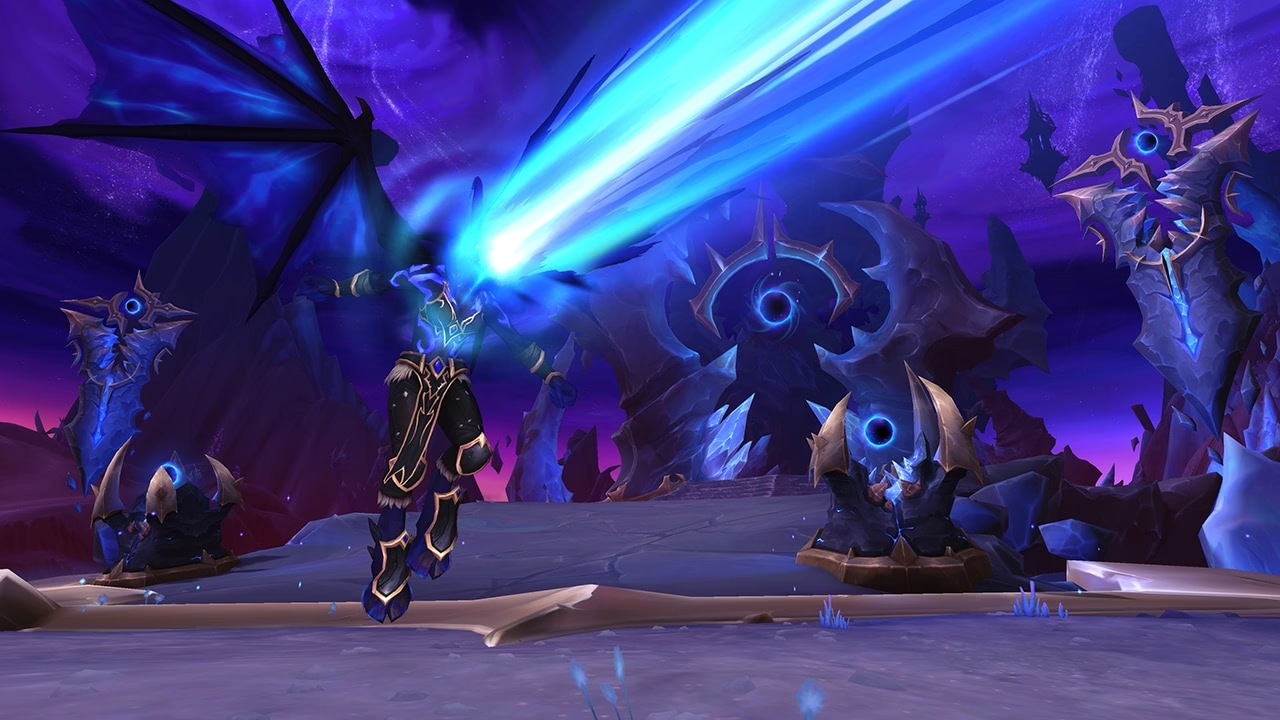
The Devourer Demon Hunter, available to players in WoW Midnight, is one of the expansion's most-discussed new specializations. Described by early testers as a hidden gem, this spec takes the Demon Hunter class in an entirely new direction — a ranged spellcaster wielding magical scythes and launching celestial stars, governed by a soul-fragment resource system unique to the class. It made its first impression through a spectacular boss fight on Caresh, and brings that same visual intensity to the player's toolkit.
These seven points summarise the spec's core identity. The sections below go deeper into each.
Rather than swinging glaives, Devourer players wield magical scythes and project celestial void energy through a purpose-built ability set:
These abilities build fury, which is then spent to shatter souls further. Once enough are collected, players activate Void Meta, the spec's signature cooldown and the central axis of every rotation decision.
The Devourer's talent tree offers two paths suited to different playstyles and encounter types:
| Build Type | Key Abilities / Focus | Playstyle |
|---|---|---|
| Fully Ranged | Void Meta, Collapsing Star, Soul Fragment Management | Resource-based; high-risk, high-reward |
| Hybrid Melee | Void Blade, Hungering Slash, Vengeful Retreat | Blends melee actions with ranged casting |
Choosing between these builds depends primarily on encounter type: the hybrid path handles movement-heavy fights more forgivingly, while the ranged path maximises throughput on stationary targets.
Devourer DH demands high actions per minute and punishes cooldown mismanagement. Maintaining metamorphosis while managing Void Meta resets is a constant race: maximise fury and soul generation, activate the cooldown at the right moment, then sustain the window as long as possible before the cycle resets.
For players who enjoy that kind of mechanical depth, the rewards are substantial, with high damage potential and some of the most striking ability animations in WoW Midnight. The spec raises legitimate questions about balance at the high end, but offers a genuinely exhilarating ceiling for those willing to master it.
The Devourer's toolkit is built around exceptional repositioning. Shift — a targeted blink with 3 charges, a 30-yard range, and an 18-second cooldown — outpaces the baseline mage blink by a significant margin, letting players dodge mechanics without sacrificing a major defensive. Combined with bonus glide speed, Devourer becomes one of the most agile specs in Midnight.
Demon Hunters retain Blur and Darkness for additional defensive coverage. Each soul fragment collected also grants a healing effect, giving the spec an unusually strong self-sustain profile for a pure damage dealer.
While the spec can be demanding, two talent choices meaningfully reduce the pressure for players who prefer a more manageable pace:
Players new to the spec generally find starting with the passive option far less frustrating. Learning the rotation's shape before adding active resource management is a cleaner path to proficiency.
Despite its strengths, Devourer DH carries some practical constraints worth knowing before committing. The spec operates at a 25-yard effective range — the same awkward middle distance as Evoker — requiring deliberate positioning in raid groups to avoid clipping melee while still reaching all targets cleanly.
High-stakes encounters introduce additional risk from Void Blade and Void Ray positioning requirements. There is also ongoing community concern that certain talent paths significantly outperform others, potentially creating accessibility gaps between high-output builds and more relaxed setups.
The Devourer's success is not purely mechanical. Purple wings, void trail particle effects, and star-launch animations create an immersive visual and auditory experience that players consistently cite as a major draw. The sound design — each soul shatter registering with a distinct audio cue — turns resource management into a tactile feedback loop that rewards attentive play.
The spec may not carry the historical legacy of the Death Knight or the original Demon Hunter launch, but as a Midnight addition it is a commendable design: versatile enough for advanced players seeking a high ceiling, accessible enough via passive talents for those who want engaging combat without punishing complexity.
With those core features covered, here are the questions players ask most often about the spec.
Devourer Demon Hunter is the third specialization for the DH class, introduced in World of Warcraft: Midnight. It is a ranged/hybrid spellcaster built around collecting soul fragments and activating Void Meta for damage burst windows. The spec is unlocked through a quest line on Caresh.
Primarily ranged, with an optimal casting range of 25 yards. A hybrid melee talent path exists for players who prefer staying closer to targets, incorporating Void Blade and Hungering Slash into the rotation alongside ranged casting.
The Fully Ranged build focuses on maintaining Void Meta uptime through careful soul-fragment management. The Hybrid Melee build incorporates close-range burst abilities for players who want more forgiving positioning. The ranged path has a higher skill ceiling; the hybrid path is generally more accessible.
The fully ranged build has a demanding skill ceiling due to fast resource cycles and Void Meta management. However, the passive automation talent and Soul Emulation lower the floor considerably. New players are advised to start with the passive configuration before switching to active resource management for progression content.
Shift offers 3 charges with a 30-yard range on an 18-second cooldown — substantially outpacing the Mage's baseline blink. Combined with glide, it makes Devourer DH one of the most mobile ranged specs available in Midnight.
Yes, though the 25-yard range creates positioning adjustments in tight dungeon corridors and spread raid scenarios. Tuning continues to develop post-launch, but the spec has strong throughput potential at high execution levels. For carry services in current Midnight content, see our WoW Dungeons and WoW Raid pages.
Yes, Devourer is available as a third specialization alongside Havoc and Vengeance for any Demon Hunter character in WoW Midnight. It is obtained through a quest line on Caresh.
Void Meta is the spec's signature cooldown, transforming the Demon Hunter into an enhanced void form with amplified damage output. Maintaining uptime through meta resets — triggered by talent synergies and soul-fragment consumption — is the primary skill expression of the Devourer specialization.