The Key Is How You Load the Player Clones
Banana Codex uses D as relative north during M12S Phase 2’s Staging and Replication II. It assigns the stack, cone and defamation mechanics to particular player-clone positions so the later replay has a predictable solution.
“Stack → cone → defamation” describes the assignment layout from relative north toward relative south. It is not permission to ignore the actual cast order or run into a stack before confirming your tether.
This mini-guide follows Hector’s February 1, 2026 explanation and the linked Banana Codex team raidplan, where Staging begins at step 14. Agree on that complete version with your group. A DN assignment layout or another rotated variant cannot be mixed in halfway through the mechanic.
D Is North for the Strategy, Not the Arena’s Compass
Face the boss toward D while Staging is being cast. In the usual marker layout, D is west on the actual compass. For this explanation, relative north means toward D, relative south means toward B, and the other relative directions rotate with them.
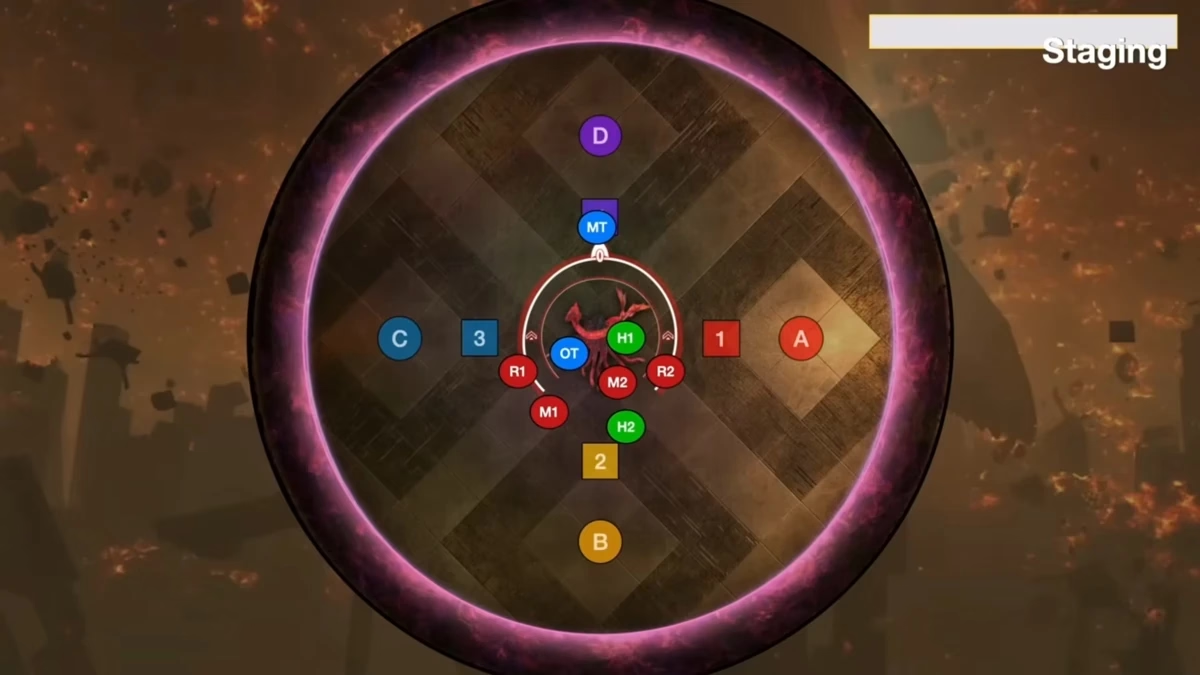
Staging links players to their player clones. Go to your own clone and identify the clock position you have been given. That position determines which mechanic you need next. The job icons in an example diagram do not mean that one particular healer or off-tank always receives the same mechanic.
Choose the Correct Tether Before It Locks
The underlying encounter breakdown distinguishes two stages: the initial player-clone tether is not transferable; the subsequent Lindschrat mechanic tethers can be passed until they lock. Six mechanic clones and the boss provide seven tethers, leaving one player without one.
| Your player-clone position | Banana Codex assignment |
|---|---|
| Relative north: D | Boss tether: Firefall Splash. |
| Relative northeast / northwest | Heavy Slam: four-dot stack tether. |
| Relative east / west | Hemorrhagic Projection: cone tether. |
| Relative southeast / southwest | Mana Burst: single-dot defamation tether. |
| Relative south: B | No tether. |
There are two copies of each clone mechanic. Use the agreed opposite search priorities to avoid two players choosing the same copy: one side scans from relative north clockwise; the other starts relative northwest and scans counterclockwise. Match the side assignments in the plan, rather than assuming your usual light-party number decides them.
Resolve the Initial Attacks Before Reenactment
- Take the assigned opening positions. The boss-tether player is toward relative north; the untethered player is farthest toward relative south. Defamation players use their separate southern corners. The remaining players use their assigned wall positions.
- Resolve Firefall Splash, Scalding Waves and the defamations. The boss’s extra Mana Burst targets the farthest player independently of the clone tethers. Maintain the intended distances instead of drifting behind the untethered player.
- Form the temporary four-person stacks. Cone players stay slightly closer to the middle, aim their cones correctly and wait for both stacks and cones to finish.
- Dodge Snaking Kick. Move behind the boss, then prepare for the replay.
The initial attacks are being recorded on player clones. A wrong tether or position now changes the replay later; it is worth checking the setup before blaming a Reenactment movement.
Netherwrath Near and Far Use the Same Paired Setup
Before the first replayed attacks, each stack-assigned player pairs with a cone-assigned player beside the boss. The intended distance ordering is what makes the setup work:
- Near: stack-assigned players sit at the inner hitbox, slightly south of its east/west side. They bait the two closest-target stacks and share each with their cone partner.
- Far: cone-assigned players stand outside the hitbox and bait the two farthest-target stacks. The other players must not stand farther away and steal those targets.
Players grouped at relative north stay on the hitbox; other non-baiters remain inside it as shown in the plan. The first replayed cones resolve with Netherwrath. Cone baiters need the small inward diagonal offset shown in the guide so their own clone’s cone does not clip them.
This is a precise position setup. “Automatic Near/Far” means the prepared geometry handles either cast, not that any location near the boss is safe.
One Group Handles Both Replayed Heavy Slams
After Netherwrath and the first cones resolve, the four stack/cone-assigned players return to their wall positions for the replayed Firefall Splash and its cleaves. The other four players—the two defamation assignments, boss tether and no tether—handle both Heavy Slam clone stacks.
Take the first designated stack, then cross to the second after the first resolves. Do not cut through the replayed boss jump on the way across. That crossing hazard is specifically called out in Hector’s explanation and is a practical cost of the strategy.
The replay groups follow their original mechanics. They are not automatically “melee take one stack, ranged take the other.” Use the two Heavy Slam clone locations in your agreed diagram; waymarker numbering can differ between plans.
Identify the Failed Step Before the Next Pull
- Wrong mechanic recorded: check the player’s Staging clock, requested tether type and search direction.
- Netherwrath hits the wrong person: compare everyone’s distance from the boss. Check both the intended baiter and anyone who drifted closer or farther.
- Cone baiter gets clipped: check the offset from that player’s clone, not only the distance from the boss.
- Stack group dies while crossing: inspect the route and timing around Firefall Splash’s replay.
Practice the D-relative assignments and the two replay groups as a unit. Knowing only the phrase “stack, cone, defamation” leaves out the decisions that make Banana Codex work.