What Changed in Marvel Rivals Season 7
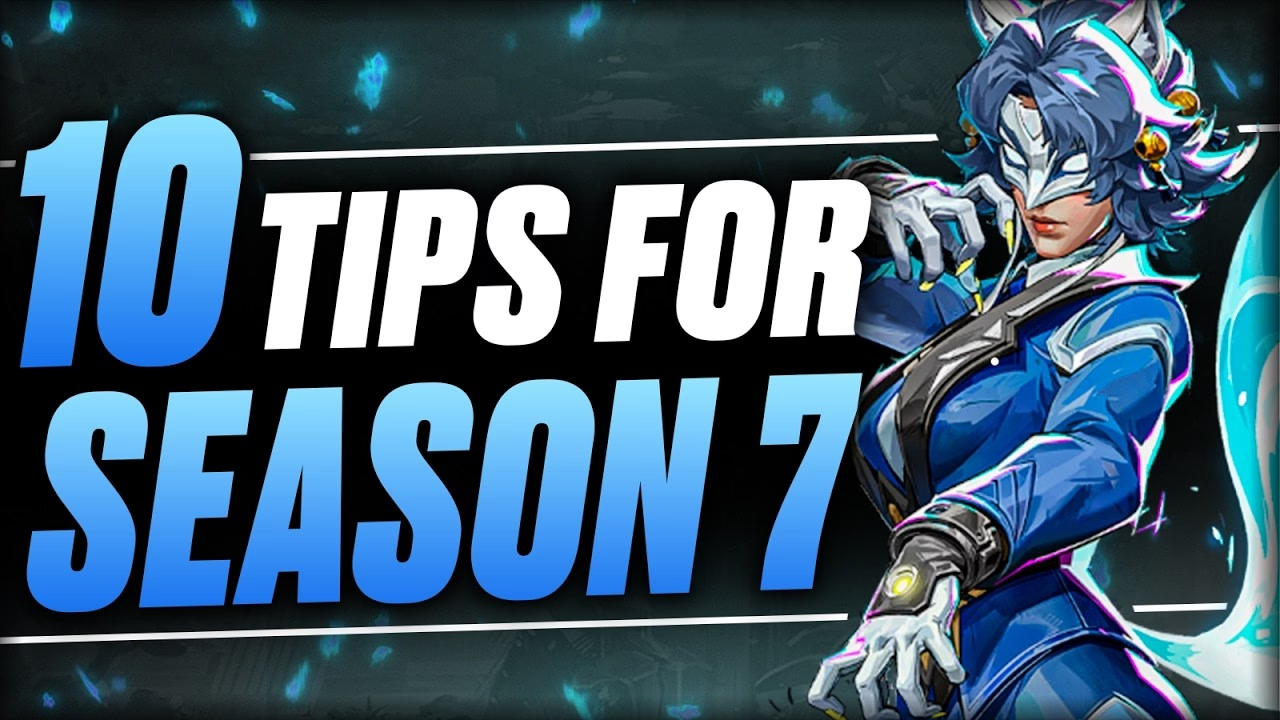
Season 7 went live in Marvel Rivals on March 20, 2026 with a system-level rebalance that hits ultimates harder than any single hero pass. The marquee additions were White Fox (a new Strategist), the Lower Manhattan Convergence map (added April 3 as a mid-cycle drop), and a bump to three bans per team. The team-up roster also shifted — Duality Dance (Adam Warlock + Luna Snow) and Jeff-nado (Storm + Jeff the Land Shark) were removed, and Blessing of the Kumiho (White Fox + Luna Snow) and Cosmic Cyclone (Storm + Adam Warlock) replaced them.

Key Takeaways
- Strategist passive ult-charge dropped from 12 to 8 per second and damage/healing-to-energy conversion fell from 90% to 75% — Strategists were hit hardest by the systemic nerf (official S7 Balance Post).
- Vanguards and Duelists also lost charge speed but to a lesser degree (12→11/s, 90%→70%) — triple-Strategist comps are the explicit target.
- Bans jumped from 2 to 3 per team (6 total), with the ban timer shortened from 20 to 15 seconds; bans activate at Gold III and above.
- Ranked stays open queue in S7; NetEase has stated role queue is not planned.
- White Fox is the S7 Strategist addition; Lower Manhattan is the new Convergence map and Shin-Shibuya returns to rotation.
- Duality Dance and Jeff-nado team-ups were removed: if your comp depended on either, you're rebuilding.
The rest of the article walks through the ten habits that translate that patch sheet into actual ranked wins.
Squeeze Every Ultimate Out of an 8-Per-Second Strategist
The single biggest meta shift in Season 7 is the passive ult-charge cut. Strategists feel it most: 8 per second is roughly a third less free charge than the 12/s S6 baseline. The systemic message from NetEase is "earn it through impact" — passive sitting in the backline charges far less of your ultimate than throwing a heal into an actual teamfight.
- Hold position inside healing range of your barrier Vanguards, not behind them. Every healing tick converts at 75%, but only if you actually output heals.
- Force-feed your conversion by pre-healing low Vanguards before the fight starts; pre-fight ticks count toward your ultimate.
- If you're playing Duelist or Vanguard, the cut is gentler (11/s, 70% conversion) but the same principle applies — passive downtime is wasted ultimate.
With ultimates harder to earn, the rest of your kit has to carry more of the round.
Treat Cooldowns Like Currency
The S7 cooldown-discipline gap separates Gold from Diamond more than any individual mechanic. When ultimates come slower, the basic-ability cycle decides most teamfights.
- Conserve cooldowns until the trade is forced. Doctor Strange's Maelstrom of Madness and Magneto's Iron Bulwark are too valuable to throw at chip damage.
- Bait the enemy's cooldowns first. Mobility heroes like Spider-Man and Magik can force a Strategist to burn a defensive ability without trading anything significant in return.
- Reset position between trades. Bad positioning turns a wasted cooldown into a wasted respawn timer; one bad pick in S7 often loses the round on its own.
Cooldown discipline only matters if the comp you're playing actually fits the map and the draft.
Build for Dive, Poke, or Brawl — Not All Three
S7 compositions still resolve into three archetypes. Picking a mix usually means losing to every one of the pure versions.
- Dive: mobility into the enemy backline. Captain America, Venom, and Spider-Man are the canonical Vanguard-Vanguard-Duelist spine.
- Poke: long-range pressure. Phoenix (Jean Grey) and Magneto are the meta Duelist and Vanguard for the archetype in S7.
- Brawl: close-range sustain trades. Thor and Groot anchor the Vanguard side; hybrid Duelists like Iron Fist can pull a brawl shape into a dive matchup.
The matchups break roughly the way you'd expect: Dive outmanoeuvres pure Poke unless the Poke side brings brawl-flexible Duelists like Elsa Bloodstone; Brawl beats Dive most of the time because close-range sustain wins the trade window. For a deeper draft breakdown from a high-rank coach perspective, see how Eternity-rank coaches read the S7 meta.

Ban the Hero Their Whole Comp Needs, Not the One You Counter
With six total bans (three per team) the ban phase decides more than it used to. The instinct is to ban the hero you struggle against personally; the higher-impact choice is to ban the hero their composition can't replace.
- Identify the linchpin in the enemy draft: the Strategist a triple-support comp can't survive without, or the Vanguard a dive depends on for the engage.
- Avoid banning heroes your existing pick already counters; a counter pick beats a ban every time.
- Ban into your own weakness: if you're locked into Dive, ban brawl-flexible Duelists like Elsa Bloodstone rather than the obvious Spider-Man counter.
Bans only resolve well when the role buckets are correctly mapped, which the S7 dev pass quietly changed.
Vanguards Are Not All Barrier Tanks
A common ranked mistake is requiring a barrier-projecting Vanguard in every composition. In Marvel Rivals every front-liner is a Vanguard, but only a subset (Doctor Strange, Magneto, Captain America, Emma Frost) actually project barriers. The rest — Hulk, Thor, Venom, Groot — pressure space differently.
| Role | Key Consideration |
|---|---|
| Barrier Vanguard (Doctor Strange, Magneto, Captain America, Emma Frost) | Mitigates pressure; non-negotiable for poke or brawl comps |
| Pressure Vanguard (Hulk, Thor, Venom, Groot) | Creates space through threat and mobility; pairs with dive |
| Strategist (support) | Survivability first in dive comps; healing throughput in brawl |
| Duelist (DPS) | Complements team strategy whether peel, dive, or burst |
An aggressive assassination comp built around Wolverine, Thor, and Angela may want a pressure Vanguard and no barrier at all — the win condition is to bypass the enemy frontline, not to outlast it.
Embrace Chaos in the Early-Ranked Window
The first two weeks of any new Marvel Rivals season are statistical noise. Placement matches in S7 track individual performance independent of teammates and grant ±100 SR per placement — meaning the early ladder is built on incomplete data about everyone's true rank.
- Experiment with hero picks. The "right" answer to S7's draft puzzle doesn't exist yet; tests beat optimization in week one.
- Stay flexible with the hero pool. If a hero you don't main spikes in the meta, leaning in for ten games will teach you more about S7 than perfect Spider-Man play would.
- Push the limits. Boundary-testing while the meta is fluid finds the angles that lock in once the patch settles.
If you'd rather skip the early-season chaos entirely, you can explore our Marvel Rivals competitive-mode services for placements-ready support.
Build a Hero Pool That Survives Three Bans
Six total bans per match (three each side) means a one- or two-hero hero pool dies on the ban screen. The S7 ranked floor is roughly four to five practiced heroes spanning at least two roles, with one flex pick outside your comfort zone for the matches where everything you main is gone.
- Step outside your main role for ten ranked games: playing Strategist when you main Duelist teaches you what the support side actually needs from your normal hero.
- Build genuine competency on 4-5 heroes rather than touching 12 at a mediocre level. Mastery beats breadth, but breadth beats one-trick.
- Pick a flex hero outside your obvious counters: if your main pool is all dive, a Phoenix or Hela pick covers the poke-mirror matchup.
- When you're picking which heroes to add, check the Season 7.5 tier-list update to focus on placements that still hold up.
Hero-pool depth feeds into the next discipline: communication is what coordinates a 4-hero pool across six teammates.
Communicate Cooldowns and Ultimates, Skip Everything Else
Most teams lose ranked because of communication noise, not silence. The high-leverage callouts are short, specific, and timing-sensitive.
- Call key cooldowns the moment they're used. "Strange Maelstrom on cd 12" tells the team a 12-second window opened.
- Coordinate ultimates pre-engage. "Pop the Ammo Overload team-up with Punisher's Final Judgment" turns two ultimates into a round-winning combo; "Hela ult on three" stops your own team from wasting heals during the burst.
- Skip the chatter. Naming a missed shot doesn't help anyone; calling the next play does.
| Communication tip | Why it matters |
|---|---|
| Call key cooldowns | Opens an attackable window the rest of the team can exploit |
| Coordinate ultimates | Stacks burst into one engage instead of feeding it in pieces |
| Stay concise and relevant | Reduces decision fatigue inside fast S7 rounds |
Leadership in ranked is calm callouts, not aggression — a clear "let's combo the Punisher / Rocket team-up" beats five frustrated pings every time.
Warm Up Before You Climb
Mechanical consistency carries through the harder rounds. A cold first game costs more SR than the previous round's loss because muscle memory hasn't loaded yet — whether you're landing Luna Snow's Absolute Zero on the right cluster or threading Thor's Awakening Rune through a brawl, the first five minutes of a session matter most.
- A 5-10 minute aim-and-ability warm-up reduces opening-game errors more than any other single intervention.
- Bot games and the Practice Range cover both aim and ability rotations without burning a ranked slot.
- Pre-load the heroes you intend to queue, not just the one you main; cold first-time picks lose more rounds than they teach.
Mechanics layer onto the tank role's job of reading the fight, which the S7 cooldown changes made strategically heavier.
Vanguard Players Read the Fight
Vanguard play is reading combat flow more than landing damage. The role decides when the team commits and when it disengages, and S7's ultimate-charge nerf makes a wrong commit more punishing because the comeback ultimates aren't ready as often.
- Track the kill count actively: a 3-for-1 trade means push; a 1-for-2 means pull back even if your team is yelling forward.
- Watch enemy defensive cooldowns (Strange's barrier, Magneto's Iron Bulwark, Doctor Strange's portal) — a barrier on cooldown is the engage window.
- Sync your engage with at least one teammate's offensive cooldown. Solo-engaging a fresh enemy comp in S7 is a death sentence.
Vanguard discipline pairs with the Duelist's job of staying alive long enough to convert it.
Duelist Plays After a Team Wipe
When the team folds, the Duelist's job switches from damage to restart. The S7 ultimate economy punishes the team that respawns into a half-built composition, so the Duelist staying alive past a wipe is often the round's most valuable single decision.
- Disengage and regroup rather than chasing the final pick: a 0-1 fight that doesn't become 0-2 is the cheapest reset.
- Take a non-standard angle on the next push: flank routes that the enemy team doesn't expect on a fresh respawn.
- Don't pre-fire from spawn; first-blood pre-fires give the enemy free ultimate charge under the new conversion rates.
Aggression has to be paid for in trades, not in hope.
Control Aggression: Trade Up or Don't Trade
In a season where ultimates charge slower, trade quality matters more than trade frequency. A trade that eliminates a Strategist or low-HP Vanguard denies the enemy the same percentage of ultimate charge it grants you — that's the most valuable trade in S7.
- Evaluate the trade target. A trade for a Strategist denies the enemy ~25% of their heal-converted ultimate budget; a trade for a Duelist denies less.
- Don't stagger your respawns. Two heroes returning to point at 5-second offset is two free picks for the enemy; wait the full timer if it groups you up.
- Read the team's pressure window. If your composition has Doctor Strange's portal and Luna Snow's Idol Aura up, the next 15 seconds is your strongest engage.
Strategist positioning closes the loop on every other tip in this article.
Strategist Positioning Against Dive
Dive comps still target the back line first, and S7's ultimate nerf made the punish for a bad Strategist position even harsher — you charge slower, so you can't ult your way out of a dive that catches you wrong-footed.
- Stay tucked, not pulled back. Backing in a straight line drags your Vanguards out of their barrier coverage and starts the cascade.
- Use cover over distance. Moving horizontally behind terrain breaks line-of-sight on dive heroes; backing in the open just feeds them.
- Anticipate the dive cooldowns. If Spider-Man hasn't used Web Swing in 12 seconds, your next reposition needs to assume it's about to land.

The personal-improvement side of all this is what carries the climb across the whole season.
Set Goals That Survive the Patch
Ranked progress is a season-long arc, not a single play session. The S7 cycle runs into the Sins of Alchemax (Season 8) drop in May 2026, which gives roughly two months of stable meta to bank progress against.
- Set realistic per-week goals. "Climb one tier in two weeks" beats "hit Diamond by next month" because the milestone is measurable.
- Expand the hero pool deliberately. One new hero per ranked session, ten games minimum before judging it.
- Track mistakes between matches. Two minutes of replay review after a loss catches the pattern faster than 20 more games.
- Players who want a measurable boost toward those milestones can lean on our Marvel Rivals win-boost catalog to bank specific ranked wins between practice sessions.
The S7 cycle is short and the S8 reset arrives faster than it feels — the climb that fits in this window is the one banked on disciplined fundamentals, not the one waiting for a perfect meta.
Frequently Asked Questions
When did Marvel Rivals Season 7 launch?
S7 went live on March 20, 2026 (Version 20260320). The S7.5 mid-season patch followed on April 17, 2026, and Season 8 (Sins of Alchemax) is scheduled for May 15, 2026. The headline systemic change in S7 was the passive ultimate-charge nerf across all three roles.
How many bans does each team get in S7?
Three bans per team for six total bans per match, with a 15-second ban timer. The bans activate at Gold III and above; matches below that threshold don't run the ban phase. The S7 jump from two to three bans per team made hero-pool depth meaningfully more important than in S6.
Is there role queue in S7?
No. Ranked stays open queue in Season 7. NetEase has publicly stated that role queue is not in the development plan; the official position is that open queue is part of Marvel Rivals' design identity. Plan your hero pool around that — flex picks across two roles still matter more than role specialisation.
Who is the Season 7 new hero?
White Fox (Ami Han), a Strategist styled on the Kumiho — a Korean nine-tailed fox spirit. Her kit uses "Yeowoo Guseul" (Fox Marbles) for heal and damage, and her ultimate transforms her into the nine-tailed form for an extended pressure window. White Fox also anchors the new Blessing of the Kumiho team-up with Luna Snow.
What new map was added in Season 7?
Lower Manhattan, a Convergence map, was added on April 3, 2026 as a mid-cycle drop rather than at the season launch. Shin-Shibuya also returned to the Convergence rotation. Both maps reward dive comps with vertical movement options that the older S6 Convergence maps didn't offer as cleanly.
Which team-ups got removed in Season 7?
Duality Dance (Adam Warlock + Luna Snow) and Jeff-nado (Storm + Jeff the Land Shark) were both removed in S7. Their replacements are Blessing of the Kumiho (White Fox + Luna Snow) and Cosmic Cyclone (Storm + Adam Warlock). If your S6 comp depended on Duality Dance for round-resetting heals, the rebuild needs the new Kumiho team-up.
How much did Strategist ultimate charge actually get nerfed?
Strategist passive ult-charge went from 12 per second to 8 per second, and damage/heal-to-energy conversion fell from 90% to 75%. Vanguards and Duelists also lost charge speed but to a lesser degree (12→11/s, 90%→70%). The Strategist-specific cut was deliberate — the patch notes call out triple-Strategist comps as the design target.