Explained: 7 Levels of WoW PvPers
Discover the 7 archetypes of WoW PvP players in Midnight Season 1, from complete noob to Elite Champion. Find out where you stand on the Solo Shuffle ladder.
By:
John Langan
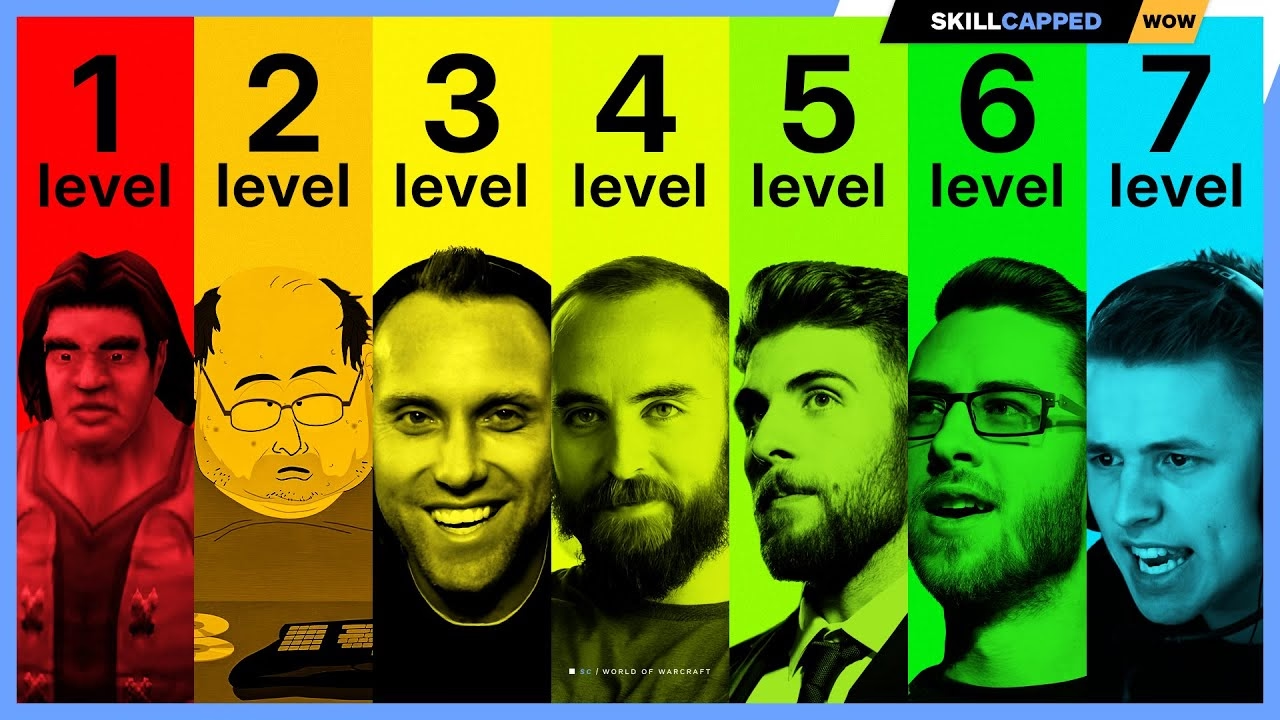
The seven levels follow from the last, each defined by a single skill gap that separates it from the one above.
World of Warcraft PvP spans every skill tier imaginable, from players queuing their first Solo Shuffle match to Arena veterans at 2400+ reading replays frame by frame. Sorting that range into seven archetypes helps any player identify where they stand and what one change would move them up. Each level follows in order, with the characteristic behaviour that defines it.
The baseline is the complete noob — not an insult, just a starting point. These are players making their first character into a battleground or queuing Solo Shuffle out of curiosity after levelling. Without specific goals, they enter the PvP environment with enthusiasm and no defensive toolkit awareness. Cooldowns are pressed on instinct, positioning is random, and healers are never targeted first. The biggest challenge is that the queue offers no guided difficulty ramp: a fresh Level 1 player lands in matches alongside players from every higher tier.
Moving up from Level 1 is the BG Enthusiast: a player who has found their home in battlegrounds and invested real time learning how PvP works. Their defining characteristic is knowing the game system underneath the combat: how honor converts to conquest, which tokens matter for weekly caps, and how to read a BG map rather than follow the zerg.
Solo Shuffle and organised Arena do not captivate BG Enthusiasts yet (the team coordination feels overwhelming) but their foundational PvP knowledge is real and expanding fast.
Rewards Chasers are the largest recognisable tier in the Solo Shuffle pool, sitting in roughly the top 30% of the ladder. Their motivation is specific: they want the 1800 Rival milestone that unlocks the elite cosmetic transmog sets — the most visible PvP status symbol in Midnight Season 1. The path they take is methodical rather than experimental:
With a better grasp of PvP fundamentals (specifically, trading cooldowns proactively rather than reactively) Rewards Chasers can improve quickly. The next level is closer than most realise.
Skill Grinders have pushed past the 1800 milestone and are chasing rating for its own sake. Their defining trait is self-correction: they watch their own deaths, identify what they missed, and go back into queue with a specific fix in mind. Their capabilities include:
Skill Grinders often stall for months at a specific rating. The bottleneck is almost always missing one thing: the ability to model what the opponent is going to do rather than respond to what they just did. That shift marks the entrance to Level 5.
Master Strategists have fully internalised their own class and learned enough about every opposing spec to build an accurate mental model of any match in real time. They construct personalised builds, recognise non-obvious cooldown exchange opportunities, and read raid frames as continuous information streams rather than health bar checks.
The distinction between Level 4 and Level 5 is almost entirely non-mechanical. Pressing buttons faster is Level 4 work. Predicting what the opponent will press next is Level 5 work.
Tournament Contenders operate at the standard seen in the Arena World Championship open cups. The defining attribute is precision: doing the right thing at the right sub-second window, every time, under pressure. Key attributes:
This level of play requires a stable team with consistent scheduling. Individual skill is necessary but not sufficient; the coordination layer is what separates Level 6 from high-rated Solo Shuffle players stuck just below it. Players aiming to reach this ceiling can book Arena coaching to compress the learning curve.
Level 7 is where the top end of competitive WoW PvP lives. Elite Champions are not just executing perfectly; they are anticipating what perfect execution looks like several globals ahead. Their game-sense is predictive rather than reactive:
These are the names that appear repeatedly in AWC finals and at the top of the Solo Shuffle ladder. Understanding what they do is the fastest way to diagnose what Level 4 or Level 5 players are still missing.
Yes. Solo Shuffle has been a core rated PvP format since Shadowlands and is fully active in Midnight Season 1 (Patch 12.0.5) with a separate solo-shuffle rating track alongside premade Arena.
Reaching 1800 places a player at Rival I tier and unlocks the elite cosmetic transmog set for the current season. This is a cosmetic milestone; Conquest gear item level is determined by weekly vault choices and currency caps, not by personal rating.
Duelist in Midnight Season 1 starts at 2100 rated. Rival covers 1800–2099 and is the most-competed aspirational bracket for non-professional players. Gladiator requires a seasonal top-percentage cutoff (approximately 0.1% of the active ladder).
The Arena World Championship is Blizzard's official top-level team Arena competition. It is fully active in Midnight, with the 2026 Grand Finals scheduled for September 12–13 at BlizzCon in Anaheim.
A dead global (or dead GCD) is a global cooldown window where a player queues nothing: no ability, no movement spell, no consumable. At every rating below 1600, reducing dead globals is the single highest-leverage improvement available to most players.
Honor is the baseline PvP currency earned from all PvP activities and buys entry-level gear (ilvl 276 in Midnight). Conquest is the weekly-capped premium currency earned only from rated PvP (Solo Shuffle, Arena, rated BGs) and buys ilvl 289 gear. Both are required before a player can meaningfully participate in the rated ladder.
Reaching 1800 in Solo Shuffle typically takes two to four weeks of consistent play at Rewards Chaser pace once a player has Conquest gear and a stable class rotation. The bottleneck is almost always fundamentals (consistent spell usage and basic target prioritisation) rather than gear or raw game time.