Best and Worst WoW PvP Advice
In the world of World of Warcraft PvP, advice varies widely, and sometimes it's hard to distinguish the beneficial from the detrimental. By exploring platforms ranging from Reddit to the official WoW forums, we've sought to uncover the most and least valuable tips. Surprisingly, during our search, we came across historical advice from players dating back to the Shadowlands expansion. Notably, one piece of advice from the forums suggested for casters to juke less. This sparked interest and debate among players.
Key Takeaways
- Juking works best mid-cast — high-level opponents hold interrupts until 70–80%, so faking at cast start wastes the tactic.
- Modern PvP positioning is primarily defensive: cut CC angles and preempt incoming bursts rather than hunting a fixed power spot.
- Night Elf and Orc racials lead for all-around PvP flexibility; racials are secondary to mastering damage uptime and CC timing.
- Eliminating dead globals — casting, refreshing HoTs, or landing an offensive dispel — is the highest-leverage rating habit below Gladiator.
- A consistent Solo Shuffle healer opener (pre-HoT both DPS, hold major defensive for the first hard-swap) limits variance against unknown matchups.
- Binding interrupts and defensives to the same keys across all characters makes reactions automatic rather than deliberate.
The topics below explore where the community actually agrees and disagrees when it comes to these fundamentals.
The Juking Debate
Juking, or "fake casting," is a classic mechanic for casters, allowing them to bait enemy interrupts. The suggestion to juke less challenges a well-established tactic. Here's how the discussion unfolds:
- The Importance of Juking: Mastering juking can allow you to capitalize on casting opportunities and gain momentum, particularly with abilities like Precog.
- Potential Drawbacks: Over-reliance on juking can lead to missed casting opportunities, resulting in reduced damage output.
- Late Kicking: High-level players often "late kick," holding interrupts until the last moment to catch casters off guard.
While some advocate minimizing juking, it's clear that applying this tactic effectively depends on specific circumstances and player skill levels.
Positioning adds another layer to the PvP debate, drawing equally divided opinions from forum veterans and high-rated players alike.
Positioning and Its Impact
Another frequent topic revolves around positioning, with mixed opinions emerging from forums. There's a common misconception that positioning holds magical quality in PvP, akin to finding perfect spots in other genres. However, the current PvP meta, especially in modes like Solo Shuffle, suggests otherwise due to class mobility and defensive mechanics.
- Positioning mattered more in earlier expansions due to limited mobility.
- Now, effective defensive play is often prioritized, with good players focusing on preemptively avoiding damage and crowd control.
Beyond positioning, racial abilities stir equal debate — with equally polarized views on how much they actually matter.
The Significance of Racials
A longstanding PvP debate involves racial abilities’ impact. Some argue racials are critical, while others suggest they play only a small part:
- Benefits of Racials: They can offer unique counterplay in specific matchups (e.g., gnome priest vs. balance druid).
- Exceptions and Standouts: Night Elf and Orc racials consistently rank high due to flexibility and power.
- General Consensus: Racials enhance gameplay but are secondary to core fundamentals like damage output and CC flexibility.
With racials covered, the path to a higher rating leads back to fundamentals — specifically what you do on every global cooldown.
Tips for PvP Fundamentals
Despite the nuances of PvP mechanics, success fundamentally relies on a few key practices:
- Focus on maximizing damage and utilizing crowd control strategically.
- Avoid overlapping defensive cooldowns.
Maintaining consistent pressure through high damage output is crucial. This approach enhances crowd control effectiveness and indirectly improves defense by keeping opponents on their toes.
Practical PvP Rules
Minimizing "dead globals" is essential for maximizing damage and healing. Always use an ability when the global cooldown allows:
- Maintain Buffs: Refresh HoTs and shields as needed.
- Offensive Actions: Even if not damaged, perform offensive dispels or minor attacks to maintain momentum.
Sticking to PvP fundamentals is critical regardless of the meta. When to deploy specialized tactics — juking, racial buttons, nameplate configuration — depends on the specific matchup and your current rating bracket.
Understanding the dynamics of WoW PvP, particularly as a healer, requires mastery of both personal tactics and team synergy. While it's crucial to protect your team and be proactive in matches, it's equally important to provide stability. For healers, especially those at lower ratings, refining your opening strategy is critical. The first 30 seconds of each round can dictate the entire match's outcome. By bolstering your teammates early on and wisely using your cooldowns, you create a foundation for mid and late-game success. Most healers can rely on a consistent strategy for solo shuffle openers, aiding in reducing early-game chaos and supporting overall team durability.
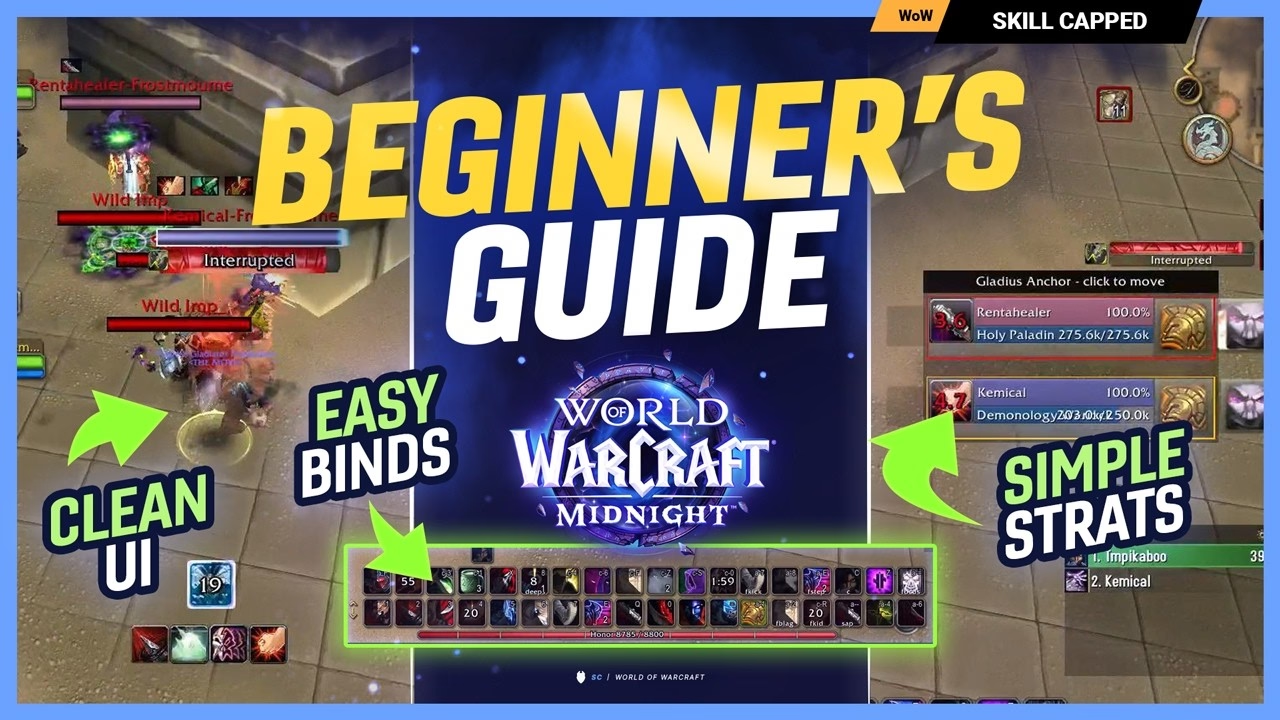
Moreover, when it comes to setup and play style, the advice found on forums can vary greatly in quality. For instance, generic suggestions like using add-ons to hide keybinds, akin to learning to drive blindfolded, are often counterproductive. A well-organized keybinding system, however, can be a game-changer.
- Universal Keybinds: Use the same keys for similar actions across all characters, e.g., binding interrupts to a single key.
- Defensive Consistency: Keep defensive abilities on the same binds across characters to streamline reactions.
- Reduce Complexity: Avoid unnecessary complexity that can lead to mistakes or slow reactions.
Nameplates are another critical aspect of your interface. Instead of overcrowding them with cooldown data, which can be obstructive and ineffective, refine your nameplate setup to deliver precise, essential information.
- Track critical debuffs.
- Isolate significant enemy cooldowns.
- Keep detailed info to avoid crowd control blunders.
Streamlining your in-game interface is vital for competitive PvP play, enabling you to focus more on strategy and less on managing chaotic screens. By concentrating on these setups, your skills sharpen, your reactions quicken, and your gameplay grows more efficient, raising your overall PvP performance.
The fundamentals and interface advice above apply across every arena and Solo Shuffle session. Players who want to accelerate the climb can compare WoW arena carry options to find the right rating bracket as an entry point. Below are the questions players ask most often when putting these changes into practice.
Last reviewed 2026-06-15 against Patch 12.0.5 Lingering Shadows — Maintained by WowCarry's WoW team.
Frequently Asked Questions
Is juking (fake casting) still worth doing in WoW PvP?
Yes, but timing determines the payoff. Juke mid-cast when your opponent has burned their interrupt or when you read a predictable reaction pattern. Over-juking at cast start costs more real casts than the fakes recover.
How important is positioning in Solo Shuffle and arena?
In current WoW PvP, positioning is primarily about limiting CC exposure: stay at max range of hard-casters and break contact when a CC chain is loading. For rated practice, start with Arena Skirmishes to drill positioning habits before queuing competitive.
Which racials are strongest for WoW PvP?
Night Elf (Shadowmeld to drop targeting) and Orc (stun reduction, Blood Fury) are the top all-around PvP racials. Gnome (Escape Artist) and Human (Will to Survive) dominate specific matchups. Racials matter most at Gladiator; fundamentals outweigh racial edge at lower ratings.
What is a dead global in WoW PvP?
A dead global is any GCD window where you do nothing — no damage, no heal, no CC, no dispel. Minimising dead globals by always finding a useful action (refreshing a HoT, maintaining a DoT, landing an offensive dispel) is the fastest way to raise arena rating.
How should I open as a healer in Solo Shuffle?
Pre-HoT both DPS before the gate opens, hold your major defensive (Pain Suppression, Guardian Spirit, Ironbark) for the first hard-swap attempt, and do not trinket in the opening ten seconds unless a stun chain threatens a kill. A repeatable opener removes guesswork and caps your loss rate against unknown matchups.
Are arena keybinds really that important?
Consistent keybinding is one of the highest-leverage PvP investments you can make. Binding the same ability type — interrupt, defensive, dispel — to the same key across every character eliminates the need to consciously search during a burst window. Six months of consistent binds outperform any meta shift in raw rating gain.